MB Stories
Union Budget 2024-25
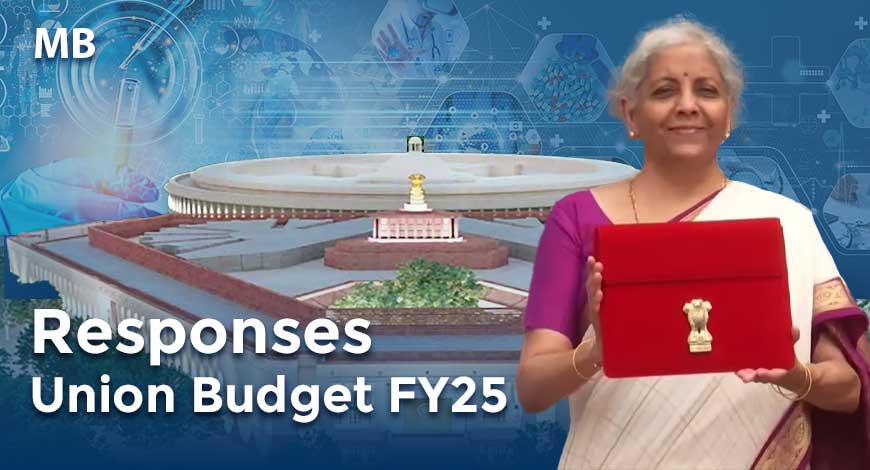
Nirmala Sitharaman, Minister of Finance & Corporate Affairs, presented the Union Budget 2024-25 in the Parliament on July 23, 2024.

The government has allocated ₹89,287 crore for developing, maintaining, and improving the country’s healthcare system, marginally higher than ₹88,956 crore allocated in FY24.
The government has also proposed the exemption of three more cancer medications from customs duties. In March 2023, the government had fully exempted Pembrolizumab (Keytruda), a Merck cancer drug used for cervical cancer, from basic customs duty. The government also exempted customs duty for foods and medicines used for rare diseases. Some rare diseases mentioned in the National Policy for Rare Diseases 2021 list include Wilson’s, cystic fibrosis and Pompe disease.
The government has also proposed changes in the BCD on x-ray tubes and flat panel detectors for use in medical x-ray machines under the Phased Manufacturing Programme, to synchronise them with domestic capacity addition.
The government will operationalize the Anusandhan National Research Fund for basic research and prototype development. In line with the interim budget announcement, it will also set up a mechanism for spurring private sector-driven research and innovation at a commercial scale with a financing pool of ₹1 lakh crore.
In the interim Union Budget for 2024-25, presented earlier in February, the Finance Minister allocated ₹90,171 crore to the health sector, which was higher than the allocation of ₹79,221 crore in 2023-24.
The allocation for the Ayushman Bharat Pradhan Mantri Jan Arogya Yojana was raised from ₹7,200 crore in 2023-24 to ₹7,500 crore in 2024-25. The allocation for the Pradhan Mantri Ayushman Bharat Health Infrastructure Mission was increased from ₹2,100 crore in 2023-24 to ₹4,108 crore in 2024-25.
RESPONSES
INDUSTRY
 Aravind Viswanathan
CEO,
Transasia Bio-Medicals Ltd.
The Interim Budget 2024 presented earlier this year marked a significant step forward in India’s healthcare sector, focusing on expanding healthcare infrastructure, including more medical colleges integrated with existing hospital facilities. Initiatives like the Pradhan Mantri Swasthya Suraksha Yojana (PMSSY) and the Pradhan Mantri Ayushman Bharat Health Infrastructure Mission (PMABHIM) underscored the government’s commitment to enhancing accessibility, affordability, and quality of care.
However, the medical devices industry had hoped for more substantial measures to support affordable healthcare. We anticipated nominal duty increases on medical devices to support robust manufacturing capabilities. Removing GST on diagnostic services and lowering customs duties on imported equipment could have significantly reduced costs and improved accessibility. Additionally, a uniform GST rate of 5 percent on all Make in India medical devices would have levelled the playing field for domestic manufacturers facing higher operational costs compared to international counterparts.
Further, removing nil duty exemptions on specific medical devices could have promoted the Make in India initiative, boosting our global competitiveness. We recommended strategic increases in customs duties to 10-15 percent to foster balanced trade conditions, stimulate local manufacturing, and decrease dependency on imports, which currently constitute 70 percent of the sector.
Then other critical aspects continue to remain unaddressed. For instance, the Production Linked Incentive (PLI) scheme should extend a 7 percent incentive to all domestically produced medical devices over the next decade. Moreover, incentivizing research and development with a weighted tax deduction of 200 percent is essential for advancing technological capabilities in the medical device sector and achieving self-reliance.
Overall, while the Budget introduces vital reforms, additional targeted measures are needed to fully harness India’s potential in medical technology and ensure comprehensive healthcare for all.
 Thomas John
Managing Director,
Agappe Diagnostics Ltd.
The Union Budget for 2024-25 emphasizes employment, skilling, MSMEs, and the middle class while maintaining fiscal discipline and supporting robust growth. This follows an 8.2 percent GDP growth in FY 2024, aided by a decade of government and RBI initiatives.
Employment and Skilling
- The Budget targets the skilling of 4.1 crore individuals, enhancing ITIs, and offering internships with allowances. Three new employment incentive schemes aim to boost job creation. Special focus is given to women’s workforce participation and labour reforms with e-portals to ease compliance.
Agricultural Productivity and Rural Development
- Initiatives to enhance food security and rural development include comprehensive development in the eastern region, integrating 63,000 villages and five crore tribal individuals into the mainstream economy.
Support for MSMEs
- Proposals include a self-financing guarantee fund, increased MUDRA loans to ₹20 lakhs, and support for distressed MSMEs. Financial backing for food irradiation units and testing labs will boost food manufacturing.
Infrastructure and Energy
- A substantial allocation of 3.4 percent of GDP (₹11,11,111 crores) is dedicated to infrastructure, with significant investments in solar and nuclear energy.
Research and Development - Establishment of a national research fund and private sector-led research initiatives supported by ₹1,00,000 crore aim to foster innovation, particularly in healthcare and medical devices.
Tax Reforms and FDI
- Simplified GST, reduced customs duties, and streamlined FDI regulations aim to enhance tax revenues, lower manufacturing costs, and boost economic growth. The Vivad se Vishwas scheme and other measures aim to create a taxpayer-friendly environment.
Overall, the Budget supports growth while maintaining fiscal discipline, aiming for a developed India or Vikisit Bharat.
 Dr Rajeev Gautam
Corporate Officer – HORIBA, Ltd., Japan;
President – HORIBA India Pvt. Ltd.
About 13 percent of the rise in the Budget received for the Ministry of Health is a good, progressing sign of the government being more cautious about the healthcare sector.
However, there is still a severe lack of appropriate funding for healthcare expenditures, even compared to neighboring SAARC nations.
GOI should invest about 2.5 percent of our GDP in the healthcare sector.
India must give precedence to and increase investments in healthcare, leveraging Public-Private Partnerships to improve services without a significant increase in Budgets. Regular and inclusive screenings are necessary, along with additional training courses for healthcare professionals to attract and enhance talent in the healthcare industry.
 Sunil Khurana
CEO & MD,
BPL Medical Technologies
The Union Budget 2024, presented by our FM earlier today, presented several forward-looking proposals steering India’s economic growth. However, I find myself contemplating the short-term and long-term implications of the Budget, specifically on the medical device industry, with a combination of cautious optimism and unmet expectations.
A notable point mentioned in the Budget is the changes in basic customs duty. This change under the Phased Manufacturing Programme, reduced customs duty from 15 percent to 5 percent for some of the components required in x-ray machines and flat panel detectors, a move that will certainly aid in our efforts to provide premium quality equipment. The government’s decision to provide relief in this area is a welcome move to maintain synchronicity with domestic production. In addition, the focus on skill development and R&D funding will boost local production and position India as a global leader in healthcare manufacturing. The new scheme for internships in 500 top companies for 1 crore youth over 5 years will create a huge difference, resulting in a highly skilled workforce and fostering innovation. We are optimistic that this will accelerate the research and innovation initiatives in the medical device industry.
While the Budget rightfully prioritizes several areas, its direct implication on medical devices seems limited. The specific measures that could have significantly boosted our sector were not addressed. For instance, an increase in customs duty on medical devices, a move that rightfully could’ve encouraged domestic manufacturing and reduced our dependency on import, was not addressed.
In conclusion, the Union Budget certainly holds potential but falls short of providing the much-needed boost to the medical device sector. I humbly urge the government to consider strategic measures that will support and significantly enhance the growth and global competitiveness of the Indian medical device industry.
 GSK Velu
Chairman & Managing Director,
Trivitron Healthcare, Neuberg Diagnostics, Maxivision Super Specialty Eye Hospitals.
The Union Budget 2024, presented by Finance Minister Ms Nirmala Sitharaman, is being acclaimed as visionary and progressive, with strong potential to boost economic growth and contribute to the vision of Viksit Bharat. A notable highlight for the medical device industry is the reduction in duty on importing components for x-ray equipment until domestic production capabilities are established. This move is anticipated to encourage investment in making India a global manufacturing hub.
The Union Budget 2024 is comprehensive, addressing the diverse needs of the nation. It emphasizes financial stability, retail growth, educational advancements, accessible loans, and developmental initiatives. This Budget supports India’s vision of becoming a thriving and progressive nation. By focusing on these critical areas, it embodies the spirit of ‘Vikas’ and positions India as a global leader.
The Budget highlighted the fiscal incentives for research and development (R&D) and capital expenditure (CapEx) in the medical devices sector under the Budget. These measures set innovation, enhance production capabilities, and propel India towards self-reliance in medical technology.
The Budget addresses import dependence in the medical device sector by introducing a health cess on customs duty for remaining medical devices. This aims to fund Ayushman Bharat and ensure quality, affordable healthcare.
 Himanshu Baid
Managing Director,
Poly Medicure Ltd.
We welcome the Union Budget’s focus on healthcare, which marks a pivotal step towards enhancing healthcare accessibility and quality in India.
Finance Minister’s proposed changes in customs duty aimed at synchronizing domestic capacity addition for x-ray tubes and flat panel detectors is worthy. This measure will bolster local manufacturing capabilities in medical technology, fostering self-reliance and enhancing accessibility to critical diagnostic equipment.
Furthermore, the exemption of basic customs duty on three cancer treatment medicines is a commendable step towards improving affordability and availability of essential treatments. This initiative aligns with our commitment to advancing healthcare outcomes through innovative solutions.
The government’s initiatives to strengthen India’s healthcare infrastructure and accelerate growth in the pharmaceutical & medical device sector represent a significant leap towards sustainable development and innovation in healthcare. Overall, the Union Budget’s healthcare provisions set a positive tone for the sector’s growth and development, reinforcing our optimism for the future of healthcare in the country.
 Vikas Khanna
South Asia Manager,
Brandon Medical
The 2024 Budget initiatives are a positive step towards a more resilient and efficient healthcare system in India.
Key initiatives include reducing the cost and burden of cancer treatment by reducing the customs duty on cancer drugs and x-ray medical equipment (it was not clear on the surgical equipment used for cancer surgeries) and establishing new medical colleges using existing hospital infrastructure.
These initiatives emphasize preventive care, developing clinical staff, and enhancing research. Brandon Medical India remains committed to advocating for resilient healthcare, starting with robust medical infrastructure. Durable medical equipment prevents interruptions and saves costs. Our SMART approach (Standardisation, Modularity, Adaptability, Reliability, and Digital Technology Integration) in operating theatre design ensures surgical environments are future-proof and efficient.
In ICU design, we should integrate advanced technology with patient-focused features, streamline workflows, reduce clutter, and create comfortable spaces with innovative solutions to maximise space and adaptability to peak use during crises while future-proofing designs.
 Gaurav Agarwal
MD,
Innvolution Healthcare Pvt Ltd.
The Interim Budget 2024 is a game-changer for the MedTech industry, with the government’s decision to reduce customs duties on x-ray tubes and flat panel detectors, components not currently manufactured in India. This strategic move will lower costs for healthcare providers, making advanced medical imaging technologies more accessible and affordable. Additionally, this initiative aligns with making India Atmanirbhar in the highly import-dependent x-ray segment. Furthermore, the Budget’s focus on skill development and R&D funding will help cultivate a highly skilled workforce and foster innovation, positioning India as a global leader in the manufacturing of novel technologies. These initiatives reflect the government’s commitment to transforming India into a hub of manufacturing excellence and ensuring the best healthcare outcomes for all.
 Bhaumik Trivedi
Asst. Manager Business Development – Clinical & Diagnostics,
Shimadzu Analytical (India) Pvt Ltd.
This is a Budget of continuity and for inclusive growth. The decision to extend custom exemptions for Trastuzumab Deruxtecan, Osimertinib, and Durvalumab is a commendable step, and the proposed changes in the Basic Custom Duty (BCD) on x-ray tubes and flat panel detectors, aimed at aligning with the phased manufacturing programs, are positive moves. However, some long-standing healthcare sector demands remain unaddressed, such as increasing the GDP spent on healthcare as a national issue, focusing on newborn screening, promoting medical value travel in India, and rationalizing GST with a uniform rate and full input tax credit eligibility.
Sunilkumar Parmar
Zonal Manager,
B&E Bio-technology Co., Ltd.
Nirmala Sitharaman’s 2024 Budget brings promising advancements for the healthcare industry, particularly in the areas of in vitro diagnostics (IVD), hospitals and diagnostic centers, manufacturing, and exports.
The IVD sector is set to benefit significantly from the Budget’s focus on enhancing research and development. Increased funding for innovation in diagnostic technologies will improve early disease detection and patient outcomes. This support is crucial for developing cost-effective and cutting-edge diagnostic tools that can meet the growing healthcare needs of the population.
Hospitals and diagnostic centers will see a substantial impact from the Budget’s allocation of ₹20,000 crore for new hospital constructions, especially in underserved rural and semi-urban areas. This initiative will expand healthcare accessibility, ensuring quality medical care reaches more people.
Overall, the 2024 Budget provides a robust framework for advancing the healthcare industry, addressing critical areas such as diagnostics, infrastructure, and manufacturing. These measures are expected to drive innovation, improve healthcare delivery, and position India as a leader in the global healthcare sector.
HOSPITALS
 Dr Sangita Reddy
Joint Managing Director,
Apollo Hospitals Group
The Budget announcement demonstrates the Government’s commitment to enhancing the healthcare system through a holistic approach. The change in the Basic Customs Duty (BCD) for x-ray tubes and flat panel detectors under the phased manufacturing program is a great strategic move. This will reduce costs and give a boost to domestic manufacturing capacity of India.
Further, announcement of exemption of customs duties on three cancer medications is a notable step in improving treatment accessibility and affordability for a major health challenge. This move shows the Government’s dedication to addressing the cancer burden and alleviating patient financial stress.
In the interim Budget the government allocated ₹90,171 crore for the health sector, this investment was crucial for developing sustainable healthcare strategies across India. Additionally, the Budget had already announced health coverage for individuals over 70 up to ₹5 lakhs and an innovation fund, which are critical for advancing healthcare. These moves have helped the healthcare sector to strengthen infrastructure.
 Dr Azad Moopen
Founder & Chairman,
Aster DM Healthcare
Although healthcare did not seem to have a major focus this time, it is promising to see the 12.5 percent hike in Budget allocation for the sector at ₹89,287 crores as compared to the last Budget.
In a period of maintaining the status quo, the government is taking bold strides with initiatives outlined in the Interim Budget 2024, including the establishment of new medical colleges, the promotion of vaccines for cervical cancer, expanded maternal and child care schemes, and the innovative “You Win” platform for immunisation.
Additionally, the proposed reduction in customs duties on x-ray tubes and flat panel detectors for domestic x-ray machine production, alongside the exemption of three cancer medicines from customs duty, marks a significant relief for cancer patients nationwide. This progressive Budget underscores a commitment to fostering inclusive growth within the healthcare sector, striving to bridge the rural-urban divide and ensure equitable access to essential services.
 Sandhya J
Group CFO,
Narayana Health
The Union interim Budget had allocated ₹89,287 crore to health care. So, there is no major change in the allocation to healthcare sector.
While we appreciate the initiatives, however, certain expectations remain unmet. The healthcare sector is a long-term industry that requires long-term affordable credit facilities. Similar to infrastructure projects that have access to 20-30 year bonds, hospitals should receive the same status and have access to extended credit term facilities. As an essential service, lack of Input credit increases the cost of service, which could have been addressed.
Customs duty is a high burden as well as 80 percent of medical equipment in the country are imported and we will definitely await some positive action in that space. The aim is to bring down the landed cost of health care. We would also look forward to see how the thrust on research helps innovation in health care. As these get addressed in the future, it will greatly benefit the healthcare industry and contribute to sustainable growth.
Finance Minister Nirmala Sitharaman has outlined the government Nine Priorities and some of them would have trickle down effects on healthcare sector too. Though the budgetary fund allocations remain the same as mentioned in the interim Budget.
 Vishal Bali
Executive Chairman,
Asia Healthcare Holdings
What the Budget does not achieve is focus on healthcare as another pillar of Viksit Bharat, give it the capital outlay of more than 2.5 percent of GDP and reforms that will support the sector’s growth and give an impetus to indigenous medical technology manufacturing. An outlay of ₹90,958cr is a mere 12.9 percent growth over the previous year, which is insufficient towards bridging the demand-supply gap in India’s healthcare.
 Abrarali Dalal
Director & CEO,
Sahyadri Hospitals Pvt Ltd.
The union Budget’s removal of basic customs duty on three critical cancer treatment drugs and the reduction of duties on medical technologies such as x-ray tubes and flat panel detectors will notably enhance the affordability and accessibility of healthcare, particularly for advanced cancer treatments. Through the Anusandhan National Research Fund, the increased research funding will foster innovation, development, and improved treatment options in the healthcare sector. Although these initiatives show promise, there is still potential for further enhancements to bolster India’s healthcare infrastructure fully.
 Behram Khodaiji
CEO,
Ruby Hall Clinic
We commend the government’s commitment to improving healthcare, as highlighted in the Union Budget 2024. The changes in Basic Customs Duty (BCD) for x-ray tubes and flat panel detectors used in x-ray machines under the phased manufacturing program are highly appreciated. Synchronizing these changes with domestic capacity addition will bolster our diagnostic capabilities and promote the growth of the domestic medical device industry. These measures reflect a comprehensive strategy to enhance India’s healthcare infrastructure and patient care.
ASSOCIATIONS
 Rajiv Nath
Forum Coordinator,
AiMeD
We are thankful to the GoI for the reduction in duty on the import of components of x-ray equipment until these get to be produced in India. This enables continuity in investment in efforts to become a manufacturing hub of x-ray equipment globally.
In a representation to Arunish Chawla, Secretary, DoP, dated January 19, 2024, AiMeD raised the issue of an increase in custom duty and removal of benefits for import of x-ray tubes and flat panel detectors under the Phased Manufacturing Programme (PMP). Since no domestic manufacturers exist for these two critical components, the relief from the government is palpable.
We at AiMeD had, however, been hoping that the recommendations of Department of Pharmacy (DoP), which were backed by DGHS, would have helped on nominal duty increase on at least those medical devices that India had substantial manufacturing capacity as demonstrated during Covid-19 pandemic times.
During Covid-19 pandemic, Indian medical devices showed its resilience in manufacturing syringes, masks, oximeters, oxygen concentrator and certain testing kits while the so-called world leaders were caught unawares. Removal of nil duty exemption on some of these medical devices would have acted as a further enabler for Make in India drive and enhance our global competitiveness.
The imports of medical devices are consistently over ₹61,000 crore for the last three years and regretfully this year have increased by 13 per cent to ₹69,000 crore. To address this, AiMeD has proposed the implementation of a 5 per cent health cess on custom duty for the remaining medical devices as this was earlier applied to a limonite’s medical devices and this health cess was used to fund resources for Ayushman Bharat.
Another pivotal aspect highlighted by AiMeD was the necessity for trade margin capping. By monitoring the Maximum Retail Price (MRP) of imports, the Government will curb the excessive mark-ups often seen in the market. This measure will make medical devices more affordable and accessible to the Indian populace, ultimately benefiting public health as consumers are affected not by import duty protection as much as by artificially inflated MRP of medical devices.
 Pavan Choudary
Chairman,
Medical Technology Association of India (MTaI)
Regarding MedTech, it is FDI which brings most of the investment in the sector and it scaled a new high of USD 502 million in 2023.
As healthcare skilling benefits substantially from the government’s overall emphasis on skilling, this is a welcome focus area too. Healthcare skilling helps us tap the lucrative global market as well. Currently a whooping 24 percent of foreign workforce in healthcare in the world is from India! And the government targets exporting 300,000 Healthcare Workers (including doctors, nurses, technicians) annually. ‘Train in India for the world’, needs international MedTech’s engagement and we stand ready to provide it.
Customs duty reduction on finished goods is a pending demand. Even though that has not happened, the reduction of custom duty on x ray machine components is perhaps reflective of the realization that only those products which we can manufacture in the short to mid-term can be protected without triggering adverse unintended consequences. We do hope that tariff barriers on finished MedTech products which are not import substitutable in the short to mid-term, will eventually, come down. This would further patient affordability and foster competition and quality.
 Dr K Hari Prasad
Group Chairman & Non-Executive Director,
Quality Care India Ltd.
Thank the Finance Minister for her continued efforts in making healthcare more accessible by exempting additional cancer medications from customs duties, building on the exemptions introduced in the last Budget. This, along with the customs duty exemptions for foods and drugs used for rare diseases, significantly alleviates the financial burden on patients who are already grappling with the trauma of their conditions.
We eagerly anticipate further exemptions for drugs and medical consumables related to other lifestyle diseases, which will help make healthcare accessible to even more people. However, it is worth noting that the increase in the healthcare Budget allocation compared to the previous year is marginal. There is still a pressing need to substantially bridge the gap in achieving the vision of quality healthcare for all.
 Anjan Bose
Founding Secretary General, NATHEALTH; Former President,
Philips Healthcare & Consumer Lifestyle; and currently advisor to eminent organizations
This was being termed a Budget of Hope. For the healthcare sector, there were positive announcements on import duty rationalization for some cancer medicines and MedTech items like x-ray tube and flat panel detector there were many asks from the sector like on Ayushman Bharat pricing, GST rationalisation, overall Budget allocation for healthcare sector etc so we have to wait for the details with the fine prints to come out.