Headlines of The Day
India’s high-value medical device push: Right diagnosis, harder cure
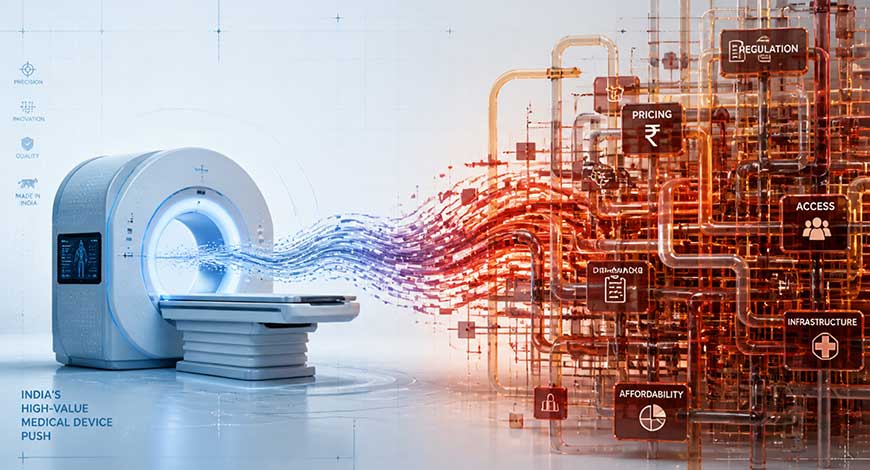
There is a particular kind of import dependency that is easy to describe and difficult to fix. The kind where the problem is not money, not market size, not even political will, but technology that took other countries thirty years and enormous institutional investment to build. India’s medical device import bill, now touching ₹89,000 crore and rising 17 percent in a single year, is precisely that kind of problem. And the government’s response, which is to identify eight to ten high-value device categories for accelerated domestic production, is the right instinct applied to a structural challenge that incentives alone will not solve.

The policy pivot under discussion is significant in what it does not do. It does not target syringes, gloves, or wound care consumables, the categories where Indian manufacturing has already proven itself competitive. It targets MRI systems, pacemakers, continuous glucose monitoring devices, advanced ultrasound equipment, high-end in-vitro diagnostic analyzers, and critical imaging components: X-ray tubes, imaging detectors, and ultrasound probes. These are products whose manufacturing complexity sits an order of magnitude above anything the existing Production Linked Incentive scheme was designed to incentivise. The strategic signal is correct. The execution path remains underspecified.
Why the import concentration matters
The import data, read carefully, is both alarming and instructive. India imports medical devices across over 6,000 product lines spanning 160 eight-digit HS codes. Of these, 40 codes, with individual import values above ₹500 crore each, account for ₹77,000 crore, or roughly 85 percent of the total bill. The top 19 product categories alone account for nearly ₹26,000 crore, close to 30 percent of all imports.
This concentration is, paradoxically, an opportunity. If domestic policy can meaningfully shift the economics of even five or six high-import categories, the import bill moves materially. The problem is that the categories responsible for the most important value are also the ones with the highest technological barriers, not because global manufacturers have kept secrets particularly well, but because excellence in imaging physics, precision mechatronics, and bioelectronics compounds over decades of R&D, regulatory iteration, and clinical validation in ways that cannot be compressed by a five-year incentive window.
The devices under consideration share a common profile: they are capital equipment with long replacement cycles, complex regulatory pathways, and value chains where the critical components, not the housing, not the assembly, are the source of both cost and competitive advantage. An MRI machine assembled in India using imported gradient coils, superconducting magnets sourced from a handful of global suppliers, and software developed abroad is not a domestic manufacturing success in any strategically meaningful sense. It is a repackaging operation.
The PLI paradox
The existing PLI scheme for medical devices, with an outlay of ₹3,420 crore, has produced results, but results of a particular kind. Four notified device parks have come online. Domestic production of linear accelerators, CT systems, mammography units, and high-end x-ray tubes has been seeded. These are genuine achievements. They also illustrate the scheme’s ceiling: PLI is structured to reward revenue, which incentivises production volume. It does not naturally incentivise the kind of long-cycle, uncertain, non-linear R&D that closes technology gaps.
A PLI 2.0, if it follows the architecture of its predecessor, will expand the capital base of Indian MedTech and encourage more companies to enter the assembly and mid-complexity manufacturing space. That is valuable, and should not be dismissed. But for the categories now under government focus, CGM devices, high-end IVD analysers, advanced pacemakers, the limiting factor is not the absence of willing manufacturers. It is the absence of the underlying science, the component ecosystems, and the clinical evidence generation infrastructure that global leaders have built over decades.
The honest version of a PLI 2.0 for these categories would look less like a revenue-linked production incentive and more like a targeted R&D support mechanism, potentially structured around joint ventures with global technology holders, mandated technology transfer arrangements, and academic-industry research pipelines with measurable milestones. Whether the scheme being designed has this architecture, or whether it defaults to the simpler revenue-linkage model, will determine its long-term impact.
The tariff question and its contradictions
Among the policy levers under review, tariff adjustments are the most immediately consequential and the most internally contradictory. Raising import duties on finished high-value devices creates price protection for nascent domestic manufacturers, which is standard industrial policy logic. It also raises the cost of healthcare for hospitals and, ultimately, patients, a politically uncomfortable consequence in a country where out-of-pocket health expenditure is already high.
The contradiction is made sharper by a parallel policy signal: proposals to allow hospitals to directly import approximately 80 categories of high-end equipment, bypassing existing procurement layers, ostensibly to improve patient access. If that channel opens while the domestic manufacturing push is still in its early stages, the protective effect of tariff adjustments is diluted. Hospitals will access global technology through the import route; domestic manufacturers will face competitive pressure before they have the scale or technology to compete. This is not an argument against improving patient access, it is an argument for sequencing these two goals more carefully than the current policy signals suggest they are being sequenced.
The component indigenisation piece of the policy conversation is, in this context, more promising than the finished-device focus. If India can build domestic capability in X-ray tubes, imaging detectors, ultrasound probes, and the reagents used in high-end IVD analysers, the strategic gain is durable in a way that finished-device assembly is not. Components travel across product lines. A competitive domestic x-ray tube industry serves CT manufacturers, radiography equipment makers, and industrial imaging applications. The multiplier effect is larger, and the technology gap, while still real, is narrower than for full system integration.
Market structure and the JV imperative
Global MedTech at the high end is not a competitive market in the conventional sense. In MRI systems, three companies account for the large majority of global installations. Advanced ultrasound probes are similarly concentrated. High-end IVD platforms are dominated by a small number of global diagnostics groups whose competitive moat lies as much in reagent chemistry, software, and installed-base lock-in as in hardware.
Breaking into these markets requires either a genuinely novel technological approach, unlikely, given the maturity of these categories, or access to existing technology through joint ventures, licensing arrangements, or technology transfer. The government’s consultation with industry is seeking to understand where such arrangements are feasible. The honest answer is that feasibility depends on the incentive structure facing global manufacturers: they will transfer technology only if the Indian market opportunity, or the regulatory pressure to do so, outweighs the risk of creating a future competitor.
That calculus is not entirely unfavourable. India’s medical device market is growing at 15–16 percent annually and is projected to reach $50 billion by 2030. A credible domestic manufacturing ecosystem, one with reliable quality standards, a trained workforce, and stable regulatory pathways, could attract technology partnerships that a purely volume-driven market cannot. The government’s role in making that case is as important as any tariff or subsidy it designs.
What the industry reconfiguration looks like
For companies currently operating in the Indian MedTech space, the policy shift has different implications depending on where they sit in the value chain.
Domestic manufacturers with existing PLI participation and the financial capacity to invest in higher-complexity categories stand to benefit most from an extended or redesigned scheme, particularly if public procurement preferences are strengthened. The Global Tender Enquiry rules, which currently allow unrestricted international procurement above certain thresholds, are the mechanism by which government hospital procurement either supports or undermines the domestic manufacturing push. Any strengthening of local content requirements in public procurement will materially change the economics for domestic players.
Global OEMs with Indian distribution and assembly operations face a more complex environment. Tariff adjustments that protect domestic manufacturers effectively raise the cost of their imported finished products, creating pressure to localise more aggressively, which may, in some cases, accelerate the technology transfer that the government is seeking. The alternative, maintaining an import-led model while domestic competitors receive policy support, becomes progressively less tenable as the policy environment tightens.
Diagnostic chains and hospital groups are the end market that will feel the tension most acutely. If import access for high-end capital equipment becomes more restricted or more expensive, procurement cycles lengthen, capital expenditure rises, and the pressure on service pricing increases. For listed hospital groups, the working capital implications of higher equipment costs are meaningful, and any sector analysis needs to account for the pace at which domestic alternatives become available and cost-competitive.
The decade-long bet
The government’s stated ambition, repositioning India from an import-dependent medical device market to a MedTech manufacturing and R&D hub over the next decade, is achievable in principle. It is not achievable on the current policy architecture alone.
The five-year PLI window is misaligned with the R&D cycles of complex capital equipment, where the distance from laboratory to clinical validation to commercial production is often 10 to 15 years. The academic-industry research pipeline that would need to feed this cycle, producing graduates with great skills in imaging physics, biosensor design, and precision manufacturing, does not exist at the required scale. Building it requires not just funding but institutional design: research hospitals that generate clinical evidence for domestic devices, university-industry partnerships with commercialisation mandates, and regulatory pathways that do not inadvertently make domestic clinical trials more expensive than importing finished products.
None of this makes the initiative wrong. It makes it harder than the policy signals currently acknowledge. The eight to ten devices being targeted were not chosen arbitrarily, they represent both high import value and, in several cases, genuine possibilities for near-term domestic progress. CGM devices, where the core technology is more accessible than MRI physics, may yield results within a five-year window. Pacemakers, where international players have existing Indian operations, may be amenable to technology transfer arrangements. High-end IVD analysers, where reagent chemistry is the real competitive barrier, will take longer.
The import bill will not fall to zero. It should not, global specialisation in complex technology is not a failure of industrial policy, it is an argument for comparative advantage. The realistic target is a meaningful reduction in the categories where domestic manufacturing is technically feasible and strategically important, combined with a genuine upgrade in India’s capacity to generate, not just assemble, medical technology. That outcome is worth pursuing. It will require more institutional investment, more patience, and more tolerance for the messy reality of technology development than the current consultation process seems designed to deliver.
MB Bureau