Headlines of The Day
Inside India’s Rs 40,000-crore hospital bed rush
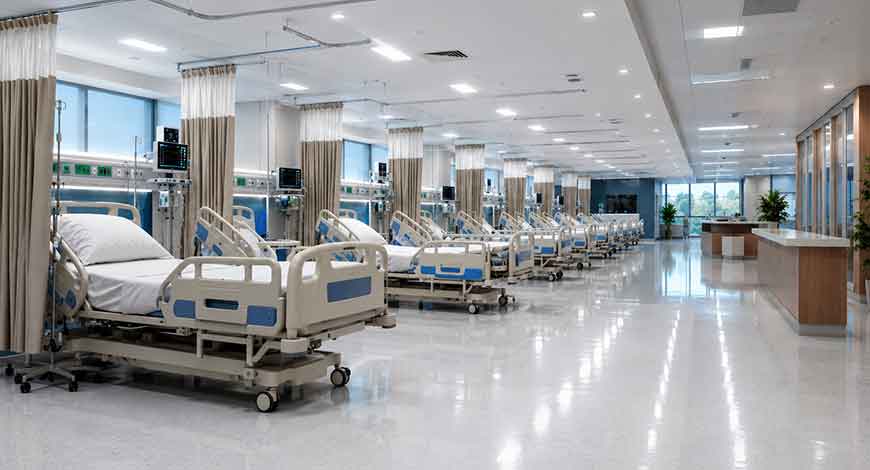
A Bajaj Broking Prive report puts a number on something that’s been building for years: India’s large private hospital networks are planning roughly Rs 40,000 crore of fresh CapEx to add more than 38,000 beds by 2030. On its own, that figure is easy to skim past. It becomes more interesting once it’s converted into a per-bed cost, because Rs 40,000 crore, divided across 38,000 beds, works out to a little over Rs 1 crore of CapEx per new bed the industry plans to build. That’s a useful yardstick for judging whether any single hospital chain’s plans, discussed further below, are unusually capital-intensive or comparatively lean.

The other number worth unpacking is the 54percent increase in bed capacity the report attributes to this build-out. If 38,000 additional beds represent a 54percent jump, that implies the major private networks are currently operating from a base of roughly 70,000 beds, a base that would grow to somewhere in the neighbourhood of 108,000 beds by the end of the decade. Framed that way, this isn’t an incremental expansion; it’s closer to the private hospital sector rebuilding more than half of its existing capacity inside seven years.
The demand-side justification is straightforward enough: an ageing population, a rising chronic-disease burden and wider insurance penetration are pushing more people toward formal hospital care, and the brokerage expects India’s overall healthcare market to cross $372 billion by 2027. But the more telling statistic is India’s bed density, just 1.3 hospital beds per 1,000 people, which sits well below the global median. That gap is really the entire investment thesis in one number: there simply isn’t enough physical capacity in the system yet, regardless of how demand trends evolve from here.
Why renovate instead of build from scratch
Roughly 63percent of the new beds are expected to come from brownfield projects, meaning expansions or upgrades of hospitals that are already operating, rather than entirely new facilities on new land. This isn’t a minor implementation detail; it’s arguably the most important operational choice in the entire plan. Brownfield expansion lets a chain add beds inside a hospital that already has doctors, brand recognition, a referral network and a functioning supply chain, which cuts both the capital required per bed and the time it takes for a new bed to become profitable. Greenfield hospitals, by contrast, often take years to reach breakeven occupancy because they have to build all of that infrastructure, clinical reputation included, from zero.
The other lever operators are pulling is a shift in case mix, not just bed count. Average revenue per occupied bed, a metric that essentially captures how much a hospital earns per patient per day, is projected to rise by close to 45percent , as chains lean harder into speciality and tertiary-care services that command higher realisations than routine inpatient care. In other words, a meaningful share of the projected growth isn’t just about treating more patients, it’s about each occupied bed generating substantially more revenue than it does today.
The real growth story is playing out beyond the metros
It would be easy to assume that a CapEx programme this size is mainly a metro story, given how concentrated India’s top hospital brands have historically been in large cities. The data suggests the opposite. Healthcare demand in tier-II and tier-III cities is projected to grow at a 16-18percent compound annual rate, comfortably ahead of the 12-14percent pace expected in metro markets. Two structural supports explain why smaller cities are becoming the more attractive growth avenue: more than 70percent of hospitals empanelled under Ayushman Bharat, the government’s flagship health insurance scheme, are already located in smaller cities and towns, effectively pre-building a patient funnel for any corporate chain willing to expand there, and rising private insurance coverage, medical tourism and digital health adoption are reinforcing the same shift from a different direction.
Put simply, tier-II and tier-III expansion isn’t a defensive or philanthropic move for these hospital chains; on these growth-rate numbers, it’s arguably where the more attractive unit economics are, precisely because land and construction costs tend to be lower even as patient volumes catch up quickly.
Three different playbooks, one shared thesis
Bajaj Broking Prive singles out three listed operators, Apollo Hospitals Enterprise, Narayana Health and Rainbow Children’s Medicare, as its preferred ways to play this build-out. Each is pursuing a distinct version of the same underlying strategy:
| Company | CapEx Plan | New Beds | Strategic Angle |
| Apollo Hospitals | ~Rs 8,000 cr | ~4,400 by FY30 | Corporate restructuring sharpens core healthcare focus; positioned for both medical tourism and domestic demand |
| Narayana Health | ~Rs 3,000 cr | ~2,000 over 3 yrs | Six new domestic projects; improving domestic metrics plus global expansion and high-margin clinical segments |
| Rainbow Children’s Medicare | Not disclosed | 900+ under development | Expanding into north and central India; shifting from capital-heavy build-out to an earnings-harvesting phase |
Running the same per-bed arithmetic used earlier in this piece on the two companies that disclose both figures is revealing. Apollo’s plan works out to roughly Rs 1.8 crore of CapEx per bed, while Narayana’s works out closer to Rs 1.5 crore per bed, both meaningfully above the sector-wide average of about Rs 1 crore per bed calculated earlier. That gap isn’t necessarily a red flag; it more likely reflects the fact that both chains are skewing their expansion toward higher-acuity, higher-specification tertiary care rather than lower-cost general beds, which is consistent with the ARPOB story described above. Rainbow doesn’t disclose a CapEx figure alongside its bed count, making it the hardest of the three to benchmark on this metric, though its shift toward an earnings-harvesting phase suggests the heaviest capital outlay may already be behind it.
What the growth estimates actually imply
Bajaj Broking Prive’s FY27 revenue growth estimates for the three names line up in a way that doesn’t perfectly track the CapEx figures above, which is itself worth noting:
| Company | FY27 Revenue Growth (est.) | CapEx Scale |
| Apollo Hospitals | 18.5percent | Largest (Rs 8,000 cr) |
| Narayana Health | 33.1percent | Smallest disclosed (Rs 3,000 cr) |
| Rainbow Children’s Medicare | 17.7percent | Not disclosed |
Narayana Health has the smallest disclosed CapEx of the three yet is projected to grow revenue at almost twice Apollo’s rate in FY27. That combination points to Narayana’s growth being driven less by the sheer scale of new construction and more by improving domestic performance, global operations and a mix shift toward higher-margin clinical segments, the same factors the brokerage flags separately as reasons for its optimism on the stock. Apollo’s more moderate growth rate, despite by far the largest CapEx outlay, is consistent with a company whose new beds are still ramping up toward full occupancy rather than immediately contributing at scale. As new hospitals mature and occupancy climbs across all three chains, margins are expected to improve in step, a fairly standard pattern in hospital economics: the first few years after a bed opens are typically the least profitable on a per-bed basis.
The part of the story that could go wrong
None of this build-out happens in a vacuum, and the report is careful to flag the structural weakness sitting underneath the entire private hospital growth story: India’s public health spending remains stuck at around 2percent of GDP, among the lowest levels for an economy of its size. That underfunding is precisely what pushes so much of the country’s healthcare burden onto private providers and out-of-pocket payments in the first place, which is good for private hospital revenue growth but says something less flattering about the system’s overall resilience and equity.
Beyond that macro backdrop, there are more conventional execution risks. Rising input and staffing costs, tighter regulatory oversight, and price controls on procedures or medical devices could all compress margins even if patient volumes arrive as expected. Slower-than-anticipated ramp-up at newly opened facilities is arguably the most immediate risk of all three, since it directly determines how quickly the roughly Rs 1 crore-per-bed CapEx figure calculated above starts generating a return. A hospital bed that takes an extra year or two to reach breakeven occupancy doesn’t just delay revenue; it also delays the margin expansion that the entire investment case is currently leaning on.
Bottom line
The demand case for more hospital beds in India is hard to argue with given the bed-density gap, but the more interesting story here is how the capacity is being added, mostly brownfield, increasingly tier-II and tier-III, and skewed toward higher-margin specialty care. Whether that translates into the earnings growth currently being modeled depends less on how much capital gets spent and more on how quickly each new bed actually fills up.
MB Bureau