Headlines of The Day
Healthcare’s next growth corridor: CapEx meets structural demand
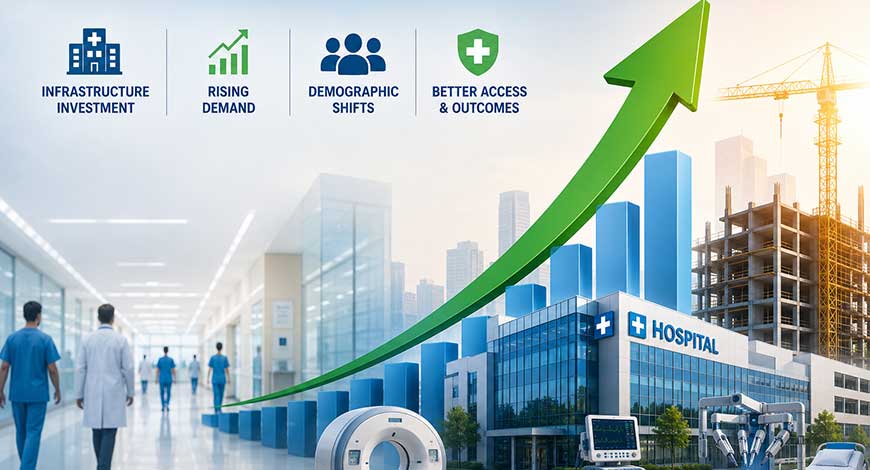
India’s healthcare sector is entering its next growth phase, supported by rising healthcare awareness, increasing lifestyle diseases, expanding insurance penetration, and sustained investments in hospital infrastructure. Demand for tertiary and quaternary care continues to outpace capacity additions across several urban clusters, creating a favourable environment for organised healthcare providers. The combination of rapid urbanisation, improving affordability, and stronger healthcare accessibility is reinforcing long-term growth visibility, while hospital operators continue to scale capacities through a balanced mix of greenfield and brownfield expansions.

The sector continues to benefit from structural demand drivers. Emerging urban centres are evolving into major healthcare hubs, supported by population growth, corporate employment, and wider regional catchment areas. The Noida-Greater Noida region, for instance, has witnessed population growth of 5.4 per cent CAGR over the past five years to 1.3 million people, while the super-specialty bed base remains limited at only approximately 4,500 beds, highlighting significant under-penetration. Rising incidence of cardiac disorders, oncology, diabetes, organ transplants, robotic surgeries, and critical care requirements is steadily increasing demand for advanced healthcare services, while improving transport infrastructure and airport connectivity are expanding medical tourism opportunities.
Capacity expansion remains a defining industry theme, with hospital operators focusing on enhancing bed capacity, operating theatres, and specialised centres of excellence rather than pursuing aggressive pricing. Occupancy levels across mature facilities continue to improve, indicating healthy demand absorption despite ongoing additions. Higher bed utilisation, better patient throughput, and an improving case mix are supporting revenue growth and operating leverage. However, the availability of specialist doctors remains a key industry constraint, with rising talent costs emerging as one of the primary variables influencing profitability. Hospitals are increasingly focusing on physician retention, productivity enhancement, and operational efficiencies to mitigate these pressures.
Margin dynamics remain constructive despite elevated employee costs. Improving occupancy, higher contribution from complex procedures, optimised payer mix, and greater operational efficiency are supporting EBITDA expansion across the sector. At the same time, insurance empanelment, government healthcare schemes, and increasing reimbursement-led treatments are broadening patient access without materially affecting demand. The industry’s strong brand recall, expanding digital engagement, and rising acceptance of organised healthcare providers continue to
strengthen patient acquisition while supporting sustainable revenue growth over the medium term.
Healthcare infrastructure remains structurally underpenetrated across several regions, creating a long runway for expansion. The increasing preference for organised hospitals, combined with rising investments in advanced medical technologies, robotic-assisted surgeries, diagnostics, and specialised treatment centres, is gradually shifting patient volumes away from smaller standalone facilities. While competitive intensity is increasing as new capacities come online, healthy demand growth, improving healthcare affordability, and continued urban migration are expected to support efficient absorption of incremental capacity across major healthcare markets.
Overall, the Indian healthcare sector remains well positioned for sustained long-term growth, supported by structural demand, expanding hospital infrastructure, increasing healthcare spending, and favourable demographic trends. Although rising manpower costs and specialist talent availability may create periodic margin pressures, improving occupancy, capacity utilisation, and the continued expansion of organised healthcare networks are likely to support healthy earnings growth, reinforcing the sector’s attractive long-term outlook.
Max Healthcare | Target price: ₹1,260
Max Healthcare operates a high-acuity multi-specialty hospital network complemented by diagnostics and homecare platforms, with growth supported by brownfield expansions, digital patient acquisition, and rising tertiary-care penetration. Strong occupancy, improving specialty mix, and disciplined capital deployment support resilient EBITDA per bed, while low leverage strengthens long-term earnings visibility.
The fourth quarter of FY26 saw revenue growth remain subdued due to the discontinuation of select chemotherapy drugs and softer inpatient volumes, resulting in a revenue miss versus estimates. However, stable ARPOB, 75 per cent occupancy, and resilient EBITDA per bed supported margin expansion, while higher depreciation, interest, and tax outgo weighed on PAT. The brownfield ramp-up at Smart, Nanavati, and Mohali is expected to support near-term recovery, while the Gurgaon greenfield project is expected to contribute from FY28 despite commissioning delays. Consolidated revenue, EBITDA, and PAT are projected to grow at a CAGR of 14 per cent, 15 per cent, and 20 per cent respectively over FY26–28, supported by capacity additions and operating leverage.
Global Health (Medanta) | Target price: ₹1,490
Medanta is witnessing healthy demand across both mature and developing hospitals, supported by higher patient volumes, improving realisations, and ongoing capacity expansion. The company remains focused on optimising occupancy, adding doctor
talent, and scaling up specialties across key hospitals, while Noida is expected to achieve EBITDA breakeven in the second half of FY27. Expansion into new markets such as Indore, Varanasi, Guwahati, Mumbai, and South Delhi, along with growing international patient inflows and healthcare ecosystem initiatives, is expected to support long-term growth.
Medanta reported 24.5 per cent year-on-year revenue growth in the fourth quarter of FY26, while EBITDA and adjusted PAT grew 8.5 per cent and 3.4 per cent year-on-year respectively, with margins impacted by higher operating costs related to the Noida hospital ramp-up. Mature hospitals posted 11 per cent revenue growth with margin expansion, while developing hospitals revenue grew 51 per cent year-on-year, supported by strong traction across Ranchi, Patna, and Noida. For the full year FY26, revenue, EBITDA, and PAT grew 19 per cent, 3 per cent, and 7 per cent year-on-year respectively, while IPD and OPD volumes increased 23 per cent and 27.5 per cent year-on-year, and international patient revenue rose 22 per cent year-on-year.
A BUY stance on Medanta is maintained, supported by strong patient volume growth, ongoing hospital ramp-up, and an aggressive expansion pipeline. A robust 28 per cent earnings CAGR is estimated over FY26–28, driven by the scaling up of Noida, improving utilisation across existing hospitals, and continued capacity additions.
This article is by Motilal Oswal Wealth Management Research Desk.