Patient Monitoring Equipment
Enhancing patient care and safety with PMS

With advancements in medical technology, patient monitoring has evolved from basic vital signs measurement to sophisticated real-time systems that integrate data from multiple sources.

In modern hospitals, patient monitoring systems (PMS) have become the backbone of safe and effective healthcare delivery. These devices go far beyond recording vital signs–they provide clinicians with real-time data that supports rapid decision-making and timely interventions. Whether tracking heart rate, blood pressure, or respiratory function, continuous monitoring ensures that even the smallest changes in a patient’s condition are detected early, preventing complications and saving lives. By acting as an ever-present safety net, monitoring systems reduce human error, strengthen clinical workflows, and allow medical teams to prioritize patients at greatest risk. In an era of increasing patient loads and workforce pressures, these technologies are not just tools but essential partners in safeguarding patient outcomes. Their role in ensuring accuracy, consistency, and vigilance underscores why patient monitoring is indispensable in today’s healthcare environment.
Indian market dynamics
India’s patient monitoring equipment market, estimated at ₹700 crore, saw little movement in 2024 after years of contraction. Having declined annually since 2020, the sector finally bounced back in 2023 before plateauing.
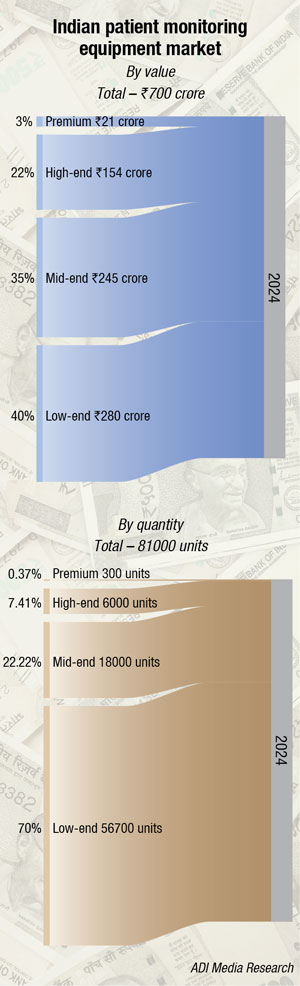
During 2024, demand for low- and mid-end patient monitoring equipment grew across India, even as the premium segment saw little change. The expansion into Tier-II and Tier-III markets drove much of this shift. In major cities, some brands attracted hospital chains by offering five-year payment deals, with payments deferred until the third year. Nonetheless, average unit prices rose across all segments.
|
Leading players* 2024 |
|
| Tier I | Mindray and Philips |
| Tier II | Nihon Kohden |
| Tier III | GE, Contec, and Schiller |
| Tier IV | BPL, Yonker, Allied, Comen, and Drager |
| Others | Edan, Skanray, Biolight, Spacelabs, RMS India, Niscomed, Narang Medical, Olives India, Instromedix, Nareena, and Akas Medical |
|
*Vendors are placed in different tiers on the basis of their sales contribution to the overall revenues of the Indian patient monitoring equipment market. ADI Media Research |
|
Chinese brands–including Mindray, Contec, Yonker, Comen, and Edan–accounted for over 40 percent of the market by value in 2024. Mindray and Philips continued to lead the segment, while Nihon Kohden increased its share during the year.
Devices that enable continuous monitoring of vital signs are becoming central to modern care, providing real-time data for timely decision-making and reducing the risk of complications. Government-led initiatives supporting digital health, rising healthcare investments, and favourable policies are further strengthening adoption.
At the same time, India faces certain hurdles, including the high cost of advanced monitoring systems, a shortage of trained professionals to interpret data, and concerns around data security and privacy. Yet, these challenges are being balanced by opportunities created through technological progress. Wireless connectivity, cloud integration, and predictive analytics are transforming the way patient data is collected and utilized, leading to smarter and more proactive care solutions.
Key trends such as the integration of artificial intelligence, the rise of wearable health devices, and the growing popularity of mobile health applications are reshaping patient monitoring in India. Remote monitoring is particularly gaining traction, offering better access to healthcare for rural populations and enabling patients to be managed from home, thus reducing hospital burdens.
Global market dynamics
The global patient monitoring devices market is estimated to reach USD 107.93 billion by 2034, up from USD 52.22 billion in 2025, growing at a CAGR of 8.40 percent as per Precedence Research.
The global patient monitoring devices market is evolving rapidly as healthcare shifts toward more connected, data-driven, and patient-centered care. Rising demand for residential monitoring, driven by aging populations, growing prevalence of chronic diseases, and the need for long-term management of conditions such as cardiovascular disorders, diabetes, and neurological illnesses, is a key driver. Today, the industry is experiencing a wave of innovation, with manufacturers developing advanced devices capable of continuous, real-time measurement of vital signs and therapeutic parameters.
Technology stands at the core of this growth, as AI-powered analytics, IoT-enabled sensors, and non-invasive solutions such as radar-based monitoring systems are reshaping the way health data is captured and interpreted. At the same time, usability and patient engagement are emerging as critical components, as devices need to be both clinically reliable and user-friendly for healthcare providers and patients alike. Remote patient monitoring platforms, wearable ECGs, and integrated therapeutic devices like ventilators and oxygen monitors are expanding the scope of monitoring beyond hospital walls, creating opportunities across home care, telemedicine, and digital health ecosystems.
The growth of the patient monitoring industry is supported by contributions from multiple sectors. MedTech companies are driving device innovation, technology providers are enabling connectivity and data security, while healthcare facilities and home care providers are adopting these systems for operational efficiency and better patient outcomes. Moreover, AI and software vendors are playing an increasingly important role in turning raw physiological data into actionable insights, further enhancing clinical decision-making. Collaborative efforts across these industries are shaping a more connected and preventive model of healthcare.
India’s pulse – Tracking the future of patient monitoring equipment
 Dr Vysakh V
Lead-Advanced Technology, R&D,
Skanray Technologies Limited
The Indian patient monitoring equipment market is expanding steadily, reflecting a combination of demographic change, rising chronic disease burden, and the adoption of digital health infrastructure. Current estimates place the market at USD 2.27 billion in 2025, with projections of USD 3.41 billion by 2030, indicating a compound annual growth rate (CAGR) of approximately 8.5 percent.
The epidemiological transition in India–marked by an increase in cardiovascular disease, diabetes, and respiratory disorders–has intensified the requirement for continuous physiological assessment. The COVID-19 pandemic further demonstrated the utility of decentralized and remote monitoring platforms, establishing telemedicine as a complementary model of care delivery.
Recent technical advancements have substantially enhanced the capabilities of monitoring systems. Wearable and patch-based biosensors are increasingly employed for real-time acquisition of parameters such as electrocardiography, photoplethysmography, and respiratory activity. These devices rely on low-power wireless protocols to ensure seamless data transfer to smartphones, hospital servers, or cloud environments. Concurrently, artificial intelligence and machine learning algorithms are being embedded into monitoring workflows, enabling predictive analytics, anomaly detection, and automated generation of early warning scores. Advanced signal processing techniques, including adaptive filtering and beat-to-beat variability analysis, are being integrated to improve accuracy and reduce noise artefacts in critical care environments.
In hospital settings, modular multi-parameter monitors are evolving to provide scalability, rugged construction, and improved battery autonomy, features essential for intra- and inter-hospital patient transport. Digital interoperability has become a design priority, with many systems adopting HL7 or FHIR standards to interface efficiently with electronic health records and central monitoring stations. Enhanced cybersecurity protocols, including encryption and secure authentication, are increasingly incorporated to safeguard patient data integrity during transmission.
Nevertheless, barriers to universal adoption persist. High-end technologies may be inaccessible to secondary and rural facilities due to cost constraints, underscoring the need for affordable, reliable baseline monitoring systems. Furthermore, the effective use of advanced features requires personnel training and compliance with regulatory frameworks governing safety and data security.
In summary, the Indian patient monitoring equipment market is characterized by strong growth potential and increasing technological sophistication. The future trajectory will probably be defined by the balance between affordability, digital integration, predictive intelligence, and robust data security, positioning patient monitoring as a cornerstone of India’s evolving healthcare landscape.
However, alongside strong growth potential, the market also faces significant challenges. Data privacy and cybersecurity concerns are mounting with the rise of connected and cloud-based monitoring systems. High device costs and interoperability issues create barriers to adoption, especially in resource-limited regions. Patient compliance, regulatory complexities, and recurring issues such as product recalls also hinder smooth market expansion. The industry must also address usability challenges to ensure systems fit seamlessly into clinical workflows while remaining intuitive for end-users.
As the market matures, striking the right balance between innovation, affordability, security, and user-centric design will determine the pace of adoption. The future of patient monitoring devices lies not only in advanced technologies but also in building trust, accessibility, and integration across healthcare ecosystems worldwide.
Within the region, North America is anticipated to remain at the forefront with largest market share of more than 43 percent in 2024, driven by strong healthcare infrastructure, increasing research and development efforts, and the higher prevalence of infectious and lifestyle-related diseases. Europe is also witnessing sustained growth, shaped by supportive healthcare policies, emphasis on patient safety, and investments in digital healthcare adoption.
In the Asia Pacific region, the market is expanding rapidly due to the rising incidence of chronic diseases, such as diabetes and cardiovascular disorders, combined with increasing healthcare expenditure and growing awareness of digital health. Countries across the region are turning to patient monitoring solutions to manage large populations and limited healthcare resources more effectively. Within this regional growth story, India represents a strong example of how the market is evolving.
Overall, the evolution of patient monitoring devices worldwide reflects a shift toward more connected, data-driven, and patient-centric care. While mature markets continue to refine their systems, emerging regions like Asia Pacific are harnessing innovation to bridge gaps in access and quality. India stands out as a strong example of how digital health initiatives, combined with advanced technologies, are paving the way for scalable, efficient, and future-ready patient monitoring solutions.
From manual charting to AI–The transformation in hospitals
Patient monitoring systems in hospitals have undergone a remarkable transformation, evolving from manual and labour-intensive methods to advanced, intelligent platforms that reshape how patient care is delivered. In the past, nurses and doctors relied on periodic checks and manual charting of vital signs, a process that was time-consuming, prone to errors, and often delayed the detection of early signs of patient deterioration. As patient volumes grew and healthcare needs became more complex, the limitations of these traditional practices became increasingly evident, creating an urgent need for more efficient, reliable, and proactive monitoring solutions.
The introduction of bedside monitors and centralized stations marked the first leap forward, enabling continuous tracking of parameters such as heart rate, blood pressure, oxygen saturation, and respiration. These systems reduced reliance on manual recording and ensured a more consistent flow of patient data, but challenges like data overload, fragmented platforms, and limited accessibility persisted. With the integration of advanced hardware and wireless technologies, monitoring systems expanded to cover multiple patients across departments, improving collaboration and reducing response times.
Today, the evolution has reached a new frontier with the infusion of AI into patient monitoring. Modern systems not only track vitals in real time but also analyze patterns, detect abnormalities, and issue timely alerts, allowing healthcare providers to intervene before conditions escalate into emergencies. Predictive analytics and automated alarm management minimize missed events, enhance clinical accuracy, and ease the workload of healthcare staff. Extended data storage and retrospective analysis further support informed decision-making and quality improvement initiatives.
By combining sophisticated hardware, seamless connectivity, and AI-driven insights, hospital-focused monitoring systems have transitioned into proactive, intelligent frameworks. These advancements enable faster detection of patient deterioration, reduce costs through optimized workflows, and elevate patient safety and outcomes.
From data capture to data intelligence
The evolution of patient monitoring has moved far beyond simple data capture, transforming into a sophisticated ecosystem driven by big data, AI, and predictive analytics. In the past, monitoring systems primarily focused on collecting basic physiological information, often limited by manual recording and periodic checks. Today, advanced technologies enable continuous, real-time observation of vast amounts of health data through connected devices, wearable sensors, and automated systems. This data is seamlessly integrated and analyzed at scale, eliminating delays and improving accuracy while ensuring secure handling and interoperability across platforms.
AI and predictive analytics take this process further by converting raw data into actionable intelligence. Machine learning and deep learning models identify patterns, detect anomalies, and predict potential health risks before they escalate into emergencies, enabling timely interventions and personalized care. These systems continuously learn from both real-time streams and historical records, ensuring adaptability as patient conditions change.
By integrating predictive modelling, clinicians can make proactive decisions rather than reactive ones, enhancing diagnostic accuracy and patient outcomes. Ultimately, the shift from simple data collection to intelligent decision-support tools empowers healthcare providers to deliver faster, safer, and more efficient care while optimizing resources and improving the overall patient experience.
Beyond the numbers – The future of patient monitoring
 Abhay Kumar
Manager Medical Equipments,
Nihon Kohden India Private Limited
Patient monitoring today is far more than just numbers on a screen. It has become an essential part of modern healthcare, enabling clinicians to detect even subtle changes in a patient’s condition and intervene before complications arise. In intensive care units, operating rooms, and emergency departments, having timely and accurate information can significantly impact patient outcomes.
Our focus is on designing monitoring systems that are precise, user-friendly, and seamlessly connected across hospital settings. By linking bedside monitors with central stations and electronic health records, doctors and nurses can access critical patient data anytime and anywhere. This connectivity allows for faster clinical decision-making and prompt responses when a patient’s condition changes.
One noteworthy technology is esCCO™ (estimated Continuous Cardiac Output), which continuously measures cardiac output without invasive procedures, providing valuable insights into heart function safely and reliably.
Another significant advancement is iNIBP (Non-Invasive Blood Pressure) technology. It enables continuous, real-time blood pressure measurement with exceptional accuracy, allowing clinicians to assess blood pressure instantly while minimizing patient discomfort. Using a linear inflationary algorithm, iNIBP measures blood pressure during cuff inflation, offering faster, gentler, and more comfortable readings compared to conventional deflationary methods. This innovation reduces measurement time, avoids overinflation, and decreases patient stress.
These technologies help improve patient outcomes by enabling timely interventions, enhance safety for critically ill patients, and streamline workflow in ICUs and surgical areas.
As healthcare continues to evolve, patient monitoring will become even more important. At Nihon Kohden, we are committed to creating monitoring systems that not only track vital signs but also support medical teams in delivering the best care. By focusing on accuracy, usability, and connectivity, we aim to help clinicians make better decisions, improve patient safety, and build a healthier future for patients worldwide.
In conclusion, modern patient monitoring goes far beyond displaying numbers–it empowers healthcare professionals to make faster, smarter, and more informed decisions. By integrating accuracy, real-time insights, seamless connectivity, and predictive analytics, advanced monitoring systems enhance patient safety, improve outcomes, and fully support clinicians in delivering high-quality care. Nihon Kohden is committed to driving this transformation for a healthier, safer future.
Imaging and critical care integration
The convergence of imaging technologies and patient monitoring has opened a new era in critical care, where timely diagnosis and rapid intervention can significantly improve patient outcomes. Traditionally, monitoring systems provided real-time data on vital parameters, while imaging was used separately to confirm diagnoses or track disease progression. Today, the integration of these two domains allows clinicians to correlate continuous physiological trends with visual insights, creating a more comprehensive and dynamic picture of patient health.
By providing clinicians with real-time insights supported by imaging confirmation, the integration also reduces the incidence of “code blues” – situations where patients experience sudden and severe deterioration.
Moreover, these integrated systems strengthen collaboration across critical care teams by creating a shared framework of data and imagery. Radiologists, intensivists, and nurses can view synchronized streams of information, reducing miscommunication and supporting coordinated interventions. This not only accelerates response times but also helps optimize resource use within ICUs.
The result is a more proactive, connected, and patient-centered model of care. By uniting the strengths of imaging and monitoring, healthcare providers can move beyond fragmented observations toward holistic management. This synergy empowers clinicians to act swiftly, reduce preventable adverse events, and ensure that patients receive the highest standard of critical care.
Smarter monitoring, healthier India ahead
 Aditya Kohli
CFO & Director,
Allied Medical Limited
The Indian healthcare industry is undergoing rapid transformation, and patient monitoring devices are at the heart of this growth. With the rising demand for quality healthcare, the patient monitor market in India is experiencing steady expansion, driven by factors such as an increased disease burden, government initiatives, and a growing private hospital sector. The surge in chronic diseases like cardiac ailments, diabetes, and respiratory disorders has significantly increased the need for patient monitoring. Hospitals, nursing homes, and even home healthcare setups are investing in advanced monitors to improve patient outcomes. Growing ICU setups and specialty centers further add to this demand. Earlier dominated by basic multiparameter models, the Indian market is now shifting to modular and high-acuity systems. Features like EtCO₂, invasive blood pressure, and advanced hemodynamic monitoring are increasingly sought after, especially in tertiary care hospitals. Manufacturers are also innovating with compact and user-friendly designs for wider adoption.
Government programs such as Ayushman Bharat and the growth of health insurance penetration are improving access to healthcare. This drives hospitals across tier-II and tier-III cities to invest in patient monitors, expanding the market beyond metros.
The COVID-19 pandemic accelerated the adoption of portable and wearable monitors.
Home care providers and telemedicine platforms continue to drive demand for compact, wireless solutions, enabling remote monitoring and continuity of care. The market is highly competitive, with global leaders competing alongside Indian manufacturers. Import substitution and government push for Make in India are further encouraging local production of affordable patient monitors without compromising quality. Artificial intelligence, IoT, and cloud connectivity are expected to define the next phase of patient monitoring in India. From predictive analytics to real-time remote monitoring, the market is set for robust growth.
The Indian patient monitor market is on a strong growth trajectory. With rising healthcare investments, technological advancements, and expanding access, patient monitors will continue to play a critical role in enabling better patient care nationwide.
Smarter monitoring technologies are transforming healthcare in India–delivering faster, safer, affordable care across urban and rural settings. With innovation and adoption rising, India is set to become a global hub. Partnering with the best medical equipment company ensures advanced solutions.
IoT and smart sensor-based monitoring devices
The rapid rise in healthcare demands, coupled with the growing need for elderly care and chronic disease management, has made continuous patient monitoring a cornerstone of modern medicine. Patient monitoring equipment, traditionally limited to hospital ICUs and operating rooms, has evolved into more advanced and connected systems that extend beyond the clinical setting. The integration of Internet of Things (IoT) technology and smart sensors has enabled these systems to provide real-time tracking of vital signs and even patient movement. This shift is reducing reliance on frequent hospital visits while ensuring timely medical intervention.
IoT-enabled smart sensors play a central role by wirelessly transmitting patient data to cloud-based platforms where it is stored, visualized, and analyzed. The use of AI in these systems further strengthens their utility by detecting abnormal patterns, reducing false alarms, and generating alerts for healthcare professionals. This capability enables early detection of subtle health changes, supporting faster response and personalized care–especially for post-surgical, chronic, and elderly patients needing continuous monitoring.
Beyond individual health benefits, these systems enhance hospital operations by minimizing manual data collection and reducing the risk of human error. Automated logging and analysis improve data accuracy and reliability, while also freeing up healthcare providers to focus more on direct patient care. In emergency settings, the ability to generate early warnings–such as detecting rapid drops in oxygen saturation or irregular cardiac activity–can prove lifesaving.
Another key contribution of IoT-based monitoring lies in extending healthcare services to remote or underserved areas. Through mobile and cloud platforms, patients can share their vital signs with medical teams in real time, bridging geographic gaps and enabling access to quality healthcare. Longitudinal data gathered from continuous monitoring not only aids in tracking disease progression but also supports the development of precision medicine approaches, allowing treatments to be tailored to individual patient needs.
Recent innovations further demonstrate how smart monitoring devices are moving toward more user-friendly and non-invasive designs. From wearable devices to contactless sensing through cameras or imaging technologies, these advancements ensure greater comfort, usability, and adoption across different healthcare environments. As these systems continue to mature, they are expected to become integral to proactive health management, shifting care models from reactive treatment to preventive and predictive healthcare.
Overall, IoT-enabled smart sensor-based monitoring devices represent a significant advancement in patient monitoring equipment. They provide real-time insights, enhance safety, cut costs, and enable scalable care, paving the way for smarter, connected healthcare systems.
Research advances in physiological monitoring
Recent advances in physiological monitoring have brought significant improvements to the way vital signs are captured, analyzed, and applied in clinical care. Among these, respiratory rate has gained renewed attention as a critical indicator of patient deterioration, often preceding events such as pneumonia, respiratory failure, or cardiac arrest. Traditional methods for measuring respiratory rate, while accurate, can be intrusive and unsuitable for continuous monitoring. To address these limitations, researchers have explored non-invasive approaches that extract respiratory signals from existing cardiovascular data streams, offering a more practical and scalable solution.
One area of innovation lies in leveraging electrocardiogram (ECG) and photoplethysmogram (PPG) signals for respiratory monitoring. Both signals contain respiratory modulation components that can be analyzed to estimate breathing patterns. Early approaches focused on using single sources, but these were often affected by noise, motion artifacts, and inconsistent signal quality. More recent studies emphasize fusing respiratory components derived from both ECG and PPG to build a more robust and accurate picture of breathing activity.
Temporal fusion techniques have emerged as particularly promising, where multiple respiratory modulation components are screened for quality and then combined using statistical or computational models such as principal component analysis. Beyond respiratory rate, these advances illustrate a broader trend in physiological monitoring–shifting from isolated measurements toward multimodal integration. By combining signals from multiple sources and applying intelligent processing techniques, clinicians gain access to richer and more actionable insights into patient status.
While challenges remain in ensuring accuracy under varying conditions and expanding applicability across populations, the research progress is clear. Continuous, non-invasive monitoring methods supported by signal fusion and advanced algorithms are reshaping how vital signs are measured and applied in practice. As these innovations mature, they hold the promise of making physiological monitoring more reliable, less intrusive, and more widely accessible across healthcare settings.
Smarter monitoring, stronger care
Hospitals worldwide are increasingly adopting patient monitoring systems to improve care delivery, enhance efficiency, and support proactive interventions. Case studies from different healthcare settings reveal that monitoring solutions are being deployed not only for critical care units but also for chronic disease management, post-surgical recovery, and elderly care. Hospitals that implement tailored monitoring platforms report smoother integration with their workflows, greater flexibility to scale, and improved responsiveness to patient needs compared to standard off-the-shelf systems. These real-world examples demonstrate that custom monitoring approaches can adapt more effectively to unique clinical environments, ensuring seamless connectivity across medical devices, hospital systems, and care teams.
From a market perspective, the demand for patient monitoring solutions is driven by the growing need for remote care, chronic disease management, and reduced readmission rates. Continuous monitoring supported by wearable devices, sensors, and AI-powered analytics has shifted the focus from reactive treatment to preventive and predictive care. Hospitals are adopting layered architectures that combine data collection, API integration, AI-based processing, and user-friendly applications for clinicians and patients.
At the same time, challenges such as interoperability with legacy systems, data privacy, user adoption, and cost management remain central considerations. Market trends suggest that hospitals prefer scalable, customizable systems that balance innovation with compliance and usability, ensuring both immediate clinical benefits and long-term readiness. Together, these hospital deployments and broader adoption trends highlight how monitoring systems are becoming integral to smarter, more connected healthcare ecosystems.
Industry standards, regulations and sustainability
The evolution of patient monitoring equipment has entered a new era where innovation is not only measured by clinical performance but also by its alignment with global standards, regulatory compliance, and sustainability goals. Modern monitoring systems must navigate a complex regulatory landscape, ensuring safety, usability, and reliability across diverse environments–from intensive care units to home-based care. International standards such as those addressing safety, alarm systems, and usability form the foundation of compliance, while new frameworks aim to unify requirements across multiple device types. This regulatory rigor is essential to guarantee that next-generation monitoring solutions are both technologically advanced and clinically dependable.
Beyond compliance, sustainability has become a defining pillar of innovation in patient monitoring. Next-generation systems are designed with energy efficiency, reduced packaging, and recyclable materials at their core, helping to lower the ecological footprint of healthcare operations. Compared to traditional models that relied heavily on disposable components and high energy consumption, modern devices now incorporate reusable sensors, rechargeable power sources, and intelligent features that minimize waste and extend product lifecycles. Practices such as refurbishment, modular upgrades, and parts harvesting further enhance circularity, reducing the strain on scarce resources while maintaining high standards of performance.
These advancements are closely tied to global environmental objectives, with healthcare technology increasingly contributing to emissions reduction and resource conservation. Life cycle assessments of new monitoring systems demonstrate significant decreases in waste, energy use, and carbon output, highlighting how technological innovation can align with sustainability targets. By embedding environmental responsibility into design and production, the sector not only supports regulatory compliance but also fosters resilience against the rising demand for greener healthcare practices.
Equally important is the integration of digital and remote capabilities, which ensure continuous uptime, secure operations, and reduced service-related environmental impacts. Remote servicing, software-based upgrades, and cybersecurity compliance reduce the need for resource-intensive physical interventions while strengthening patient safety. This combination of digital efficiency and environmental mindfulness positions patient monitoring systems as both clinically transformative and ecologically responsible.
RPM–Expanding the boundaries of patient care
Patient monitoring has long been centered around hospital wards, with bedside devices essential for tracking vital signs in intensive and acute care settings. Traditionally, these systems relied on staff presence and manual checks, limiting oversight to the hospital environment. As healthcare needs have grown more complex, the scope of monitoring has expanded beyond hospital walls, addressing the need for earlier detection, improved chronic care, and optimal resource utilization.
Remote Patient Monitoring (RPM) represents the next stage in this evolution, bringing hospital-grade supervision into homes, rural communities, and outpatient clinics. By leveraging wearable sensors, wireless communications, and data analytics, RPM enables real-time tracking of patient conditions in non-traditional settings. This allows for continuous observation of post-operative patients, individuals with chronic illnesses, and those requiring long-term surveillance–reducing dependency on frequent hospital visits and enabling prompt medical interventions when subtle changes occur.
The backbone of RPM lies in technological innovations: sensor miniaturization, IoT architectures, and cloud-based platforms provide secure, reliable data transmission. Continuous streams of patient data are processed using advanced algorithms that detect anomalies, generate alerts, and support visualization dashboards accessible to clinicians and caregivers. Customized thresholds and alerts tailored to each patient enhance accuracy, reducing false positives and fostering more effective care collaboration.
RPM is also driving improvements in patient engagement and clinical efficiency. Interactive dashboards and mobile apps encourage patients and families to take an active role in care. Clinicians, meanwhile, benefit from consolidated, actionable insights, enabling stronger collaboration and reinforcing trust in the healthcare process. System-wide efficiencies are achieved by minimizing unnecessary admissions and reducing staff workload, aligning with sustainability goals such as reduced travel, optimal resource usage, and scalable models of care.
Recent research highlights the integration of wireless networks, wearable sensors, and IoT-enabled devices capable of tracking vital parameters–including heart rate, blood pressure, oxygen saturation, temperature, ECG, and respiration–in real time. These portable, accessible technologies support both clinical and home applications, ensuring early detection of deterioration and continuous observation. Studies document the successful adoption of wireless communication platforms–Wi-Fi, backscatter systems, and emerging 5G networks–enabling reliable connectivity even in remote areas. IoT-enabled prototypes have demonstrated high accuracy, affordability, and mobility-friendly features when validated against conventional monitoring devices.
With advances in hardware, research increasingly focuses on AI-driven RPM platforms that analyze continuous data streams to detect anomalies, predict health risks, and deliver actionable insights. Predictive analytics, real-time dashboards, and automated alerts enhance clinician decision-making and contribute to reduced hospital readmissions and costs. Security and compliance are central, supported by robust encryption and authentication protocols for sensitive health data. Scalability and adaptability remain priorities, ensuring these platforms can serve a wide range of patient populations, including those in underserved regions.
Industry perspectives affirm that RPM is not merely about data collection–it is about creating interconnected ecosystems for telemedicine, hospital-at-home models, and intelligent monitoring. Wearables, IoT sensors, and AI analytics provide actionable insights, enabling physicians to remotely track and respond to real-time health data, reduce unnecessary hospital visits, lower costs, and ensure early detection of complications. The integration of telemedicine enables proactive interventions, while hospital-at-home models deliver advanced care in a comfortable, familiar environment.
Looking ahead, RPM will continue to evolve through intelligent monitoring solutions powered by AI and machine learning. These platforms are increasingly adept at identifying patterns, predicting risks, and initiating timely alerts to support clinical care. Industry discussion emphasizes interoperability, patient-centered design, and inclusivity–ensuring solutions are accurate, comfortable, and adaptable. Sustainability also takes precedence, with calls for eco-friendly device designs and energy-efficient technologies.
RPM is bridging the gap from hospital walls to smart homes, ushering in an era of predictive, personalized, and preventive healthcare for patients everywhere.
Looking ahead
The future of patient monitoring is evolving toward an era defined by intelligence, connectivity, and personalization. Advanced technologies such as AI, predictive analytics, and real-time data integration are transforming these systems from passive trackers into proactive tools that can anticipate health risks before they escalate.
At the same time, the expansion of wearable devices and remote monitoring platforms is extending care beyond hospitals, empowering patients to actively engage in managing their own health from the comfort of their homes. This shift not only enhances patient safety and convenience but also reduces hospital burden and healthcare costs. By bridging hospital-based monitoring with community and home-based care, the next generation of patient monitoring solutions is set to create a more responsive, preventive, and sustainable healthcare ecosystem worldwide.
Second opinion
AI-powered patient monitoring reshapes India’s healthcare through inclusive innovation.