Headlines of The Day
Health, demographics and rural welfare take centre stage at NITI Aayog governing council
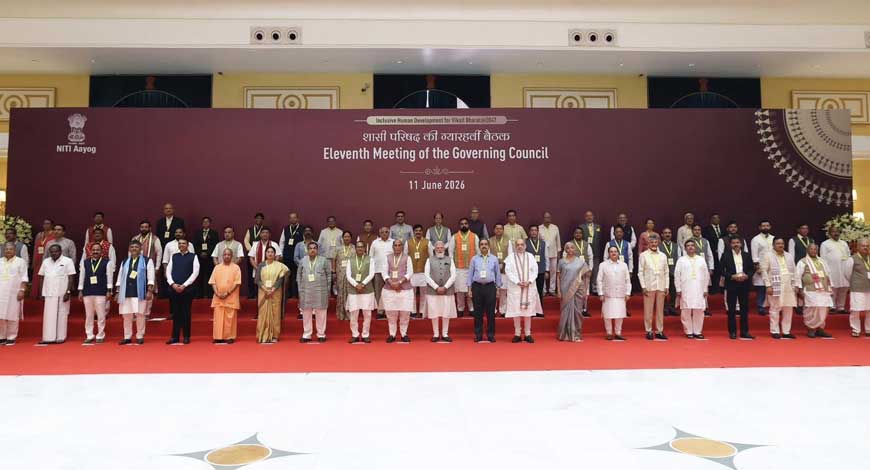
The 11th meeting of the NITI Aayog Governing Council, chaired by Prime Minister Narendra Modi, placed human development at its thematic core, and the interventions from state chief ministers reflected a wide spectrum of health and demographic concerns, from India’s emerging fertility crisis in the south to the chronic underfunding of rural health infrastructure and the economic deprivation that underpins poor health outcomes in tribal and border regions.

The meeting was attended by chief ministers, lieutenant governors and administrators of all 28 states and five Union Territories, the first time all state CMs participated in the council’s session, the government noted.
Andhra Pradesh Chief Minister N Chandrababu Naidu opened perhaps the most medically consequential discussion of the day, raising the alarm over declining fertility rates in his state and across southern India. Naidu, who has been vocal on this issue for the past two years, outlined his government’s population management policy as a framework to address what he described as future workforce shortages, ageing-related challenges and long-term economic sustainability. The concerns he raised echo a broader demographic reality that public health experts have flagged: several southern states are now below the replacement fertility rate of 2.1, setting in motion an ageing population curve that will place significant pressure on healthcare systems, pension frameworks and social support structures in the coming decades.
The issue of population ageing is no longer a distant projection, it has direct and near-term implications for healthcare infrastructure planning, the demand for geriatric care services, the burden of non-communicable diseases, and the capacity of state health systems to cope. Naidu’s framing of it as a national policy priority, at the highest forum of federal governance, is a signal that demographic health is moving up the political agenda.
Karnataka Chief Minister D K Shivakumar made a targeted push for health and education infrastructure, proposing a one-time central grant to upgrade government schools and colleges to bring their facilities on par with the private sector. More significantly for the health sector, he urged the Ministry of Corporate Affairs to strictly enforce corporate social responsibility rules to ensure that corporate funds are channelled towards upgrading rural health and education infrastructure within defined timeframes. The proposal, if acted upon, could unlock a meaningful stream of private capital for primary health centres, district hospitals and rural clinics, facilities that have historically been underfunded relative to the disease burden they carry.
Shivakumar’s intervention also pointed to the structural health pressure that rapid urbanisation creates. With 40 per cent of Bengaluru’s population comprising migrants from other states, the city’s public health infrastructure, designed for a far smaller and slower-growing population, is under sustained stress. He argued that the Centre must treat urban infrastructure investment, including health facilities, as a shared federal responsibility rather than a state burden alone.
Chhattisgarh Chief Minister Vishnu Deo Sai presented a roadmap for the Bastar region that carried significant public health undertones. He noted that around 85 per cent of families in Bastar currently earn less than Rs 15,000 per month, and set a target of raising monthly household income to Rs 30,000 over the next three years. The link between income poverty and health outcomes is well established, low-income households face greater barriers to accessing healthcare, higher rates of malnutrition, and lower immunisation coverage. Sai also proposed expanding irrigation facilities and ushering in a dairy revolution, both of which carry nutritional and food-security implications for tribal communities that have historically recorded high rates of anaemia, stunting and wasting.
Punjab Chief Minister Bhagwant Singh Mann highlighted the developmental gaps in his state’s border areas, noting that more than 2,000 villages and towns in proximity to the border remain inadequately covered by the Vibrant Village-II Programme, with only 107 villages included so far. For the health sector, the significance of this gap is direct: border villages in Punjab have limited access to secondary and tertiary healthcare, and the shortage of healthcare workers willing to serve in remote areas compounds the problem. Mann sought a special financial package for border area revitalisation, an ask that implicitly includes health infrastructure.
Himachal Pradesh CM Sukhvinder Singh Sukhu called for a high-level committee to assess his state’s financial losses, citing the discontinuation of the Revenue Deficit Grant, natural disaster damages and revenue shortfalls from the GST regime. Himalayan states like Himachal Pradesh face a distinctive health geography, difficult terrain, dispersed populations, seasonal road closures and higher per-unit costs of health service delivery, that makes central fiscal support particularly critical for maintaining a functioning public health network.
Goa CM Pramod Sawant’s appeal for equity in the application of centrally sponsored schemes has a health dimension as well. He noted that over 60 per cent of Goa’s land falls under ecological protection zones, constraining the state’s fiscal base and limiting its capacity to co-fund central health programmes without a more favourable cost-sharing arrangement.
Across these interventions, a common thread emerged: the health and demographic challenges that states are grappling with are too large, too structural and too interlinked with fiscal capacity for any state to address alone. Whether the concern is the epidemiological shift driven by an ageing southern population, the primary healthcare deficit in tribal and border areas, the urban health infrastructure gap in cities like Bengaluru, or the nutritional vulnerabilities of low-income rural households, each demands a coordinated and adequately funded central response. The 11th Governing Council meeting surfaced these concerns clearly. The test will lie in how the Union government translates them into budget allocations and policy commitments.
MB Bureau