Patient Monitoring Equipment
Monitoring becomes medicine
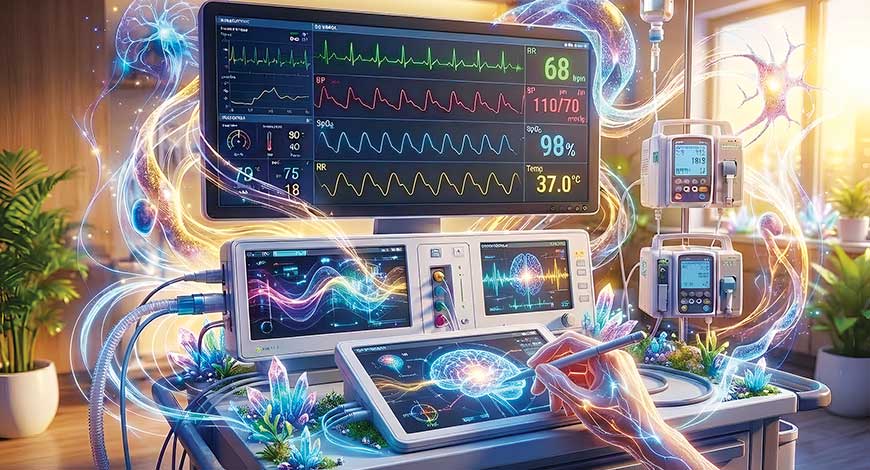
From bedside devices to intelligent networks–monitoring now powers continuous, predictive care everywhere.

For decades, patient monitoring stayed chained to the bedside–hard-wired, immobile, and largely confined to ICUs. Vital signs were transmitted via cables to bulky screens, giving clinicians intermittent snapshots rather than a continuous narrative. Patients were tethered to machines; data rarely followed them beyond the room. That model is now breaking apart. Advances in miniaturised sensors, wireless connectivity, and cloud computing are detaching monitoring from fixed equipment and placing it directly on, around, and even behind the patient–redefining how and where physiology is captured.
Wearables, patches, smart garments, implantables, and ambient sensors are making continuous health monitoring clinically viable. With advances in accuracy, battery life, interoperability, and regulation, the line between consumer and clinical devices is fading. As monitoring extends across hospitals, homes, and daily life, continuous care now defines an ongoing connection between body data and clinical decisions.
The market wakes up
Patient monitoring has shifted from peripheral spend to strategic infrastructure. What used to be a set of departmental gadgets is becoming a health system’s nervous system.
Hospitals are shifting from one-to-one monitor replacements to integrated architectures connecting devices, central stations, EHRs, and analytics platforms. Ward telemetry, step-down monitoring, and home-based remote tools now operate within unified systems. The value lies not in individual devices but in how data flows, aggregates, and drives action. Monitoring has evolved from passive recording to active, outcome-driven care.
AI enters the monitor
Monitoring has long been descriptive–devices measured, humans interpreted. AI now embeds interpretation into the stack. Beyond displaying heart rate or blood pressure, monitors calculate risk scores, detect pattern shifts, and project trajectories. Early-warning algorithms spot subtle vital-sign drifts-slight tachycardia, rising respiratory rate, marginal hypotension-hours before visible decline, prompting timely intervention. By learning individual baselines and prioritising clinically meaningful changes, intelligent systems cut false alarms and fatigue. Monitors are evolving from attention-demanding displays to collaborative tools that filter noise and surface what matters. Adaptive thresholds and context-aware alerts make monitoring more personalised, less intrusive, and safe to extend beyond high-acuity care.
Remote, yet clinical
Remote patient monitoring (RPM) has dissolved the idea that hospital-grade observation must occur within hospital walls. Globally, RPM systems are being used to support post-discharge recovery, chronic-disease management, ICU step-down care, and elderly monitoring, with growing evidence of reduced readmissions and improved adherence. In India and other large countries, RPM is recognised as a key lever for extending care into rural and underserved areas.
What began as a post-discharge safety net is becoming a core care modality. Step-down patients are discharged earlier but continue to stream vital signs and symptom data to virtual command centres. People with heart failure, COPD, diabetes, or hypertension move from episodic, visit-based care to ongoing oversight driven by home blood-pressure cuffs, weight scales, glucometers, pulse oximeters, and multi-sensor wearables.
In these hybrid models, the intensity of monitoring tapers as patients recover, but visibility rarely drops to zero. Virtual rounds integrate live physiological data with teleconsultations and algorithm-generated risk flags. Nurses and physicians work from virtual wards, managing cohorts across geographies, intervening when thresholds are breached, and adjusting therapies in near real time. The challenge now is orchestration: integrating multiple devices, normalising data formats, embedding insights into clinical systems, and staffing teams who can manage population-level dashboards.
Platforms, not products
The future of patient monitoring is platform-driven. Hospitals and health systems want ecosystems in which bedside monitors, wearables, apps, infusion pumps, ventilators, and laboratory systems all contribute data to shared repositories, governed by consistent identity, security, and interoperability standards.
This platform orientation changes procurement criteria. Accuracy and reliability remain non-negotiable, but buyers now assess how well systems integrate with records, support open APIs, comply with security and privacy frameworks, and scale across sites. They look for vendor roadmaps that include analytics, decision support, and remote-care capabilities rather than isolated smart features. Well-implemented platforms underpin command centres that track patient acuity, bed status, alarms, and staffing in real time, turning monitors into nodes of a distributed decision network.
India–Scale, affordability, and leapfrogging
India provides a vivid illustration of the new role of monitoring. Historically, continuous multi-parameter monitoring was largely an ICU and OT privilege. General wards and smaller facilities relied on intermittent manual vital-sign rounds. That is changing. Tier-I and Tier-II city hospitals are upgrading to networked multi-parameter monitors and central stations; multi-parameter systems accounted for more than a quarter of India’s monitoring revenues in 2022 and remain the largest segment. At the same time, more affordable, rugged devices from domestic and international vendors are targeting high-volume wards and emergency rooms.
Remote monitoring is emerging quickly. In systems with large rural populations, staff shortages, and uneven hospital distribution, this is less a luxury than a necessity. The strategic question for India is how to turn scattered deployments into a coherent monitoring infrastructure by investing not only in devices but also in connectivity, standards, cybersecurity, training, and workflow redesign. Done well, India can leapfrog to connected, platform-centric models, avoiding some of the legacy fragmentation seen elsewhere.
Inside the smart ICU–and beyond
The ICU remains the frontline of monitoring innovation. High-fidelity waveforms, cardiac output estimates, respiratory mechanics, and multimodal neuromonitoring generate dense data now used not just for bedside care but to train predictive models. Smart ICU projects show that AI-based risk scores derived from ICU data enhance triage and rapid-response systems on general wards using basic vital signs. Cable-lite monitors, wearable ECG patches, and wireless telemetry are erasing the boundary between monitored and unmonitored beds. Progressive units now achieve near-ICU visibility with less encumbrance, supporting early mobilisation and better patient experience. As these tools evolve, care levels will be defined more by data and staff intensity than by location.
Connected care as baseline
Monitoring is becoming core infrastructure-always on, often invisible, and integral to care delivery. Spot checks are giving way to continuous data streams and predictive insights. Hospitals extend care beyond their walls by connecting patients through safe, interpretable networks. For organisations that adapt, monitoring becomes medicine–a proactive, intelligent layer that prevents crises rather than merely recording them. Those that don’t will see the gap in outcomes, efficiency, and trust.