OR Equipment
When the OR started thinking – The new intelligence of tables and lights
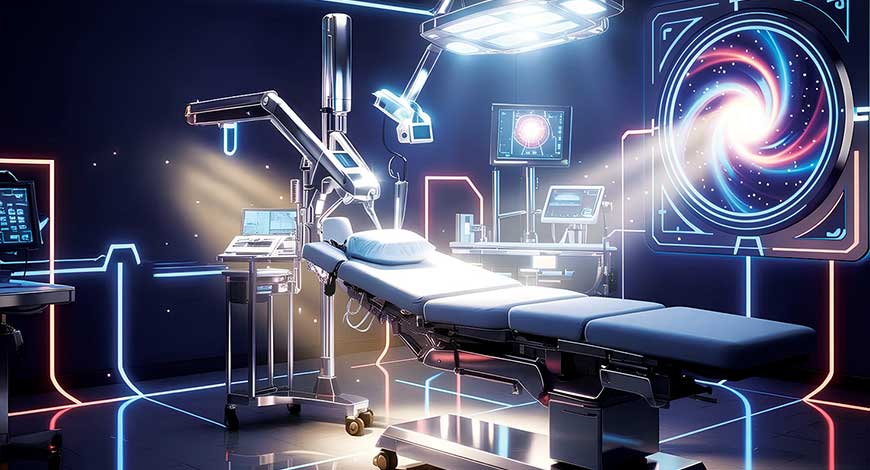
Intelligent OT tables and lights quietly become the operating room’s real infrastructure strategy engine.

For decades, operating tables and surgical lights sat quietly at the margins of decision-making–specified late, bought cheap, and expected to perform indefinitely. Seen as inert steel and LEDs, they were functional but never strategic. That era is definitely over.
From support hardware to surgical intelligence
Surgery has multiplied in complexity. Procedures now run longer, integrate real-time imaging, and blend robotics with navigation and analytics. In such environments, drift, glare, and instability are no longer tolerable imperfections–they’re operational risks.
Modern operating tables and lighting systems are being redefined as intelligent instruments, engineered for precision, ergonomics, and data-driven performance. Multi-axis tables anchor robotic arms with micron-level stability. LED lights emulate daylight fidelity flatter both human vision and 4K endoscopic cameras. Every component–from torque-controlled lifts to sterile gesture sensors–serves surgical performance, not mere illumination or support.
The talking operating room
Artificial intelligence has entered the OR, changing even its most familiar hardware. Smart surgical lighting systems can now auto-correct for hand and instrument shadows, adjusting brightness and color balance in milliseconds. Researchers tracking EEG and NASA-TLX data note measurable drops in surgeon cognitive load–less mental strain, fewer errors, faster decision-making.
Meanwhile, tables equipped with precision sensors continuously record position, tilt, load, and stability. That information feeds predictive maintenance dashboards and workflow analytics, ensuring uptime above 99 percent and virtually eliminating mid-surgery mechanical failures. The data architecture that once surrounded high-end imaging now permeates every element of the theatre.
Every function becomes measurable. Utilization tracking prevents bottlenecks. Load analytics guides safe weight distribution. Predictive service alerts arrive before breakdowns. Hospitals no longer use their OT equipment–they manage it as living infrastructure that delivers consistency, productivity, and safety.
Integration defines capability
The new operating room doesn’t host technology; it synchronizes it. Tables now communicate with imaging systems, navigation consoles, and robotic platforms. Automatic locking sequences align patient positions with fluoroscopy or CT guidance. Lighting grids integrate with 3D visualization, creating shadows or brightness profiles optimized for the operative field.. In the intelligent OR, the value of a table or light is defined not by its chassis, but by its firmware.
Built for robots, tuned for imaging
India’s robotics boom has permanently altered hospitals’ expectations for OT infrastructure. This shift redefines hardware requirements. Tables must deliver radiolucency compatible with high-end imaging, unwavering stability under multi-ton robotic arms, and programmability for hybrid procedures lasting 6 to 8 hours. Electromechanical systems increasingly pair with AI controllers that maintain alignment across micro-adjustments during surgery.
Lighting follows suit. With robotic arms moving through precise trajectories, traditional ceiling mounts can obstruct surgery. Modern lights are modular, track robot motion automatically, and adjust spectral output so that image-guided systems perceive tissue exactly as the surgeon sees it. Real-time synchronization with 5G-enabled telesurgery platforms is no longer aspirational–it’s an emerging specification.
The mandate is unambiguous: equipment that cannot plug into robotics, imaging, and analytics ecosystems is no longer future-proof–it’s a risk.
Designed around the surgeon
Ergonomics has shifted from comfort factor to clinical necessity. Next-generation tables with multi-axis articulation, memory presets, and motorized height profiles protect neutral posture, while adaptive lights with shadow correction and tunable color maintain visual comfort and reliability. Invisible safety features–voice commands, touchless controls, antimicrobial surfaces–cut contamination risk, reduce fatigue, and sharpen accuracy.
Light as clinical intelligence
Lighting is no longer about brightness–it’s about interpretation. High-CRI LEDs (color rendering index ≥95) reproduce true tissue shades, helping surgeons discriminate between vascular and connective structures with confidence. Adaptive spectral tuning supports specialty surgery–cooler hues for neurosurgery contrast, warmer tones for cosmetic and reconstructive fields.
As visualization technology migrates to 4K/8K imaging and augmented reality, lighting fidelity becomes digital infrastructure. Illumination must align seamlessly with imaging sensors, ensuring what appears on-screen mirrors what exists in situ. Intelligent lights now embed cameras for automatic video capture, remote consultation, and clear archiving of procedural data.
Sustainability requirements further reshape procurement. LED arrays lasting 60,000+ hours reduce both lifecycle cost and thermal load, easing HVAC strain and cutting energy bills. Efficient lighting design recovers investment through predictable uptime and reduced service interventions–performance and sustainability finally converge.
India’s pivot–Value-driven modernization
In India, operating infrastructure now sits between rising surgical volumes and tight budgets, pushing procurement from lowest price to total cost of ownership. High-volume hospitals demand uptime, upgradeability, strong local service, and modular tables and lights that plug into robots, imaging, and analytics. Policy reforms and PLI-backed manufacturing are boosting local, mid- to high-end OT systems with reliable lifecycle support and digital maintenance integration. With sustainability clauses demanding efficient, low-carbon, recyclable fixtures, lifecycle value–not capital cost–now shapes OR design and purchasing.
Price collapses, value triumphs
Cheap equipment dies young, and hospitals now know downtime costs dwarf any discount. The best OTs run on integration, not improvisation, with modular, upgrade-ready systems stretching every rupee across years of tech change. Software-led OR platforms turn every case into data, driving shorter turnovers, higher throughput, and clear returns, so only tables and lights that prove ROI will stay on tender lists.
The intelligent OR, 2027–2035
By 2030, the line between table, light, and digital interface will blur. AI-guided illumination will track the operative field, tables will self-calibrate to imaging and robots, and digital twins will trial workflows before incision. OTs will be judged by adaptability and uptime, functioning as ecosystems that sense, adapt, and optimize. In this era of responsive surgery, OT tables and lights will define how surgery flows, how safely it runs, and how reliably excellence is delivered.