OR Equipment
Connected precision – The new face of surgery
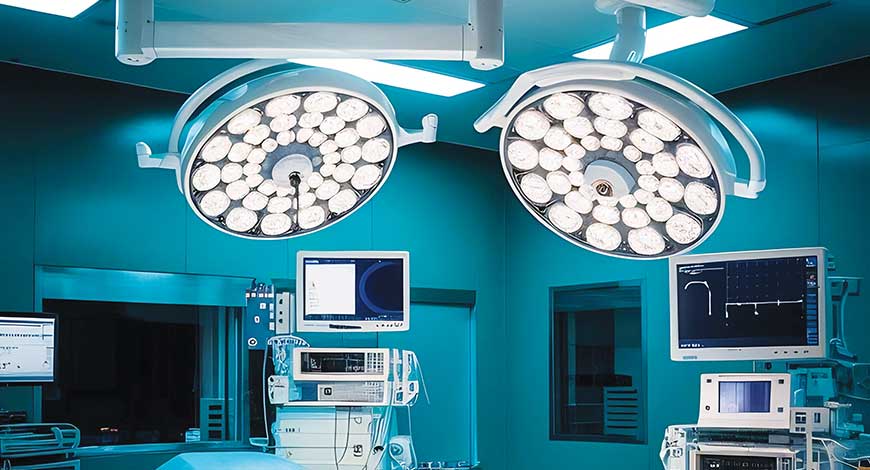
Operating tables and lights now function as intelligent, integrated partners–advancing surgical precision, connectivity, and performance in the modern operating room.

Far from a static space defined solely by surgical instruments and sterile protocols, today’s operating room has evolved into a dynamic, intelligent ecosystem–where precision engineering and digital connectivity converge to shape the future of surgery. As the boundaries of medicine expand toward unmatched accuracy and efficiency, every aspect of the OR–from architectural design to the smart integration of advanced technologies–plays a pivotal role in supporting superior clinical performance and safeguarding patient well-being.
Once regarded as passive fixtures, OT tables and OT lights are now at the forefront of this transformation. Equipped with precision positioning, adaptive illumination, and sophisticated connectivity, these systems have evolved into proactive enablers–responding in real time to surgical demands, enhancing visibility, minimizing fatigue, and synchronizing seamlessly with imaging, navigation, and robotic platforms. Together, they form the backbone of the smart surgical environment, elevating both workflow and results.
This evolution is propelled by a broader movement toward OR optimization, where data integration, automation, and ergonomic innovation are fundamentally reshaping surgical workflows, team communication, and patient outcomes. Emerging research underscores how features of the OR environment–lighting quality, spatial planning, acoustics, and equipment access–directly impact not just surgical accuracy but also team coordination and patient recovery trajectories.
Hospitals worldwide are now investing in hyper-connected, intelligent surgical suites, shifting the paradigm from basic functionality to adaptive, anticipatory environments designed to meet the nuanced needs of clinicians. In this new era of integration, the operating room becomes a living system: intuitive, data-driven, and purposefully centered on advancing both surgical precision and the well-being of the care team and patient alike.
THE OT TABLES MARKET
The operating table has evolved from a simple support surface into a precision-engineered system that underpins surgical accuracy, efficiency, and patient safety. Today’s models combine mechanical strength with advanced technology, incorporating radiolucent materials such as carbon fiber to deliver unobstructed imaging without the need for patient repositioning–streamlining workflow and reducing procedure times. Motorized controls offer millimeter-level adjustments, allowing surgeons to achieve precise positioning for complex and robot-assisted procedures.
Modern tables also emphasize ergonomics and adaptability. Features such as adjustable height, modular and detachable sections, and customizable presets allow rapid configuration across specialties ranging from orthopedics to cardiovascular surgery. Safety-focused innovations–including pressure-redistribution surfaces, stability locks, and integrated monitoring sensors–further enhance patient comfort and procedural security during long operations. Their ability to interface seamlessly with surgical robots and imaging systems enables synchronized, efficient teamwork throughout the procedure.
The contemporary operating table has thus matured into an active surgical partner–an intelligent, connected platform that merges structural precision with digital capability. This transformation mirrors the broader trajectory of surgical innovation, shifting from static mechanical tools to responsive, data-driven systems that empower surgical teams with higher precision, consistency, and confidence–defining the next era of safer, smarter operating environments.
Indian market dynamics
The Indian market for OT tables in 2025 is estimated at ₹340 crore in value and approximately 5,150 units in volume. Market dynamics were influenced by significant trends in hospital infrastructure development, evolving procurement strategies, and technological advancements. Indian manufacturers dominated unit sales and widespread adoption, whereas imported brands maintained a strong foothold in the high-end, technologically advanced segments.
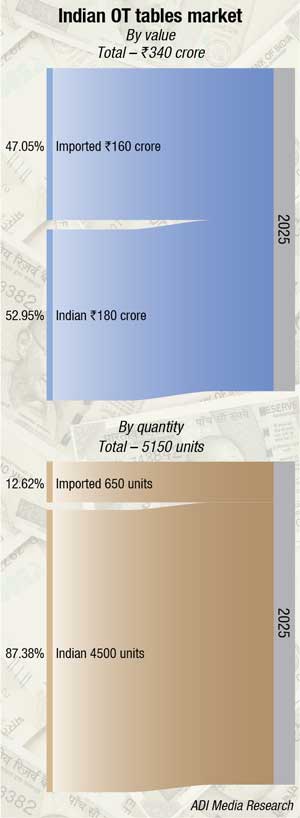
Indian brands, by units, accounted for 87 percent of operating tables purchased in 2025, supplying models tailored for general surgery, specialized procedures, and government hospital standards. Their predominant market share was reinforced by competitive pricing, robust service networks, and adaptability to diverse clinical environments across public and private healthcare facilities. These tables typically offer manual, hydraulic, electric, and motorized adjustment options, with growing compatibility for C-arm imaging, enabling hospitals to address a broad spectrum of surgical requirements.
|
Leading players – OT tables market* |
|
| Imported-Tier I | BenQ and Getinge |
| Imported-Others | Brandon, Steris, Trumpf, Mizuho, Baxter-Hillrom, Schmitz, and Mindray (sold as a package) |
| Indigenous-Tier I | Palakkad, Staan, Galaxy, Cognate, and Magnatek |
| Indigenous-Others | Technomed, Meditek, Surgident, Midmark, and other regional players |
|
*Vendors are placed in different tiers on the basis of their sales contribution to the overall revenues of the Indian OT tables market. ADI Media Research |
|
Imported operating tables accounted for 13 percent of units sold but represented 47 percent of total market value in 2025, reflecting their role in advanced surgical applications such as robotics-enabled and complex specialties. These high-value models offer sophisticated programmability, precision controls, remote operation, and modular designs, which are sought after by super-specialty hospitals, large private chains, and tertiary care centers undergoing modernization or seeking international accreditation. Their higher investment is justified by their capabilities and outcomes in settings where advanced features directly support quality benchmarks and complex clinical requirements.
Evolution of operating tables – Advancing surgical precision
 Vikas Khanna
South Asia Head/Director
Brandon Medical
Modern operating tables have transformed from static platforms into advanced, technology-driven systems that enhance surgical precision, safety, and efficiency. Designed to meet the diverse needs of surgical specialties–from orthopaedics to gynaecology–they now integrate seamlessly with imaging, robotics, and digital systems, becoming a central component of the surgical ecosystem and a cornerstone of patient-centred care.
Role across specialties
Operating tables must combine stability, versatility, and adaptability. Orthopaedic tables handle high loads and integrate with traction and imaging systems for fracture or joint procedures. Cardiovascular and hybrid theatres prioritise radiolucent, carbon-fibre tops that enable unobstructed x-ray or fluoroscopy imaging. Neurosurgical tables require ultra-precise adjustments and head-fixation devices for microscopic work, whereas general surgery demands modularity and wide positioning options, including Trendelenburg and bariatric capabilities. Urology and gynaecology tables emphasise pelvic access, rapid lithotomy positioning, and patient comfort through ergonomic padding and adjustable supports.
Emerging innovations
Future-ready tables integrate with hybrid operating rooms, robotic systems, and imaging platforms. Carbon-fibre materials and single-column designs optimise radiolucency and 360° C-arm access. Robotic-compatible tables feature synchronised motion to maintain instrument alignment during repositioning. Advanced safety systems include auto-lock mechanisms, overload sensors, smooth actuator motion, and memory-foam padding to prevent injuries.
Modular systems now allow a single table base to support multiple specialties, reducing costs and manual handling. Ergonomic enhancements, including touchscreen or foot-controlled presets, height flexibility, and surgeon-specific memory settings, minimize fatigue and streamline workflows. Infection-control-focused designs feature seamless, antimicrobial, and detachable surfaces, which accelerate turnaround times between cases and maintain strict hygiene standards.
Outlook
AI-driven and sustainable innovations will define the next generation. Smart tables may analyse patient data to recommend optimal positioning, auto-adjust during surgery, and log data for traceability. Eco-friendly materials, efficient power use, and modular upgrades will support hospitals’ carbon-neutral goals. Integration with digital health ecosystems can enable connectivity to surgical robots, imaging systems, and electronic health records, while AR overlays enhance precision and facilitate real-time decision-making.
As surgery transitions toward minimally invasive and outpatient care, operating tables will continue to evolve into intelligent, connected platforms–vital to precision, safety, sustainability, and the seamless integration of surgical technology in the modern operating room.
Global scenario
The global market for operating theatre tables continues to expand in line with the modernization of surgical environments worldwide. Valued at approximately USD 1,228.9 million in 2025 by Persistence Research, the market is expected to reach around USD 1,540.4 million by 2032, reflecting a compound annual growth rate of about 3.3 percent. North America maintains the largest share, supported by advanced healthcare infrastructure and regular investment in surgical facility upgrades.
Demand for more sophisticated and specialized operating tables, tailored to the needs of various disciplines such as cardiovascular and gynecology surgery, is rising as surgical procedures become increasingly complex. In developing regions, rapid hospital expansion–driven by government and private investment–accelerates new installations, while the aging fleet of manual tables prompts a faster replacement cycle, especially across Asia Pacific and Latin America. Hospitals are progressively installing motorized and hybrid models with enhanced ergonomics, automated controls, and integrated digital capability, aligning with the broader industry focus on efficiency, precision, and patient safety in surgical care.
Redefining surgical precision
In leading healthcare engineering, precision is a guiding principle shaping the development of advanced surgical and medical tables. Manufacturers utilize high-strength stainless steel for core structural components due to its durability, corrosion resistance, and hygienic properties, while incorporating advanced carbon fiber composites into tabletops to ensure radiolucency, optimal imaging clarity, and lightweight strength. These materials create stable, deformation-resistant platforms that support both surgical accuracy and imaging requirements at a millimeter scale.
Sophisticated motion control systems, utilizing hydraulic or electro-hydraulic technology with medical-grade, aerospace-quality seals, enable smooth and sterile table adjustments. Intelligent algorithms incorporated into these systems enable the memorization and instant recall of specific surgical setups, thereby improving operational efficiency and safety.
Operational flexibility is enhanced further through modular designs. Interchangeable tabletop sections, integrated traction or extension systems, and adaptable mounting interfaces permit rapid reconfiguration to suit a variety of surgical specialties, thereby maximizing asset utilization and reducing space constraints. Each critical actuator, joint, and interface on these tables is subjected to rigorous stress testing, routinely exceeding prescribed regulatory standards to guarantee longevity and reliability in demanding surgical environments.
Contemporary table engineering, therefore, extends beyond precision mechanics. It integrates foresight in flexible design, digital intelligence, and sustainability, creating platforms that both surgeons and hospital administrators can depend on–fostering smarter, safer, and more efficient clinical care for the future.
AI-driven interfaces for surgical excellence
Smart operating tables have undergone a significant transformation, evolving from static support platforms to intelligent surgical interfaces that integrate mechanical engineering, digital connectivity, and artificial intelligence. Their seamless interoperability with imaging, navigation, and robotic systems allows for synchronized patient positioning, which eliminates the need for manual reconfiguration and ensures real-time responsiveness within data-driven operating rooms.
AI-assisted control systems offer sub-millimeter precision, predicting and autonomously adapting to the surgeon’s needs with minimal manual input. This alignment between patient anatomy, preoperative plans, and real-time imaging delivers improved ergonomics and highly consistent surgical results. In addition, these advanced tables continuously collect and analyze motion data, which optimizes patient positioning protocols, minimizes setup times, and facilitates continuous workflow improvements through predictive maintenance and remote diagnostics.
Beyond precision and integration, smart tables are designed to boost operational resilience. They feature remote diagnostics and proactive servicing that minimize equipment downtime. Intuitive touch interfaces, embedded safety sensors, and carefully engineered ergonomic designs ensure a human-centric approach that safeguards both patients and surgical teams. As hospitals advance their digital ecosystems, smart operating tables are emerging as foundational assets–enabling surgical care that is more connected, predictive, precise, and personalized than ever.
Integrating people and technology
Modern operating tables prioritize the needs of surgeons, nurses, and patients by merging ergonomic design principles with modular versatility. Adjustable height, tilt flexibility, smooth motorized movements, and programmable presets are key features that reduce physical strain on surgical teams while enabling precise patient positioning without interrupting procedures. This focus on ergonomics enhances comfort and ensures consistent alignment during lengthy surgeries, which improves workflow efficiency and minimizes fatigue.
The modularity of these tables supports exceptional adaptability, with configurable sections and interchangeable attachments designed for various specialties, including orthopedics, cardiovascular surgery, and minimally invasive procedures. This flexibility maximizes operating room utilization and simplifies setup, aiding faster transitions between cases. Their design for seamless integration with imaging systems, robotics, and digital controls further supports connected, efficient surgical workflows.
By emphasizing ergonomics and adaptability, modern operating tables create environments that align with clinical team needs, promote better posture, reduce repetitive strain, and enhance focus even during complex procedures. This human-centered design philosophy understands that precision and comfort are interlinked, thereby enabling surgical teams to achieve superior outcomes through the harmonious integration of people and technology.
Engineered for infection prevention
Modern operating theatres prioritize infection control through the deliberate use of non-porous, antimicrobial, and chemical-resistant surfaces, which enable superior hygiene and reduce contamination risks. Seamless designs–with rounded corners, flush fixtures, and specialized flooring–eliminate crevices and moisture ingress, making cleaning between procedures more efficient and supporting a consistently sterile environment.
Integrated architectural features such as modular walls, sealed lighting, flush power outlets, and air filtration systems complement these material choices, helping sustain positive air pressure and minimize cross-contamination. By streamlining cleaning processes and increasing turnover speed, these innovations directly improve patient safety and operational efficiency in the surgical suite without sacrificing function or design.
Ultimately, thoughtful surface design and intelligent material selection are central to infection prevention strategies, supporting clinicians and staff in maintaining the highest safety standards while building operating rooms that are inherently safer and more effective.
THE OT LIGHTS MARKET
The Indian market for OT lights was valued at approximately ₹300 crore in 2025, mirroring trends seen in the operating tables segment. Domestic brands, by units, supplied 83 percent of total units, primarily offering halogen and entry-level LED lights designed for broad deployment in hospitals of all sizes. This widespread adoption was driven by the systems’ suitability for varied clinical environments, cost efficiency, and reliable availability across both public and private sectors.
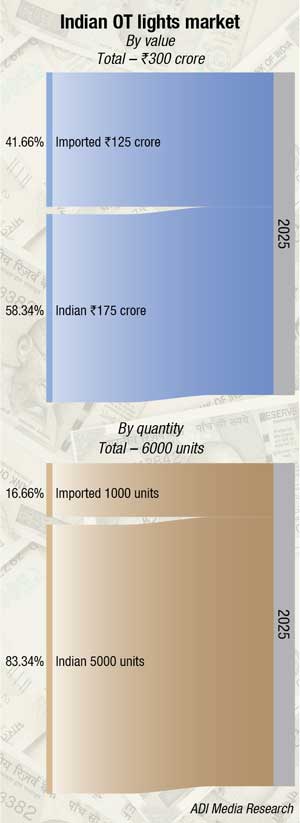
Domestic OT lights are preferred for their cost-efficiency, reliable construction, and ease of local service and spare part access, resulting in quicker maintenance and minimal downtime in high-volume hospitals. In contrast, imported OT lights accounted for 17 percent of total unit sales but contributed 42 percent of the overall market value, driven by advanced features such as high-CRI LED illumination, hybrid lighting modes, shadow reduction, digital control systems, and wireless adjustment capabilities. These premium models are especially sought by modern tertiary care centers and operating rooms with specialized focus–such as cardiac, neuro, and minimally invasive surgery–where illumination quality is critical for surgical accuracy and outcomes.
|
Leading players – OT lights market* |
|
| Imported-Tier I | Getinge, Vivid, Draeger, and Mindray |
| Imported-Others | Brandon, Dr Mach, Steris, and KLS Martin |
| Indigenous-Tier I | Matrix, Cognate, Staan, Magnatek, Confident Dental, Technomed, Galaxy, Psi (Palakkad), Hospedia, and Shalya |
| Indigenous-Others | Many small unorganized manufacturers mainly in Delhi, Bhiwani, and southern Indian states |
|
*Vendors are placed in different tiers on the basis of their sales contribution to the overall revenues of the Indian OT lights market. ADI Media Research |
|
Rapid expansion in both OT table and light segments has been fuelled by increased hospital construction, the growth of corporate medical networks, and robust government funding for health infrastructure and surgical capacity. Competitive pricing, accessible financing options, and prompt delivery from Indian manufacturers have enabled small and mid-sized hospitals to acquire and maintain this equipment on a regular basis. Meanwhile, as India’s largest hospitals pursue global accreditation and invest in robotic or image-guided surgery, demand for imported OT equipment with programmable memory, advanced features, and seamless integration with surgical imaging and data platforms has continued to climb.
Procurement patterns in 2025 reveal a distinct division: Indian-made OT tables and lights are the mainstay for hospital construction projects, government contracts, and private hospital expansions, with a focus on both routine and specialty care. Imported brands, although representing a smaller share of installations, capture a substantial portion of high-value placements in facilities prioritizing advanced technology and performance outcomes–where long-term benefits justify the premium price. With the ongoing modernization of Indian hospitals, the premium segment for imported OT tables and lights is projected to continue expanding; however, it will grow from a smaller base, as domestically manufactured equipment remains dominant in overall supply.
Global market dynamics
In parallel, the global OT lights market is on a strong upward trajectory, driven by technological advancement and rising surgical volumes.
The global surgical lighting market valued at USD 964.1 million in 2025 by Persistence Market Research is anticipated to reach USD 1,309.1 million by 2032, growing at a CAGR of 5.2 percent. This expansion is primarily driven by increasing volumes of surgical procedures, propelled by aging populations and a rise in chronic diseases. Advanced LED lighting systems are supplanting older halogen models, as LEDs deliver better illumination, superior shadow management, lower heat generation, and improved energy efficiency.
Emerging economies show strong uptake, supported by hospital infrastructure development and investments in healthcare modernization. Challenges remain due to high initial costs and complex regulations, especially for smaller or rural facilities, but the spread of ambulatory surgical centers and the ongoing evolution of energy-efficient lighting are creating new growth opportunities. Asia Pacific leads global growth projections, owing to large-scale healthcare expansion, medical tourism, and swift adoption of smart and LED lighting technologies.
Collectively, these trends position OT lights as pivotal elements in the future of sustainable, intelligent, and high-performance operating environments worldwide, driving improvements in both surgical safety and operational efficiency.
From halogen to advanced LEDs
Modern operating theatre lighting has progressed from heat-generating halogen lamps to advanced LED systems designed to enhance both surgical precision and safety. LED lights provide consistent, intense, and shadow-free illumination without the added heat, creating a cooler and more comfortable environment for both surgical teams and patients. Adjustable brightness and tunable colour temperatures ensure lighting can be tailored to specific procedures, supporting clear visibility throughout the surgical process.
A defining characteristic of today’s OT lighting is its superior colour rendering accuracy, which empowers surgeons to distinguish subtle distinctions in tissue and anatomy, helping reduce fatigue and improving intraoperative decision-making. Advanced optics, like multi-lens arrays and shadow-elimination technology, maintain uniform lighting across the surgical field regardless of movement, which is essential for maintaining surgical precision.
LED lighting significantly outperforms traditional systems in both energy efficiency and sustainability, often reducing power consumption by up to 75 percent and delivering longer service life with minimal heat output. These benefits translate into operational cost savings, a safer environment, and reduced distractions during surgery. Modern surgical lights have evolved beyond simple illumination–they now serve as adaptable, intelligent enablers of workflow optimization and superior outcomes in today’s connected operating rooms.
Smart illumination
Modern operating theatre lighting systems have rapidly evolved into intelligent, adaptive technologies that offer far more than basic illumination. Integrated with smart sensors and automated controls, these systems dynamically adjust intensity and focus in real time to maintain optimal visibility throughout surgery, minimizing shadows and delivering consistent brightness across the entire field. This hands-free automation ensures that surgeons always have a clear, unobstructed view, regardless of movements within the operating theatre.
LED-based arrays underpin the energy efficiency of these systems, producing bright, cool illumination with minimal power consumption and heat generation. This not only protects both patients and staff from discomfort but also promotes a safer and more efficient clinical environment. Advanced features–such as automatic focus and colour temperature adjustment–allow precise customization to the specifics of each procedure, enhancing tissue differentiation, limiting eye strain, and providing superior operative control even during the most complex or prolonged surgeries.
Seamless digital connectivity further elevates the value of modern OT lights, enabling integration with imaging and video systems and the ability to control lighting via touchless panels or voice commands. This preserves sterility, supports workflow efficiency, and gives surgical teams greater precision without disrupting the procedure. Collectively, intelligent lighting solutions set a higher standard for the contemporary operating room, acting as active surgical partners that sharpen visualization, minimize fatigue, and drive better clinical outcomes in connected, data-driven care environments.
Shadow-free precision
In modern operating rooms, lighting has evolved to prioritize not just brightness, but precision, comfort, and complete control over the surgical field. High-quality, shadow-free illumination is essential for surgical accuracy, providing uniform, glare-free lighting that allows each movement and tissue plane to be clearly seen–reducing eye strain and fatigue so surgeons can maintain optimal focus, even during lengthy or complex cases.
Today’s advanced lighting systems are engineered for seamless integration with operating tables, equipped to automatically adjust intensity and focus in concert with table tilts or rotations. This smart synchronization eliminates manual repositioning, streamlining workflows and ensuring a constantly stable, well-aligned visual field directly in line with the surgeon’s perspective.
The combination of steadfast table positioning and precision, shadowless light forms the backbone of a truly engineered surgical ecosystem. Surgeons operate with clarity mirroring natural daylight, maintaining perfect visibility from all angles and for every structure. This harmonious interplay of optimized technology and thoughtful ergonomics elevates surgical safety, supporting confident, precise decision-making in a continuously clear and well-illuminated environment.
Robotic lighting
In the era of robotic and AI-assisted surgery, operating theatre lighting has advanced into an intelligent, adaptive system that actively contributes to surgical precision and workflow. Modern smart lighting solutions integrate with robotic arms and surgical teams, dynamically adjusting brightness and direction to maintain consistent, shadow-free illumination across the operative field–eliminating the need for disruptive manual repositioning and supporting uninterrupted focus during critical procedures.
Equipped with sensors and motion synchronization, these lights automatically track and respond to the real-time movement of robotic instruments or surgeons, optimizing visibility and ergonomic comfort throughout the operation. This automation empowers surgical teams to concentrate fully on the procedure, while intelligent lighting ensures the operative field is always optimally illuminated–an essential element for complex, precision-guided interventions.
When seamlessly integrated with robotic and imaging platforms, these systems create a fully adaptive surgical environment that unites technological accuracy with human expertise. The result is a heightened standard for safety, efficiency, and excellence in the operating room, as advanced lighting ensures surgeons receive continuous visual support and precision for superior clinical outcomes.
CONNECTED ORs
Modern operating rooms have evolved into intelligent, interconnected environments where technology and teamwork converge. Operating tables, surgical lights, and medical devices communicate via IoT and synchronized automation, working together to create a safer, precision-driven surgical setting. For example, when a surgeon adjusts patient positioning, overhead lights automatically realign, maintaining optimal illumination through integrated sensors and real-time data exchange.
Automation streamlines workflows and minimizes distractions, allowing surgical teams to concentrate on the procedure. Voice and gesture controls enable hands-free adjustments of lights and tables, promoting sterility and precision without interrupting surgery–an advantage during critical moments. These smart interactions save time, enhance ergonomic comfort, and support clinical consistency in demanding, high-pressure environments.
Connected operating rooms also improve patient safety by synchronizing equipment to prevent issues like glare, collisions, or incorrect positioning, and by implementing automated safety limits. This integrated ecosystem anticipates team needs and responds in real time, quietly enhancing both efficiency and outcomes. Through IoT integration, hospitals now build ORs that think, respond, and evolve with each procedure, redefining standards in surgical performance and safety.
Sustainability is another emerging priority in modern OR design. Advanced LED lighting systems deliver high-quality illumination with drastically lower power consumption, less heat output, and extended lifespans–reducing replacements and electronic waste. Operating tables add efficiency through intelligent actuators, low-energy standby modes, and the use of modular, recyclable materials, supporting circular economy principles.
These innovations promote a responsible OR, balancing precision, performance, and eco-consciousness. With reduced energy costs and lower environmental impact, facilities achieve both financial and sustainability goals without sacrificing clinical effectiveness. By adopting durable, efficient, and recyclable solutions, hospitals are strengthening patient care standards while contributing to a sustainable future for healthcare.
Safety through real-time synchronization
The future operating room is becoming a sophisticated hub of intelligence, adaptability, and precision, with operating tables and surgical lights now functioning as fully integrated, responsive systems. These devices communicate with imaging systems, robotic arms, and navigation tools, enabling synchronized movement and optimized access for surgeons while lights dynamically adjust focus, brightness, and angle in real time, tracking the surgical field and robotic activity with high accuracy.
This seamless integration creates a connected surgical environment, where equipment operates in harmony to enhance precision and safety. For example, as a table tilts or repositions, overhead lights instantly auto-adjust to maintain optimal focus, while motion sensors eliminate shadows and maintain a consistently clear visual field. Such coordination streamlines workflow, boosts surgical capability, and builds greater confidence among clinicians.
The intelligent collaboration between tables and lighting marks a new era in surgical care. Rather than serving as static infrastructure, these systems act as intelligent clinical partners, augmenting surgical performance, supporting decision-making, and ensuring a more connected, precise, and user-focused operating room–where advanced technology consistently enhances rather than replaces human skill.