Ultrasound Equipment
Ultrasound’s intelligent reinvention
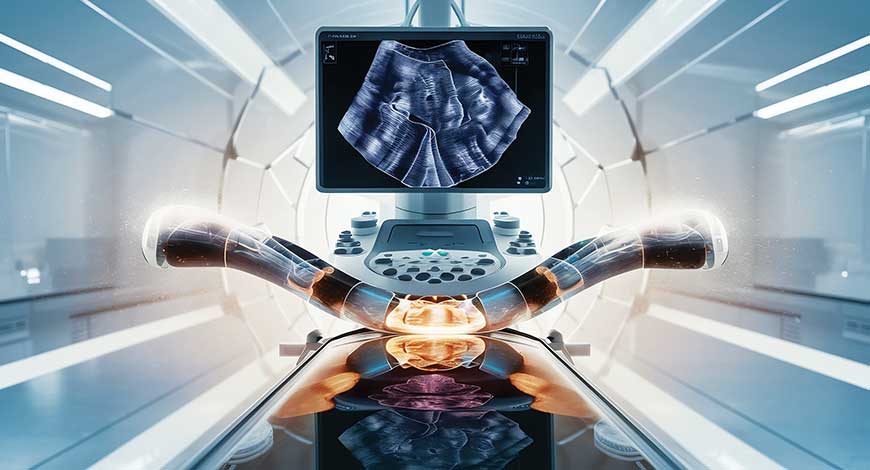
Ultrasound enters its intelligent era, transforming soundwaves into precision medicine’s guiding voice.

Ultrasound began as physics mastery–high-frequency sound waves, piezoelectric transducers, and meticulous signal processing delivering real-time glimpses beneath the skin. For decades, its hallmarks were clear–safe, non-invasive, radiation-free imaging at formidable speed and reliability. The core physics in 2026 remains unchanged, but what those sound waves enable has transformed completely. Ultrasound has evolved from a simple imaging modality into the beating heart of diagnostic medicine.
Modern ultrasound fuses real-time capture, Doppler flow analytics, and computational reconstruction into dynamic diagnostic systems. Smarter probes and adaptive beamforming now meet the power of AI-driven signal interpretation. The result is clearer images, higher consistency, and diagnostic confidence that stretches far beyond snapshots into quantifiable clinical insights.
Today, it is indispensable across clinical frontiers–foetal monitoring in OB/GYN, structural heart assessment in cardiology, and rapid bedside decision support in emergency and intensive care. Portable, radiation-free, and instantly available, ultrasound’s agility makes it the modality of choice when time and access define outcomes. But its future goes far past the scanning room–into digital ecosystems, automated workflows, and decision-ready data streams.
By fusing physics, intelligence, and connectivity, ultrasound now anchors healthcare’s shift toward precision, portability, and promptness.
AI as the new co pilot
Ultrasound is evolving into an intelligent diagnostic platform powered by AI. In 2026, AI drives 68 percent of premium systems globally and 52 percent in India. Machine learning now guides image capture, beamforming, and interpretation–cutting exam time by 35 percent, operator variability by 48 percent, and repeat scans by 60 percent. Algorithms deliver 90 percent + accuracy in cardiac metrics and speed anomaly detection threefold, ensuring consistent, expert-level results. Integrated automation halves reporting time, making ultrasound a scalable, intelligent ecosystem.
Globally, AI in imaging has become a multi trillion dollar frontier, uniting hardware, software, and cloud systems to automate workflows and enhance consistency. Ultrasound stands out–affordable, portable, and perfectly suited for scalable AI deployment. Embedded AI now drives acquisition, anomaly detection, and real time quantification, taking intelligent diagnostics everywhere. OEMs are evolving into full stack platforms, merging proprietary algorithms with cloud based analytics, while software upgrades extend device life. Investors and strategic funds are channeling capital into AI ultrasound startups and integration tools, betting that distributed, data driven diagnostics will form the next tier of healthcare infrastructure.
From an expert’s tool to a universal skill
Ultrasound was once a specialist domain, requiring years of training and a steady expert hand. That barrier is dissolving fast. AI-guided acquisition and simplified training paths are democratizing scanning–making it a fundamental skill across the healthcare spectrum. The focus shifts from who scans to what the scan reveals.
Point-of-care ultrasound (POCUS), transforms emergency and primary care alike. In trauma, cardiac arrest, respiratory failure, or shock, clinicians can generate instant visual insights that guide triage and intervention without delay. Expertise, once centralized, now travels with the device.
AI and POCUS, combined, have rewritten the playbook–turning ultrasound from a specialist silo into a universal clinical language.
Anywhere diagnostics
The walls of radiology departments no longer constrain ultrasound. Handheld, wireless devices–lighter than smartphones–are redefining immediacy in diagnostics. Clinicians at the bedside, in ambulances, or in remote health posts can now perform dynamic imaging without waiting for centralized processing or radiologist reports.
POCUS devices accelerate bedside diagnostics across emergency departments, ICUs, and rural outreach programs. They deliver rapid clarity in cardiac arrest, internal bleeding, or pulmonary crises–scenarios where every second compresses into critical clinical decisions.
This mobility equals democratization. Battery-operated, connected probes bridge infrastructure gaps in underserved regions, offering on-demand diagnostics even in power-constrained or geographically isolated areas. Ultrasonography is no longer a destination service–it’s becoming an everywhere capability.
The growth engine of medical imaging
Ultrasound is the fastest-growing segment of the global imaging market, driven by affordability, safety, and versatility. Unlike capital-intensive CT or MRI systems, ultrasound thrives on portable economics: lower upfront cost, minimal localization need, and universal clinical applicability.The competition between legacy manufacturers and agile startups has sparked a wave of innovation, focusing on AI automation, workflow integration, and ergonomic design.
Software updates now outpace hardware refreshes, turning ultrasound into a living platform rather than a static device. Cloud-based image management, remote interpretation, and AI analytics expand its utility throughout the patient journey–from screening to therapy monitoring.
The market’s center of gravity has shifted from radiology departments to the patient’s side–powered by devices that are smaller, smarter, and connected.
India–The new ultrasound powerhouse
India now stands at the forefront of MedTech manufacturing–and ultrasound is its breakout star. Under the Production-Linked Incentive scheme, local manufacturing has surged, reducing reliance on imports and turning India into a supply node for the global imaging market.
Emerging clusters in Tamil Nadu, Maharashtra, and Gujarat are building deep value chains around imaging subsystems, electronic components, probes, and software platforms. High-end systems once imported from Europe or Japan are now partly built within domestic plants, backed by component localization and design-led engineering.
In the China-plus-one calculus, India presents the ideal ultrasound manufacturing hub–cost-efficient, innovation-driven, and geopolitically stable. With portable, AI-ready systems in demand across Asia, Africa, and Latin America, India bridges global technology with regional healthcare realities. The coming decade could anchor India as the world’s primary source of intelligent ultrasound systems.
From imaging to intelligence
By 2030, ultrasound will cease to be a device–it will become an intelligent, interconnected diagnostic infrastructure. Continuous data streams from AI-embedded systems will feed hospital IT and cloud networks, enabling predictive insights, automated triage, and dynamic clinical decisions.
Portability, connectivity, and automation will scale access beyond urban centers, while standardized AI protocols eliminate operator dependency. The transformation is already underway–from seeing to foreseeing, from capturing to predicting.
Healthcare’s most ubiquitous imaging tool is stepping into its most intelligent era. The humble soundwave is now the voice of precision medicine.