Headlines of The Day
Is your ‘Made in India’ device real?
The Galgotias row forces MedTech to confront an uncomfortable question on provenance.

A robotic dog at an AI expo would not, at first glance, seem to have much to do with ventilators, CT scanners, or infusion sets. Yet the recent controversy involving Galgotias University at the India AI Impact Summit in New Delhi has quickly spilled over into India’s medical device ecosystem, sharpening scrutiny of how the country defines and declares “Made in India.”
Galgotias University was asked to vacate its stall at the India AI Impact Summit expo after a robotic dog it showcased as “Orion” – presented as an in-house innovation – was identified as the Go2 model from Chinese robotics firm Unitree, a commercially available platform sold online. Officials linked to the summit said the university’s pavilion was dismantled after videos circulated showing a faculty member describing the robot as a product of the institution’s Centre of Excellence. The university later issued a clarification saying the robot had been procured as a learning tool, but that explanation itself was challenged by community fact-checks highlighting earlier claims of indigenous development.
In isolation, this could have been dismissed as an over-enthusiastic case of academic over-claiming. But for India’s medical device manufacturers, the incident lands uncomfortably close to a long-running fault line: imported technologies rebadged as Indian, and a regulatory framework that still struggles to distinguish genuine manufacturing from relabelled imports.
A deeper malaise: The rise of pseudo-manufacturing
For more than a decade, domestic MedTech players have warned that “pseudo-manufacturing” – where importers perform minimal processing or only change labels and packaging before selling devices as Indian products – is eroding both trust and competitiveness. Rajiv Nath, Forum Coordinator of the Association of Indian Medical Device Industry (AiMeD), has repeatedly cautioned that pseudo-manufacturing is incentivising trading over real production, and allowing entities to project themselves as manufacturers without commensurate investment in plants, people, or product development.
The numbers sharpen the concern. China is now the second-largest supplier of medical devices to India after the US, with a market share of around 16.4 percent and imports valued at about ₹11,506 crore in 2023–24, according to sector analysis. Government and industry estimates peg total medical device imports at close to ₹69,000 crore in the same period, spanning everything from consumables to critical-care equipment. Domestic associations have also flagged a surge in indirect Chinese inflows via Hong Kong, Malaysia, and Singapore, which are increasingly used as transshipment hubs to route Chinese-origin devices into India.
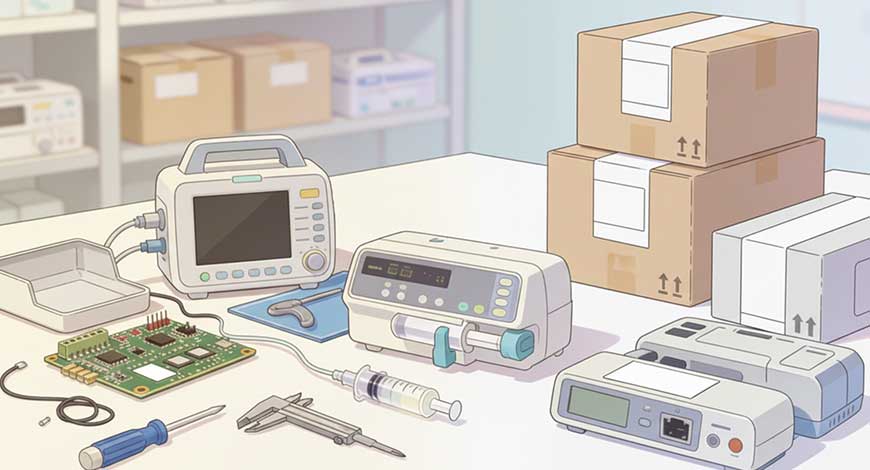
In this context, the Galgotias episode feels, to many in the industry, less like an anomaly and more like a mirror. If a robot dog can be renamed and presented as a “Centre of Excellence” showpiece, how different is that in spirit from an imported ultrasound machine or patient monitor being boxed, stickered, and sold as a “Made in India” product after minimal value addition?
When labels outpace value addition
Under current rules, the definition of a manufacturer still leaves room for entities that primarily label, repack, or assemble pre-finished products, especially under the broader implementation of the Medical Device Rules (MDR) 2017. Industry stakeholders argue that this allows companies to qualify as manufacturers in documentation and compliance terms, even if most high-value processes remain offshore.
AiMeD has, over the years, submitted roadmaps to the government urging clearer distinctions between true manufacturing and mere branding. Proposals include:
- Excluding simple relabelling and repackaging from the definition of manufacturing;
- Mandating explicit disclosure of the country of origin and original manufacturing site;
- Linking “Made in India” claims to a minimum threshold of domestic value addition, often suggested around 40 percent.
The association has also highlighted how low or negligible tariffs on certain device categories have tilted business models toward importing rather than investing in local capacity. As Nath has noted in earlier interventions, the ecosystem risks turning bona fide manufacturers into traders, while “pseudo manufacturers” leverage origin ambiguity, lighter compliance requirements, and cheaper imports to undercut domestic producers.
For hospital buyers and clinicians, the distinction is not merely academic. The provenance of a device directly relates to traceability, accountability, and post-market surveillance. When the origin is unclear, it becomes harder to establish responsibility in the event of a quality failure or safety incident.
The global lens: Credibility as a competitive asset
The controversy also intersects with India’s positioning as a global manufacturing hub. On the one hand, government schemes – including production-linked incentives and dedicated MedTech parks – aim to build a robust domestic base for high-end imaging, radiology, and life-support equipment, with several greenfield projects already underway. On the other hand, rising imports and rebranded products risk diluting the very “Make in India” narrative that underpins these programmes.
International partners track these developments closely. Investors and global device majors are sensitive not only to cost advantages but to the credibility of the regulatory and labelling ecosystem they are stepping into. Any perception that India’s manufacturing story leans too heavily on creative relabelling rather than genuine capability-building could dampen enthusiasm or push more advanced R&D and technology-transfer projects elsewhere.
That is why industry voices increasingly emphasise that provenance is not a nationalist litmus test, but an integrity issue. There is nothing inherently wrong with importing a high-quality device – Indian hospitals have long relied on global platforms for complex diagnostics and treatment. The problem arises when the same product is relabelled and marketed as domestically manufactured, distorting both procurement decisions and policy metrics.
From embarrassment to enforcement: What needs to change
So what would a more transparent, trust-led framework look like? Stakeholders point to several priority levers already under discussion:
- Stricter and more granular labelling norms that clearly differentiate “manufactured in India,” “assembled in India,” and “imported”;
- QR code–based traceability on packaging to allow hospitals and regulators to verify origin, manufacturing sites, and supply-chain routes;
- Value-addition thresholds for eligibility under “local content” preferences in public procurement, backed by third-party audits;
- Certification or vetting of “Make in India” logos by an independent body such as the Quality Council of India, to prevent misuse.
At the same time, there is recognition that enforcement cannot become a new licence raj. Industry leaders caution that the solution lies in smart regulation: Risk-based classification, digital licensing, data-driven inspections, and clear penalties for misdeclaration, rather than blanket bureaucratic chokepoints. Ongoing moves toward risk-based regulatory regimes and electronic systems under the Central Drugs Standard Control Organisation (CDSCO) are seen as steps that can enhance transparency while remaining compatible with innovation cycles.
For genuine manufacturers, these changes promise a levelling of the playing field. For clinicians and hospital administrators, they promise something even more fundamental: the ability to know what they are buying, from where, and with what degree of oversight.
Why this matters now for clinicians
For hospital decision-makers, radiologists, intensivists, and diagnostic leaders – the provenance debate is no longer an abstract industrial-policy discussion. It influences:
- How much confidence they can place in “local” brands pitched as cost-effective alternatives;
- How procurement committees evaluate tenders where products claim domestic preference eligibility;
- How risk is managed over the lifecycle of a device, from installation to maintenance and upgrades.
As AI-driven diagnostics, robotic interventions, and connected devices proliferate, the line between software, hardware, and cloud-delivered services will blur further. In that environment, clear declarations of origin, licencing, and technology ownership become central to medico-legal protection and patient safety.
The real lesson of the Galgotias episode
Ultimately, the Galgotias controversy is less about one university and more about a narrative India is still writing. A robot dog rechristened “Orion” and showcased as an indigenous marvel became a symbol of what happens when storytelling outruns substance. In medical devices, the cost of such overreach is not just reputational; it can be clinical.
For India’s MedTech sector, the path forward is emerging with increasing clarity: embrace transparent labelling, demand verifiable value addition, and align regulatory guardrails with global best practices. In doing so, the industry can ensure that when a product is stamped “Made in India,” it stands not just for location, but for accountability.
Because in the operating theatre and ICU, there is no room for ambiguity about where a device truly comes from – or who ultimately stands behind it.
MB Bureau