MB Stories
Immunochemistry at an inflection point – Building the next decade of diagnostics
Immunochemistry is evolving into core diagnostic infrastructure, driving scalable, AI-enabled precision care.

Immunochemistry is entering a defining decade–one where it is no longer seen as a background laboratory specialty but as a central engine of modern diagnostics and precision medicine. Across oncology, infectious diseases, autoimmune disorders, and chronic conditions, immunochemistry is now the backbone of disease detection, stratification, and long-term monitoring. Its unique ability to translate intricate biological interactions into measurable, clinically meaningful signals has made it indispensable for early diagnosis, therapy selection, and assessment of treatment response. As our understanding of disease biology deepens, clinicians are demanding diagnostic tools that are not only sensitive and specific but also dynamic, scalable, and truly actionable at the point of care.
This transformation is unfolding at the intersection of three powerful forces. On one side is rising clinical complexity–heterogeneous diseases, emerging treatment resistance, and the growing need for longitudinal patient monitoring. On another is the accelerating pace of technological innovation, from ultra-high-sensitivity immunoassays and fully automated platforms to biosensors, digital analytics, and AI-driven interpretation. Layered on top are mounting costs and access pressures, pushing health systems toward faster, more decentralized, and more efficient diagnostic solutions–without compromising quality or reliability. Recent advances in translational and clinical research have already laid a strong foundation, showing how refined immunochemical methods can unlock deeper biological insights and deliver tangible clinical value in real-world settings.
Together, these converging forces place immunochemistry at a critical inflection point–poised to evolve from a collection of isolated assays into fully integrated diagnostic platforms that will shape how medicine is practiced over the next decade. This moment marks the beginning of a new chapter in diagnostics, setting the stage for the scientific building blocks that are now driving the next wave of innovation.
Indian market dynamics
The Indian immunochemistry analyzers and reagents market in 2025 is pegged at approximately ₹6,385 crore. Within the broader segment, the Indian CLIA instruments and reagents market alone is placed at ₹4,345 crore in 2025, comprising about ₹365 crore from instruments and ₹3,980 crore from reagents, highlighting the clear dominance of recurring consumable revenues over capital equipment. It not only reflects their growing installed base, but also their consolidating role as the workhorse of high throughput immunoassay testing. ELISA kits contribute about ₹470 crore, sustained by their continued use in smaller laboratories and for specialized, low volume tests where cost and flexibility remain critical. Rapid tests represent roughly ₹1,340 crore, driven by expanding point of care applications across public health programs, private hospitals, and independent labs. Fluorescence immunoassays (FIA), still a nascent but fast emerging segment for near patient testing, are valued at around ₹190 crore, while radioimmunoassay (RIA), now a niche legacy technology restricted to select reference centers, contributes an additional ₹40 crore.
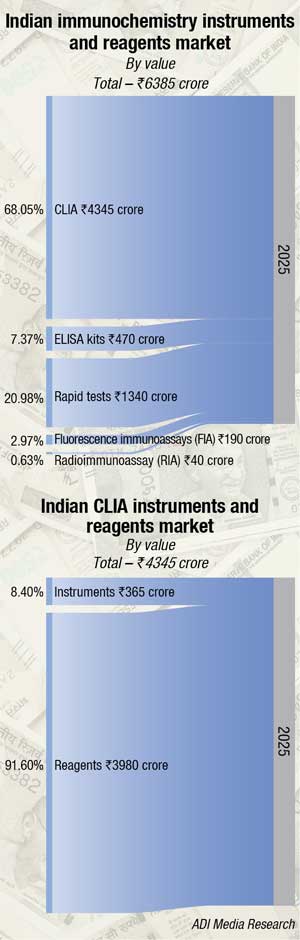
It is a mid-sized but fast-growing market, with demand driven by high test volumes, reagent-led revenue, and a strong push toward affordable, decentralized testing across public and private sectors.
Pricing, affordability, and business models reflect India’s fundamentally cost-conscious healthcare landscape. India is structurally price-sensitive, so affordability becomes a central competitive lever; many buyers, especially in Tier-II and Tier-III cities, explicitly prioritize cost per test, uptime, and service responsiveness over the global brand premium, particularly outside the top corporate hospital segment. Reagent-rental and pay per test models have therefore become standard: suppliers often place analyzers at low or zero upfront cost and recover margins through long-term, high-volume reagent contracts, a model that resonates with mid sized labs and smaller hospitals trying to preserve capital while still accessing advanced immunochemistry platforms. Domestic manufacturers and regional players are intensifying competition by offering lower per test pricing, more flexible minimum volume commitments, and assay menus tailored to Indian disease patterns, including tuberculosis, dengue, chikungunya, and other endemic vector borne infections. In parallel, self-testing and over the counter immunoassay kits for pregnancy, blood glucose, thyroid function, and selected infectious markers are gaining ground in pharmacies and e commerce channels, putting further downward pressure on prices and normalizing high-volume reagent consumption beyond traditional laboratory settings.
|
Leading players* |
|
| Tier I | Roche |
| Tier II | Abbott, QuidelOrtho, Siemens, Snibe, and bioMérieux |
| Tier III | Beckman Coulter, Tosho and Mindray |
| Others | Agappe, Matrix, Autobio, and CPC |
| ELISA | |
| Tier I | Bio-Rad, and J Mitra |
| Tier II | Immunoshop and Transasia |
| Others | Meril, and Avantor |
| Rapid tests | |
| Tier I | J Mitra |
| Tier II | Tulip, SD Biosciences and Abbott |
| Tier III | Rapid Diagnostics, Medsource Ozone, Transasia, and Meril |
| Others | Many small players |
|
*Vendors are placed in different tiers on the basis of their sales contribution to the overall revenues of the Indian immuochemistry instruments and reagents market. ADI Media Research |
|
Role of policy, local manufacturing, and R&D
Government programs such as “Make in India” are explicitly geared toward boosting domestic IVD manufacturing, and this now extends to immunoassay instruments and reagents, expanding local production capacity and gradually reducing dependence on imported platforms and kits. In parallel, public initiatives to expand lab networks and diagnostic services, together with rising incomes and a growing dual burden of infectious and chronic diseases, are raising baseline utilization of immunoassays across India rather than confining them to a few metro hubs. Responding to this demand, Indian companies are stepping up investment in R&D for novel immunological diagnostics, developing new instruments and assay menus tuned to local epidemiology, while partnering closely with hospitals and diagnostic chains to validate these solutions in real-world settings and then scale them nationally.
Metros, Delhi, Mumbai, and Bengaluru remain the command centres for high end diagnostics, with dense networks of corporate hospitals, chain labs, and reference centres running sophisticated immunoassay platforms and broad, integrated IVD menus. They host high-throughput CLIA systems, advanced ELISA and molecular platforms, subspecialty panels, and senior pathologists, and they draw not only on urban walk-in volumes but also on referral samples routed from surrounding cities and towns.
Immunochemistry at an inflection point – From technology choices to integrated strategy
 Bimal BK
CEO,
Agappe Diagnostics Ltd
India’s in vitro diagnostics sector is entering a phase of steady, structurally driven growth, fuelled by a rising burden of chronic diseases, expanding preventive healthcare, and improved access to quality laboratory services. Within this landscape, immunochemistry has become central to clinical decision-making–spanning routine tests such as thyroid hormone levels to specialized biomarkers.
What defines this evolution is not the dominance of a single technology, but the emergence of a multi-technology ecosystem.
ELISA remains relevant, particularly in infectious disease diagnostics, due to its reliability and cost-effectiveness. However, its batch-processing nature limits scalability in high-throughput settings. In contrast, CLIA-based platforms have gained strong adoption, driven by repeatability, automation, and faster turnaround times–making them well-suited for routine immunoassay workloads.
At the same time, nephelometry and turbidometry remain strategically important, especially for protein analysis and niche parameters. Their flexibility makes them valuable across laboratory segments, particularly when immunoassay platforms face menu limitations or uneconomical pack sizes for low-volume tests.
The result is a layered transition model:
- Migration from ELISA to CLIA for mainstream testing;
- Continued use of nephelometry/turbidometry for specialized parameters; and
- Growing adoption of cartridge-based systems for rare and esoteric biomarkers.
This reflects a key industry reality–no single platform today offers complete menu coverage with optimal efficiency. Laboratories are therefore evolving toward multi-platform environments that balance throughput, cost, and clinical breadth.
Simultaneously, large laboratories are moving toward integrated and connected ecosystems, prioritizing workflow simplification, space optimization, and faster turnaround times.
For diagnostic manufacturers, this shift demands flexible, scalable solutions that align with the complexity of real-world laboratories. At Agappe Diagnostics, our focus has been on enabling this transition through platforms such as Mispa i2, Mispa i3, and the newer Mispa i60 and i121, designed to combine automation, menu expansion, and operational efficiency.
Looking ahead, immunochemistry will be shaped by market expansion, novel biomarkers, integrated systems, and compact solutions for emerging labs. The laboratories that succeed will be those that strategically integrate technologies to ensure better clinical outcomes and more efficient patient care.
On the ground, however, the real volume, access, and affordability story is unfolding in Tier-II and Tier-III locations. National chains–Lal PathLabs, Metropolis, Thyrocare, SRL, Krsnaa, Suraksha, among others–are rolling out labs and collection centres across B towns and district headquarters, often at a rapid clip, to secure early-mover advantage and lock in local sample flows. Rising middle class incomes, greater health awareness, and the spread of Ayushman Bharat coverage are pulling a wider range of immunochemistry panels into routine practice in these markets, from thyroid and fertility testing to cardiac markers, diabetes monitoring, and infectious serology.
Outside the metros, immunochemistry increasingly moves through a hub and spoke, PoC enabled architecture rather than a few standalone labs. A central Tier-II hub lab, equipped with high-throughput CLIA and ELISA analyzers, typically serves a ring of spokes and collection centres across Tier-III and Tier-IV towns, consolidating complex and higher-value assays. Routine immunoassays that demand quick decisions–pregnancy tests, basic hormone profiles, frontline infection screens–are progressively handled on point of care or semi automated platforms at peripheral labs and clinics, with only the more complex or esoteric cases batched up to the regional hub or escalated further to a metro reference centre when deeper analysis is required.
Consolidation and competitive dynamics
The market is rapidly consolidating around large, high-throughput core laboratories that rely on automation to deliver faster, more reliable results at scale. Against this backdrop, Apollo is working with Roche to build a highly automated core laboratory, where advanced sample handling robotics and integrated chemistry–immuno platforms are moving the network steadily onto the Total Lab Automation trajectory now reshaping the organised diagnostics segment.
Established chains are increasingly acquiring struggling standalone labs in Tier-II and Tier-III cities to secure immediate access to local sample volumes, and then systematically upgrading these sites with standardized immunochemistry test menus and full LIMS connectivity so that workflows, quality, and reporting align with their metro hubs. For manufacturers of immunochemistry analyzers and reagents, this consolidation wave effectively creates two distinct sales theatres: at one end, premium, feature rich platforms targeted at metro reference labs and large Tier II centres that demand high throughput, automation, and advanced assay menus; at the other, rugged, low cost analyzers and point of care solutions engineered for affordability, ease of maintenance, and dependable service in the deeper Bharat markets where infrastructure is thinner but test volumes are rising.
Technology mix – CLIA, ELISA, and innovation focus
India’s technology mix in immunochemistry is settling into a clear three-layer architecture: CLIA as the high-throughput core, ELISA as the cost-sensitive mid-volume backbone, and PoC as the access layer extending into primary care and rural settings. Large hospitals, national diagnostic chains, and reference labs anchor this stack with automated CLIA and ELISA analyzers, aggregating substantial daily volumes and leveraging the infrastructure, quality systems, and specialist manpower needed to run complex immunoassays reliably. At the edge, point of care immunoassay systems are one of the fastest growing segments, driven by demand for near patient results in geographies that still lack easy access to centralized laboratories; they are increasingly embedded in local clinics, small nursing homes, GP practices, pharmacies, and home care settings, especially for chronic disease markers and infectious diseases where turnaround directly shapes clinical decisions.
Within this architecture, chemiluminescence immunoassay (CLIA) is rapidly becoming the core high throughput workhorse. Its higher sensitivity, broader dynamic range, and better specificity in complex assays reduce the need for reruns and support consistent reporting in high-stakes tests such as HIV, HBV, HCV, and dengue serology. Because CLIA integrates smoothly into fully automated workflows, it is now the preferred platform in core labs, tertiary hospitals, and multi site chains that manage large daily volumes and demand fast turnaround; market data consistently place chemiluminescence among the fastest growing immunoassay technologies, fuelled by rising endocrinology, oncology, and infectious disease workloads.
ELISA, by contrast, remains the cost sensitive backbone for mid volume labs and public programs. It still holds a dominant share in serological testing because of its longstanding use across infectious disease and screening programs nationwide, and its manual or semi automated configurations keep capital requirements low. That makes ELISA a natural fit for low to mid volume laboratories, district hospitals, and government schemes where budgets are tight but test menus are broad. Over the medium term, ELISA is likely to concentrate increasingly in decentralized, lower volume and public sector settings, complementing CLIA’s automated core rather than being displaced by it.
From accuracy to advocacy – Building trust-driven immunochemistry laboratories
 Pramod Ahire
Group Marketing Head –Immunology,
Transasia Bio-Medicals Ltd.
In the evolving landscape of healthcare, diagnostics has moved from being a support function to a strategic growth driver. Today, high-reliability laboratories are no longer operational benchmarks; they are brand assets that directly influence clinician preference and long-term loyalty.
Reagent standardisation–Delivering consistency at scale
Consistency is the first promise a laboratory makes and keeps. Reagent variability, if not tightly controlled, can compromise clinical confidence. Forward-looking laboratories are institutionalizing stringent reagent standardisation protocols, including lot-to-lot validation and calibration traceability. From a market standpoint, this discipline translates into a compelling differentiator: predictable, reproducible performance across volumes and geographies. In an environment where outcomes matter more than outputs, consistency becomes a powerful brand signal.
Quality control–From compliance to differentiation
Quality control is undergoing a strategic repositioning. What was once seen as a regulatory necessity is now a lever for competitive advantage. Laboratories that invest in advanced QC frameworks, leveraging multi-level controls, real-time trend analysis, and global benchmarking through external quality programs are able to demonstrate reliability, not just claim it. For marketing leaders, this creates an opportunity to shift conversations from features to proof points, reinforcing credibility in a data-driven manner.
Assay validation–The currency of credibility
In a crowded diagnostics market, credibility is earned through evidence. Each assay introduced into a laboratory ecosystem represents a promise that must be validated across parameters such as precision, sensitivity, and clinical concordance. Rigorous validation protocols and method comparisons ensure that results are not only accurate, but clinically meaningful. This allows organizations to elevate their narrative from selling technology to delivering validated outcomes that clinicians can trust implicitly.
Technology as an enabler of scalable trust
Automation, integration, and analytics are reshaping laboratory operations, enabling higher throughput and improved traceability. However, technology alone does not create differentiation. Its true value lies in how effectively it is integrated with robust processes and skilled teams. Laboratories that align digital capabilities with operational discipline are better positioned to scale reliability, transforming efficiency gains into trust gains.
Ultimately, the future of immunochemistry will be defined by those who can consistently translate scientific rigor into clinical confidence.
PoC immunoassays form the speed and access layer on top of this lab infrastructure. Lateral flow and cartridge based devices are spreading across primary health centres, mobile clinics, and community settings for maternal health, NCD screening, and frontline infectious disease detection. Adoption is rising particularly fast in rural and resource limited primary care, delivering earlier case finding but also surfacing familiar challenges around integration with care pathways, follow up, and quality control. India’s wider point of care diagnostics market, which includes these immunoassay platforms, is projected to grow robustly over the next decade as policymakers and providers double down on decentralized testing and outbreak responsiveness.
In practice, CLIA, ELISA, and PoC are configured as a hybrid, interlocking system rather than competing silos. Labs commonly run CLIA as the high throughput routine and critical assay platform, while reserving ELISA for specific tests where economics, installed base, or program design make it the better option. A typical metro reference lab might use CLIA for thyroid, fertility, cardiac, and HIV/HBV/HCV panels, with spoke labs or public sector partners deploying ELISA for targeted screening camps and PoC tests for rapid triage in the field, escalating samples back to the hub whenever more precise quantification or extended panels are required.
Global market overview
The immunochemistry instruments and reagents market is entering a phase of accelerated growth, driven by rising global demand for accurate, rapid, and scalable diagnostic solutions–from USD 25,666.7 million in 2025 , expected to reach USD 111,290.1 million by 2030, growing at a CAGR 15.8 percent, according to the Future Market Insights. The increasing prevalence of chronic and infectious diseases, combined with a strong shift toward early diagnosis and personalized medicine, is pushing laboratories and hospitals to adopt high-sensitivity immunoassays.
Advances in automation, multiplex testing, and assay design are significantly improving throughput, reproducibility, and clinical confidence, making immunochemistry a backbone of modern diagnostics. Growth is further supported by expanding healthcare infrastructure, wider access to diagnostics in emerging regions, and increasing use of immunochemistry across oncology, cardiology, endocrinology, and infectious disease workflows. The integration of digital tools, data analytics, and AI-enabled platforms is also enhancing laboratory efficiency and decision-making, reinforcing long-term market momentum.
Despite this positive outlook, the market faces certain constraints that may temper growth if left unaddressed. High capital investment and maintenance costs associated with advanced immunochemistry systems can limit adoption in smaller laboratories and resource-constrained settings. Competition from alternative technologies, such as molecular diagnostics and next-generation sequencing, is also reshaping testing strategies in some applications. In addition, shortages of skilled professionals, challenges in standardization across platforms, and varying regulatory requirements across regions can slow implementation and scale-up, particularly in developing markets.
Looking ahead, the growing number of collaborations and strategic partnerships among diagnostic developers, technology providers, research institutions, and healthcare organizations is emerging as a powerful growth catalyst. These alliances are accelerating innovation in assay development, expanding biomarker menus, and enabling co-development of companion diagnostics aligned with targeted therapies.
Partnerships also support faster validation, broader geographic reach, and more resilient supply chains. Combined with continued investments in automation, point-of-care testing, and sustainable system design, these collaborative efforts are strengthening the global immunochemistry ecosystem–positioning the market for sustained, high-growth expansion over the coming decade.
From a segmentation perspective, market growth is reinforced across product, application, and end-user categories. Reagents and kits continue to command a dominant share due to their recurring demand and central role in routine testing, while analyzers and automated systems are gaining traction as laboratories prioritize high-throughput and integrated workflows.
On the application front, oncology, infectious disease, cardiology, and endocrinology remain the strongest growth engines, supported by rising disease burden, screening programs, and the need for precise biomarker monitoring.
In terms of end users, hospitals and clinical laboratories account for the largest adoption, driven by high test volumes and demand for rapid turnaround, while diagnostic centers and research laboratories are increasingly investing in advanced immunochemistry platforms to support specialized testing, population screening, and translational research–together sustaining broad-based demand across the value chain.
Regional market insights
The North American immunochemistry market is expected to maintain a dominant position globally, reflecting its early adoption of advanced diagnostic technologies and a mature healthcare ecosystem. The North American immunochemistry market is anticipated to garner the highest share of 37.5 percent by the end of 2035, and continues to set the pace through advanced healthcare infrastructure, strong reimbursement systems, and sustained investment in research and innovation. High awareness of early diagnosis and a growing burden of chronic and lifestyle-related diseases are driving consistent demand for sophisticated immunochemistry solutions across clinical and research settings.
Europe is showing steady, innovation-led growth, supported by its strong emphasis on research, quality standards, and regulatory alignment. An aging population and rising prevalence of chronic conditions are increasing the need for accurate, reliable, and standardized diagnostic testing. Favourable regulatory frameworks and cross-border research collaboration are encouraging the adoption of new immunochemistry technologies across hospitals and diagnostic laboratories.
Meanwhile, the Asia Pacific is emerging as the fastest-growing region, powered by rapid healthcare infrastructure development, large patient volumes, and increasing government focus on expanding diagnostic access. Rising public healthcare spending, expanding insurance coverage, and investments in laboratory networks are accelerating the adoption of cost-effective, scalable immunochemistry platforms.
Integrated immunochemistry analyzers –Boosting TAT and efficiency
 Siddhi Pradeep Pillai
Product Manager,
DiaSys Diagnostics India Pvt Ltd
Immunoassays have evolved over time based on the type of label used for detection, which is the key factor differentiating each technology and determining its sensitivity. The earliest method, radioimmunoassay, was introduced in 1959, followed by enzyme immunoassay in 1971 and fluorescent immunoassay in 1973. Later, chemiluminescence immunoassay (CLIA) emerged in 1978, using a chemiluminescent label, and is considered the most sensitive immunoassay technology among these methods.
Traditionally, many laboratories relied on manual immunoassays that required significant hands-on time, complex pipetting steps, and intensive operator involvement. These legacy processes were laborious, prone to variability, and often became bottlenecks in high-volume lab environments where rapid turnaround and consistency are critical.
The advent of fully automated chemiluminescence immunoassay analyzers has fundamentally transformed this landscape. Modern integrated analyzers enhance standardization and accuracy by minimizing manual handling, reducing errors, and contamination. With intelligent software, real-time monitoring, and LIS connectivity, they enable efficient workflows and seamless data management by combining everything from sample identification and reagent handling to incubation, detection, and result reporting. This level of automation dramatically shortens turnaround times by streamlining each step of the testing cycle and eliminating delays caused by batching and manual setup. Another key advantage of fully automated integrated analyzers is their ability to handle multiple tests simultaneously, enabling a wide range of assays to be performed in a single run.
One of the most significant impacts of these advanced analyzers is enhanced throughput. Fully automated platforms can process dozens to hundreds of samples per hour, far surpassing the capacity of manual or semi-automated alternatives. In busy diagnostic labs, this means faster processing of STAT samples, reduced queuing, and the ability to handle peak workloads without compromising quality.
Immunochemistry testing has long been a cornerstone of clinical diagnostics, providing crucial insights into hormones, tumor markers, cardiac markers, vitamins, infectious diseases, and a wide range of biomarkers.
In essence, the shift from manual to fully automated integrated chemistry with immunoassay testing is not just a technological upgrade: it is a transformative evolution that enhances operational efficiency, empowers laboratory professionals, and ultimately accelerates patient diagnosis and treatment pathways.
ELISA backbone, CLIA surge in labs
India’s diagnostic laboratories are entering a decisive implementation phase where technology choices and quality frameworks jointly shape adoption. ELISA has long formed the backbone of immunochemistry, prized for its affordability, simplicity, and suitability for decentralized, program-driven testing. It continues to dominate low- to mid-volume settings, where cost sensitivity and operational flexibility matter most.
Meanwhile, CLIA is gaining rapid adoption in high-throughput labs as testing volumes surge and demands for sensitivity, reproducibility, and turnaround time escalate. Its automation-ready design, wider dynamic range, and seamless compatibility with integrated workflows make it perfect for handling complex disease panels and time-critical diagnostics.
This pivot to CLIA draws strength from rising focus on lab quality and standardization. Accreditation and quality frameworks compel labs to demonstrate traceability, consistency, and scaled error reduction–demands that inherently favour automated immunoassay platforms.
As accreditation rolls out across urban and non-urban areas alike, labs are realigning their technology stacks to achieve uniform performance benchmarks without compromising efficiency. The complementary pairing of ELISA and CLIA, underpinned by rigorous accreditation, is driving broader nationwide uptake of advanced immunochemistry while paving the way for faster regulatory alignment and diagnostic modernization.
Policy tailwinds fuel diagnostics surge
Regulatory and policy momentum now catalyzes the next evolution of diagnostics. Faster approval pathways, streamlined testing permissions, and parallel reviews slash time-to-market for new assays and platforms–without easing quality controls. Policy frameworks simultaneously boost domestic manufacturing, collaborative R&D, and tech transfer, pushing diagnostics closer to points of care and eroding cost barriers. These reforms mesh with growing alignment with global quality standards, building trust, interoperability, and cross-border collaboration.
These tailwinds forge an agile, innovation-ready ecosystem. Next-gen immunochemistry can scale quickly, integrate advanced automation and analytics, and tackle emerging clinical demands head-on. Over the next decade, this regulatory speed-up promises wider access, quicker clinical decisions, and a diagnostics sector that’s globally linked yet locally tough.
From classical assays to high-sensitivity platforms
Immunoassays have undergone a dramatic transformation over the past few decades–evolving from relatively simple, single-analyte laboratory tests into highly sophisticated analytical platforms that now sit at the heart of modern diagnostics. Classical methods such as enzyme-linked immunosorbent assays (ELISA), nephelometry, and turbidimetry laid the groundwork, establishing the core principles of antibody–antigen recognition and enabling reliable detection of a wide range of biomarkers. Yet as clinical questions have grown more complex, the limitations of these traditional formats have become impossible to ignore: limited sensitivity for low-abundance targets, narrow dynamic ranges, susceptibility to matrix interference, and heavy reliance on manual or semi-automated workflows that drag down throughput and reproducibility.
In response, the field is pivoting decisively toward high-sensitivity, multiplexed, and fully automated immunoassay platforms. Breakthroughs in antibody engineering, innovative signal amplification strategies, and advanced chemiluminescent and digital detection methods are pushing detection limits to levels once thought unreachable–enabling earlier disease detection and far more precise monitoring across the care continuum.
At the same time, multiplex immunoassays are redefining diagnostic efficiency by allowing multiple biomarkers to be measured from a single, tiny sample, delivering a richer, more holistic view of disease biology. Automation and integrated analytical systems are tightening consistency, boosting scalability, and slashing turnaround times–adapting immunoassays to the high volume demands of modern clinical laboratories and the fast-paced world of decentralized testing.
This evolution from classical assays to high-performance platforms is far more than an incremental upgrade–it marks a fundamental reimagining of what immunoassays can achieve in clinical practice. By overcoming long-standing analytical constraints and embracing sensitivity, multiplexing, and automation, modern immunoassays are paving the way for seamless integration with biosensors, nanotechnology, and next-generation diagnostic ecosystems that will define the future of precision medicine.
Nano-driven biosensing for ultra-precise detection
Biosensors are rapidly redefining immunochemistry, stretching detection capabilities to the molecular–and even single-analyte–scale and reshaping how biological signals are captured, amplified, and interpreted. By fusing highly specific immunochemical recognition with advanced transduction mechanisms–electrochemical, optical, and photothermal–modern biosensors deliver speed, sensitivity, and precision that conventional immunoassays cannot match. The incorporation of engineered nanomaterials such as gold nanoparticles, quantum dots, nanozymes, and magnetic particles has supercharged signal generation, enabling detection of ultra-low biomarker concentrations once considered invisible, even in complex biological and environmental matrices.
What sets this new generation of immunochemical biosensors apart is their remarkable versatility across domains. In food and environmental monitoring, they enable rapid, on-site detection of antibiotics, pathogens, and toxins, turning real-time safety surveillance from an aspiration into a practical reality. In clinical diagnostics, the same smart detection principles are being harnessed to flag early disease signals, monitor treatment trajectories, and support personalized medicine–without locking results behind centralized lab walls. This powerful convergence of nanotechnology, immunochemistry, and intelligent detection is paving the way for compact, high-performance diagnostic tools that seamlessly bridge the precision of the laboratory with the immediacy of real-world use. As these technologies evolve, they naturally gravitate toward lateral flow formats and other decentralized testing platforms, bringing molecular-level accuracy right to the point of need.
Rapid immunochemistry–From lab to POC
Immunochemistry is decisively migrating from centralized laboratories to rapid, point-of-care (POC) settings, fuelled by the urgent need for faster decisions, wider access, and scalable testing models. Sharper assay design–especially sensitivity gains in lateral flow strips and miniaturized ELISA platforms–is closing the performance gap between POC tests and conventional lab-based immunoassays. With smarter signal amplification, novel labels, and digital readouts, these compact systems now deliver reliable detection of low-abundance biomarkers, even in small, automated formats.
Yet this decentralization brings sharp trade-offs: ultra-fast turnaround can sacrifice analytical depth, and achieving both high accuracy and mass scalability remains a tough balancing act on the technical and economic front. Even so, rapid immunochemistry is proving transformative in low-resource settings, rural healthcare, emergency departments, and large-scale screening programs, where affordability, simplicity, and minimal infrastructure are non-negotiable. As the technology matures, it is evolving beyond triage to become a source of clinically actionable diagnostics–opening the door to routine use in oncology, pathology, and personalized medicine, where timely biomarker insights directly steer treatment decisions.
From manual to automated – Transforming immunochemistry efficiency
 Anant Shethji
CEO,
Vector Biotek (A Beacon Group Company)
Clinical laboratories today face increasing pressure to deliver faster diagnostic results while maintaining the highest standards of accuracy and efficiency. Immunochemistry testing plays a vital role in modern diagnostics, supporting the detection of hormones, tumor markers, cardiac markers, infectious diseases, and many other critical parameters. Traditionally, these tests were performed using manual or semi-automated methods, which required significant human intervention and often resulted in longer turnaround times. The emergence of next-generation fully automated immunochemistry analyzers is now transforming how laboratories operate.
In manual or semi-automated systems, laboratory technicians must perform several steps such as sample preparation, reagent dispensing, incubation, washing, and result interpretation. These processes are time-consuming and can introduce variability or errors due to human handling. Fully automated immunochemistry analyzers streamline these procedures by integrating all stages of testing into a single automated workflow. From sample loading to result generation, the system performs the entire process with minimal manual involvement, ensuring greater consistency and reliability.
One of the most significant advantages of next-generation immunochemistry analyzers is the reduction in turnaround time (TAT). Automated systems are designed to process large volumes of samples rapidly while maintaining high precision. With features such as continuous sample loading, random access testing, and rapid incubation technologies, laboratories can deliver test results much faster than traditional methods. Faster TAT allows clinicians to make quicker medical decisions, which can be critical in emergency and time-sensitive cases.
Automation also dramatically improves laboratory productivity. Modern immunochemistry analyzers are capable of performing hundreds of tests per hour, enabling laboratories to manage growing workloads without requiring additional manpower. By reducing repetitive manual tasks, laboratory staff can focus more on quality control, data analysis, and complex diagnostic work rather than routine processing.
Another important benefit is the integration of these analyzers with laboratory information systems (LIS). Automated data transfer and digital reporting reduce administrative workload, minimize transcription errors, and enhance overall workflow efficiency.
As healthcare systems continue to demand faster and more reliable diagnostics, next-generation immunochemistry analyzers are becoming an essential component of modern laboratories. By reducing turnaround time, improving operational efficiency, and enhancing testing capacity, these advanced systems are redefining laboratory productivity and supporting better patient care.
Redefining precision in tissue diagnostics
From a supportive staining technique to a diagnostic powerhouse, immunohistochemistry (IHC) has reshaped tissue-based diagnostics. Today, it is central to cancer diagnosis and classification, enabling pathologists to decode tumour biology through precise protein mapping within intact tissue architecture. As clinical decisions grow increasingly biomarker-driven, IHC bridges conventional histopathology and molecular pathology, turning antibody performance and reagent quality into actionable clinical insights.
This expanded role demands sharper reproducibility, rigorous standardization, and robust quality control across labs. Emerging solutions–from validated antibody panels and fully automated platforms to digital pathology and AI-assisted quality monitoring–are tightening consistency and reliability in IHC workflows.
Together, these advances place immunohistochemistry at the heart of precision medicine, where accurate tissue profiling directly steers diagnosis, prognosis, and the choice of targeted therapies.
Antibodies–The diagnostic bottleneck and breakthrough
Antibodies sit at the heart of modern diagnostics–acting as the molecular recognition engines that decide whether a test delivers confidence or confusion . Their unmatched specificity and binding affinity drive precise detection of disease biomarkers across formats, from rapid lateral flow strips and ELISAs to immunohistochemistry and mass spectrometry–based diagnostics. Yet as diagnostics scale, multiplex, and integrate AI, antibodies are also emerging as a hidden bottleneck: batch variability, epitope drift, cross-reactivity, and stability issues can quietly erode assay reproducibility and clinical trust.
This has sparked a quiet revolution in antibody science. Recombinant and next-generation engineered antibodies are being built for precision, durability, and predictable performance, turning them from simple reagents into strategic design elements. At the same time, antibody data are feeding into AI-driven discovery pipelines and digital biology platforms, where computational modelling, high content screening, and machine learning accelerate target selection and reagent design.
In this new era, antibodies are no longer just disposable consumables–they are a core innovation lever, shaping the reliability, scalability, and direction of tomorrow’s diagnostic technologies.
AI powering the next wave of immunochemistry
Artificial intelligence and computational tools are reshaping immunochemistry R&D, turning antibody and assay development from artisanal experimentation into data-driven engineering. AI-powered platforms now accelerate antibody discovery, enable de novo design, and optimize affinity–collapsing development timelines that once stretched over years down to weeks and vastly improving readiness for public health emergencies. These advances are especially transformative for cutting-edge formats like nanobodies and multiplexed assays, where computational modelling cuts through vast sequence and design spaces with precision and speed.
Yet this digital leap comes with hidden friction. Fragmented datasets, inconsistent metadata, and poor capture of negative or failed experiments can hobble model reliability and reproducibility. As a result, the focus is shifting beyond just smarter algorithms toward integrated, end-to-end workflows that connect discovery, assay development, and bioprocessing on a single data backbone. When paired with standardized data frameworks and automated lab systems, AI stops being a mere design helper–it becomes a platform-level engine, turbocharging innovation while making immunochemistry more robust, scalable, and translation-ready.
Scaling immunochemistry through automation
Automated immunochemistry platforms are reshaping diagnostics–redirecting the focus from single assays to fully integrated, high-throughput ecosystems. Modern analyzers now handle scalable testing across cardiac, oncology, infectious disease, endocrinology, and companion diagnostics, while slashing manual work and operational complexity. This system-level automation enables labs to standardize workflows, integrate immunochemistry with clinical chemistry, and tackle surging test volumes without sacrificing analytical rigor.
Yet, even in this automated era, comparative studies reveal persistent inter-platform variability–especially for immune markers like immunoglobulins and complement proteins–where clinically meaningful biases can blur the interchangeability of results. These gaps highlight the urgent need for system-specific calibrations, validated reference intervals, and harmonization frameworks to keep large-scale clinical interpretation trustworthy.
As labs advance toward companion diagnostics and multi-omics integration, automated immunochemistry platforms are evolving from mere test processors into core diagnostic infrastructures–where throughput, standardization, and data consistency are just as critical as raw sensitivity.
Immunochemistry powering precision decisions
Immunochemistry is now at the heart of clinical decision-making in the era of companion diagnostics and multi–omics–driven medicine. Once a standalone test, it has evolved into an integrated pillar that integrates protein expression data with genomic, transcriptomic, and proteomic insights to deliver a more comprehensive picture of disease biology. This convergence is especially powerful in oncology, where immunochemical biomarkers drive patient stratification, therapy selection, and ongoing treatment monitoring–enabling sharper, more personalized care.
By translating molecular alterations into visible, tissue-level protein signals, immunochemistry turns abstract genetic data into actionable clinical evidence. Woven into multi-omics workflows, it strengthens targeted therapy decisions, helps uncover therapeutic resistance, and sharpens outcome prediction across complex disease landscapes. As precision medicine reshapes clinical practice, immunochemistry stands as a critical anchor–linking advanced molecular science to real-world diagnostics and therapies, while paving the way for broader adoption and sustained market growth.
The path forward
Looking ahead, immunochemistry is no longer simply evolving–it is becoming foundational diagnostic infrastructure. Its ability to scale across populations, integrate seamlessly with automation, AI, and multi-omics platforms, and deliver reliable insights at both centralized laboratories and points of care positions it at the heart of next-generation healthcare. The inflection point is already here. Over the next decade, immunochemistry will not just support diagnostics–it will actively shape how diseases are detected, treated, and managed at scale.