Headlines of The Day
Centre gives India’s lab tests a common code
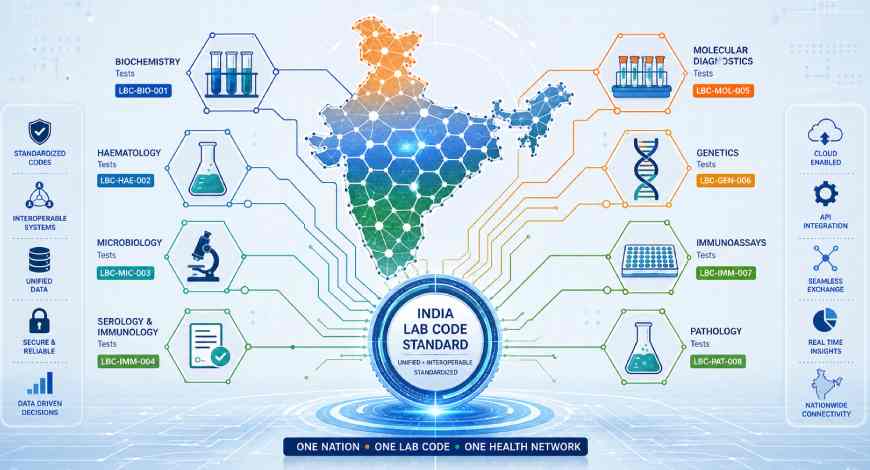
The Ministry of Health and Family Welfare has rolled out Common Lab Codes for India, a reference framework meant to fix a problem that has quietly slowed India’s digital health ambitions: the same blood test can carry a different name in every lab that runs it. Built by the National Resource Centre for EHR Standards under the Centre for Development of Advanced Computing, CLCI assigns a single machine-readable code to each routine diagnostic test, so hospital software, laboratory systems, and health records can all recognize it as the same result, regardless of which platform generated it.

A shared language for lab data
Laboratories exchange reports constantly, but naming has never been consistent. One system’s “fasting blood sugar” is another’s “FBS” and a third’s “glucose, fasting,” and that mismatch has made it difficult for hospital networks and insurers to pool records cleanly. CLCI addresses this by mapping common Indian lab tests to a curated, India-specific subset of LOINC, the international coding standard for laboratory and clinical observations. The National Resource Centre for EHR Standards worked with the voluntary LOINC India Working Group to compile the directory, with medical experts validating each mapping between a test description and its code before release.
For patients, the immediate payoff is continuity. A report generated in one city should now read correctly in a hospital system elsewhere, cutting down on repeat tests ordered simply because a previous result could not be matched or trusted. Deepak Narang, chief operating officer at Agilus Diagnostics, called it a common language that “ensures a medical report delivers consistent, accurate data to every doctor and digital platform, translating directly into safer, faster and more reliable patient care.”
How India compares internationally
India is not the first to make this move, and that is arguably the point. LOINC, developed by the US-based Regenstrief Institute, has been adopted as a national standard in more than twenty five countries outside America, and it underpins laboratory data exchange in health systems from Europe to parts of Asia. In the United States, LOINC adoption was not left to the market: the ONC’s Meaningful Use programme made LOINC-coded lab results a certification requirement for electronic health record systems, effectively forcing standardization across thousands of hospitals and labs over the past decade.
CLCI follows a similar logic but keeps a domestic focus. Rather than importing LOINC wholesale, NRCeS curated the subset most relevant to Indian clinical practice while keeping it mapped to the global standard, so Indian lab data stays interoperable with international systems even as it serves local needs. It also launched alongside the Bharat Health Terminology Service, a broader terminology layer linked to SNOMED CT that standardizes diagnoses and clinical terms, not just lab tests, and both are designed to feed directly into Aarogya Setu 2.0, the revamped personal health record app under the Ayushman Bharat Digital Mission.
What is still unproven
Standards adoption elsewhere shows the pattern that usually follows: publishing a code system is the easy part, and enforcement is what determines whether it actually changes behaviour. The US needed a regulatory mandate tied to certification and incentive payments before LOINC use became routine. India’s framework currently has no such mandate; uptake depends on labs and hospital software vendors choosing to implement it. For an industry estimated at $40 billion, and a digital health stack that has struggled with inconsistent data quality before, that adoption gap is the detail worth watching over the next year.
MB Bureau