Headlines of The Day
Stents, patents and pressure—India holds its spot on US IP watch list
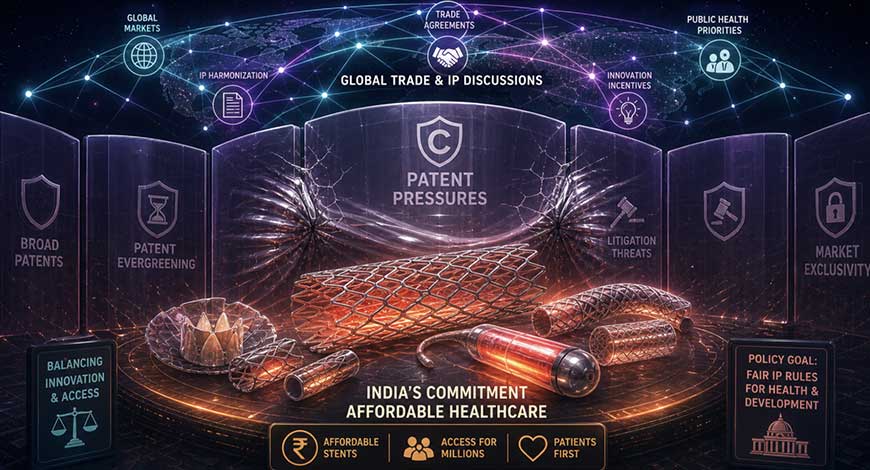
India has been retained on the United States’ Priority Watch List for intellectual property concerns in the 2026 Special 301 Report, with the medical-technology sector emerging as one of the most contentious areas of friction alongside pharmaceuticals, patents, and enforcement.

The report, released on 30 April 2026 by the Office of the United States Trade Representative (USTR), places India among six economies under the highest level of scrutiny, Chile, China, Indonesia, Russia, and Venezuela being the others. The USTR said it would seek to engage intensively with these jurisdictions through the year, including through the bilateral Trade Policy Forum.
Long-standing concerns
The 2026 report reiterates that India remains among the more challenging major economies for effective IP protection and enforcement. It flags long delays in patent approvals, what it describes as excessive reporting requirements, prolonged opposition procedures, and continuing high levels of piracy and counterfeiting.
Restrictions on patentable subject matter, particularly in the pharmaceutical sector, also continue to draw US objections, building on years of complaints from American innovator firms about Section 3(d) of the Indian Patents Act and the country’s approach to compulsory licensing.
At the same time, the USTR acknowledges progress. India amended its patent rules in 2024 to improve efficiency and reduce procedural burdens, has added more patent examiners, and has worked to strengthen IP awareness. These steps, however, were judged insufficient to warrant a downgrade from the Priority Watch List.
MedTech in the crosshairs
Medical technology has emerged as a distinct strand of the dispute this year. The USTR has criticised India’s price-control regime on essential medical devices, in particular coronary stents and knee implants, where the National Pharmaceutical Pricing Authority (NPPA) caps prices and has been slow, in the US view, to revise those ceilings to reflect changes in technology and input costs.
The report also takes issue with India’s high tariffs on medical-device imports and what it describes as unclear guidelines for refurbished and pre-owned devices. India banned imports of refurbished, repaired, and second-hand medical devices to support domestic manufacturing and patient-safety goals, a move the USTR has flagged as restrictive of market access.
A further sticking point is local-content requirements under the government’s Make-in-India and Production-Linked Incentive frameworks. The USTR has characterised some of these provisions as discriminatory against foreign suppliers; Indian officials have countered that they are calibrated industrial-policy tools aimed at building manufacturing depth in a sector where the country is a significant net importer.
India’s position is that the USTR’s framing inaccurately portrays its medical-device policy as protectionist, while sidelining its legitimate objectives of healthcare access, affordability and self-reliance. New Delhi points to the rapid expansion of its medical-device base, currently estimated at around $12 billion and projected to reach $50 billion by 2030, as evidence that the regime is delivering both investment and patient-cost relief.
Why this matters
The Priority Watch List does not, by itself, trigger trade sanctions. But it shapes the diplomatic backdrop for ongoing US–India trade negotiations, can influence how American multinationals weigh fresh investments in India, and is closely tracked by industry lobby groups on both sides as a barometer of the relationship.
For the medical-device industry, the listing matters for two reasons. First, US firms account for a meaningful share of advanced-device imports into India, particularly in cardiology, orthopaedics and imaging. Second, India is increasingly central to global MedTech supply chains, both as a manufacturing base and as a fast-growing market, a status that makes the rules around patents, pricing and market access commercially significant well beyond the bilateral relationship.
For Indian policymakers, balancing affordability with innovation incentives remains the core challenge. Stent and implant price caps have demonstrably reduced patient out-of-pocket costs but have also drawn complaints from manufacturers about return on R&D investment and the pace of new product introductions in India.
What’s next
The USTR has indicated it will continue to engage India through trade talks and the Trade Policy Forum during the year. Indian officials are expected to push back on the medical-devices critique, while continuing to press their case that the 2024 patent-rule amendments and broader IP-administration reforms warrant closer attention than the report appears to give them.
A formal Indian government response to the 2026 listing is expected in the coming days. Whether the disagreement narrows or hardens will depend in significant part on how the two sides handle the MedTech file in the next round of bilateral engagement.
MB Bureau