Anesthesia Equipment
Sentinels of the OR – Anesthesia machines quietly safeguard every surgical moment
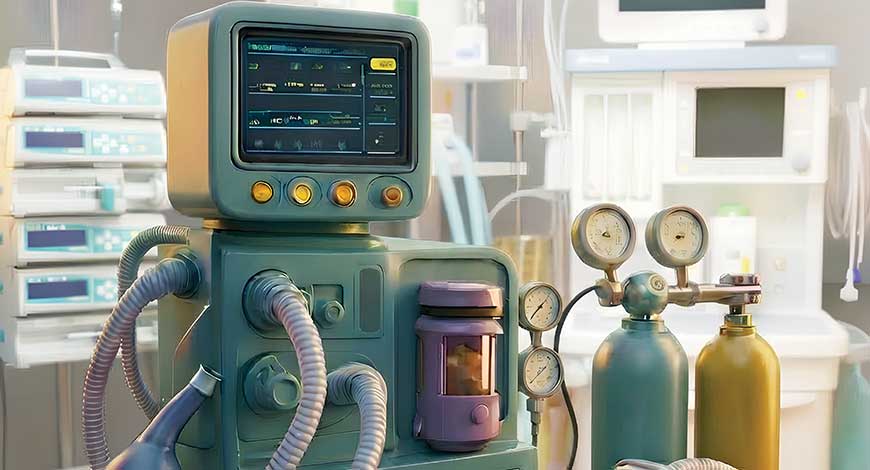
Intelligent anesthesia machines quietly safeguard every breath, transforming surgery into a safer, data-driven, patient centric experience.

Walk into any operating room and your gaze is drawn first to the bright surgical lights, the steel instruments, and the focused faces around the table. But the real guardian of that space often hums quietly in the corner, its screens pulsing with numbers and waveforms: the anesthesia machine. It is the one device that never looks away, never relaxes, and never stops calculating what every breath and heartbeat means for the person on the table.
From ancient attempts to dull pain with alcohol, herbs, or ritual, to the first ether-soaked sponges, humanity has long searched for ways to spare patients the raw agony of surgery. Those early methods were blunt, risky, and imprecise–more about survival than science. The moment reliable anesthetic agents entered clinical practice, surgery itself changed character, shifting from a desperate last resort into a deliberate, planned act of healing. Control, predictability, and a new kind of quiet confidence entered the operating room.
The anesthesia machine became the engine of that revolution. What started as crude vaporizers evolved into sophisticated workstations capable of orchestrating unconsciousness, managing ventilation, and stabilizing physiology with almost orchestral precision. These machines turned the art of keeping someone under into a disciplined science–enabling surgeries that would have once been unthinkable, and giving surgeons the time and stillness they needed to operate with skill instead of speed.
Today, modern anesthesia systems sit at the heart of the OR like mission-control hubs. They measure and meter oxygen and anesthetic gases, assist or fully take over breathing, and track vital signs breath by breath, beat by beat. Layers of alarms, fail-safes, backup batteries, and standardized connectors are built not just for convenience but for survival–designed so that the slightest deviation, whether mechanical or physiological, triggers attention before it spirals into crisis.
And as hospitals embrace connectivity and data-driven medicine, anesthesia machines are no longer isolated instruments; they are nodes in an intelligent network. They talk to monitors, ventilators, hospital servers, and electronic health records. They feed live data into analytics engines and decision-support tools. Slowly but surely, they are stepping out of the shadows of the OR to become active sentinels in a much larger ecosystem of surgical safety.
Life support when seconds matter
The true character of an anesthesia machine is often revealed not in calm, elective cases but in those fraught minutes when everything begins to go wrong. A patient’s blood pressure crashes, their lungs stiffen, their oxygen levels plummet–and the anesthesiologist and machine must respond as one.
In those moments, an anesthesia machine is no longer just a device for putting someone to sleep. It becomes a full-fledged life-support system, capable of delivering controlled ventilation, precise oxygenation, and minute-by-minute monitoring when the patient’s own body can no longer cope. When ICU ventilators are occupied–during pandemics, mass casualty events, or surges in critical illness–anesthesia machines can be repurposed at speed, standing in as emergency ventilators and reinforcing an overstretched critical care system.
For patients with severe respiratory compromise, fragile hearts, or multi-organ instability, every parameter matters. Advanced anesthesia machines are built for those high-wire acts. They offer ICU-level ventilation modes, pressure and volume settings tailored to diseased lungs, and real-time responsiveness to sudden shifts in compliance and gas exchange. Integrated monitoring of blood pressure, gas concentrations, and end-tidal CO₂ gives anesthesiologists a second-by-second window into patient stability, enabling rapid adjustments before instability becomes catastrophe.
These machines are designed for environments where there is no margin for error. In an emergency, they become the bridge between surgical anesthesia and critical care–the guardian that buys time, steadies physiology, and lets teams fight for a life that might otherwise be lost.
Smart and connected anesthesia – The growing impact of digitalization and AI in Indian operating rooms
 Srishti Chauhan
Product Manager,
Skanray Technologies Limited
Anesthesia practice in India is rapidly evolving as operating rooms (ORs) become smarter, more connected, and increasingly data-driven. Traditionally reliant on clinical expertise and standalone equipment, anesthesia is now being reshaped by digital technologies, artificial intelligence (AI), and advanced monitoring systems. This transformation is significantly enhancing patient safety, clinical efficiency, and overall perioperative outcomes in Indian hospitals.
Today’s anesthesia workstations are digitally integrated with patient monitors, ventilators, syringe pumps, and hospital information systems. Such connectivity allows continuous, real-time capture of critical physiological data, including ECG, oxygen saturation, end-tidal CO2, anesthetic agent concentration, and respiratory mechanics. By consolidating this information on unified digital platforms, anesthesiologists gain better situational awareness, reduced manual documentation, and fewer chances of oversight in high-pressure OR environments.
AI is emerging as a key driver of change in anesthesia care. Predictive analytics powered by AI can identify early warning signs of hypotension, hypoventilation, or inadequate anesthetic depth by analyzing trends rather than isolated values. These intelligent systems support anesthesiologists with timely alerts and clinical insights, enabling early intervention and improving intraoperative stability. AI-driven decision support is particularly valuable in India’s high-volume surgical settings, where optimizing workflow and reducing variability in care are critical.
Advanced patient monitoring is also redefining anesthesia standards across the country. Technologies such as depth of anesthesia monitoring, neuromuscular blockade assessment, and lung-protective ventilation monitoring are gaining wider acceptance. These tools facilitate personalized anesthesia by tailoring drug delivery and ventilation strategies to individual patient physiology, thereby reducing complications and supporting faster postoperative recovery.
Beyond the OR, connected anesthesia platforms enable cloud-based data storage, case review, and analytics for audit, research, and training. AI trends are also extending into automated record-keeping, outcome prediction, and protocol optimization. Remote monitoring and tele-anesthesia support are beginning to play a role in Tier-II and Tier-III cities, helping address specialist shortages and improve consistency of care.
Despite challenges such as cost, integration, and clinician training, smart and AI-enabled anesthesia represents a major shift in perioperative medicine. As India’s healthcare ecosystem continues its digital journey, connected and intelligent anesthesia systems will be central to building safer, more efficient, and future-ready operating rooms.
India’s moment in anesthesia technology
Nowhere is the next chapter of anesthesia more compelling than in India. Here, the story blends hard numbers with human need–a vast and growing population, accelerating surgical demand, and an urgent mandate to expand access beyond major cities.
The India anesthesia devices market is growing steadily, driven by rising surgical volumes, government insurance schemes, and an expanding private healthcare sector. Historically, much of India’s anesthesia equipment was imported. Today, a robust base of domestic manufacturers is emerging, capable of delivering lower-cost, feature-rich systems tailored to local realities.
Companies are designing machines that can handle power fluctuations, operate in smaller spaces, and be serviced quickly across long distances. Some offer compact, modular workstations suited to secondary hospitals and nursing homes, while others build advanced systems that can compete head-to-head with global brands in tertiary centers.
This shift is about more than economics. By localizing manufacturing and engineering, India is building self-reliance in a critical domain of healthcare. Each new anesthesia machine installed in a district hospital, each upgrade in a teaching institution, contributes to a broader reimagining of what safe surgery can look like at scale.
At the same time, Indian clinicians are participating in global conversations about low-flow anesthesia, sustainability, and digital integration–adapting global best practices to local constraints, and increasingly, exporting their own innovations back to the world.
Indian market dynamics
India’s anesthesia equipment market in 2025 is estimated at about ₹699.25 crore, corresponding to roughly 7,645 units sold across the country.
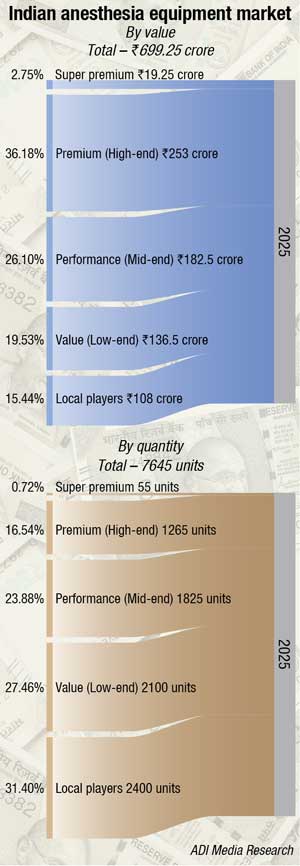
The anesthesia equipment market is broadly divided into capital equipment and disposables, with integrated workstations and ventilators contributing the largest share of device revenues because of their high unit cost and central role in modern operating rooms. On the disposables side, breathing circuits and endotracheal tubes account for the bulk of volumes thanks to their single use profile and routine deployment across most anesthetic procedures. Hospitals remain the primary end user segment as they handle the majority of complex, high acuity surgeries, while clinics and ambulatory centers provide incremental growth, particularly for more affordable, compact and portable systems tailored to day care and minimally invasive interventions.
| Leading players – Indian anesthesia equipment* 2025 |
|
| Tier I | Draeger, Mindray, and GE |
| Tier II | Skanray, BPL, Allied Medical, and Aeonmed |
| Others | Getinge, Comen, Northern Meditech, Medion, Hospitech, Medisys, and Cardiolabs |
|
*Vendors are placed in different tiers on the basis of their sales contribution to the overall revenues of the Indian anesthesia equipment. ADI Media Research |
|
Key demand drivers in 2025 include a sustained rise in chronic disease burden feeding into higher surgical volumes, continued growth in cardiac, orthopedic, oncology and other high acuity procedures, and the ongoing build out of hospital infrastructure under Ayushman Bharat and wider public and private capex programs. Medical tourism, the gradual but steady penetration of minimally invasive techniques, and growing awareness of patient safety and advanced monitoring norms are all lifting demand for sophisticated anesthesia workstations, multiparameter monitors and a broad range of single use accessories.
Against this backdrop, several constraints continue to shape market dynamics. High upfront prices for advanced systems, pronounced price sensitivity in Tier-II and Tier-III cities and in public procurement, shortages of skilled anesthesiologists and technicians, and regulatory as well as reimbursement complexity can slow the introduction and diffusion of new platforms. Rural and smaller facilities typically lag in adopting high end systems, keeping the market bifurcated between premium integrated platforms in metros and a larger installed base of more basic machines and consumables elsewhere.
A global market in fast-forward
Behind every quiet hum of an anesthesia machine there is a global industry racing to keep pace with the world’s surgical needs. As populations age, chronic diseases multiply, and access to surgery expands, the demand for safe, sophisticated anesthesia delivery is climbing sharply.
The market size was valued at USD 13.8 billion in 2025 and is expected to grow to USD 23.7 billion by 2032, exhibiting a CAGR of 8.0 percent as per the Persistence Market Research report. The market is projected to grow at a strong double-digit CAGR through 2034, reflecting the increasing reliance on safe, precise, and data-driven anesthesia delivery.
Different analysts quote different absolute numbers, but they agree on the direction of travel–the worldwide anesthesia devices and machines market is on a firm upward curve, with projections running through this decade in the high single to strong double-digit range in several segments. Rising surgical volumes, growing healthcare expenditure, and the push to modernize operating rooms are all fuelling this momentum.
What is changing is not only how many machines are being sold, but what kind. The market is clearly shifting away from basic, standalone units toward integrated anesthesia workstations that blend gas delivery, advanced ventilation, multi-parameter monitoring, and seamless electronic connectivity. These systems are engineered not only to keep patients safe in the moment, but to capture data, support clinical decisions, and fit into digital hospital strategies for years to come.
Artificial intelligence and machine learning are beginning to reshape this market from within. Manufacturers are embedding predictive algorithms into workstations, enabling more precise control of anesthetic depth, earlier warning of hypotension, and smarter use of fresh gas flows. Hospitals, in turn, are increasingly assessing equipment not just on purchase price, but on long-term impact–safety, efficiency, sustainability, and the quality of data they feed into broader health IT ecosystems.
The most dynamic growth is emerging in Asia-Pacific and Latin America, where governments and private players are investing heavily in surgical infrastructure. Countries across these regions are building new ORs, upgrading legacy systems, and broadening access to procedures for previously underserved populations. As they do, anesthesia machines become both a symbol and a prerequisite of modern care–a signal that surgery is not just available, but safe and standardized.
Yet even this bright growth story has shadows. Advanced AI-enabled workstations can be prohibitively expensive for smaller hospitals or resource-constrained systems. The cost of maintenance, calibration, and software upgrades, plus the need for regular staff training, can stretch budgets thin. Meanwhile, a global shortage of anesthesiologists and trained anesthesia providers threatens to undermine the full use of these sophisticated tools.
In other words, the technology is racing ahead–but ensuring that it is equitably deployed and expertly used remains one of healthcare’s great unfinished tasks.
India’s anaesthesia market – From volume-driven surgery to safety- and quality-led growth
 Aditya Kohli
CFO & Director,
Allied Medical Limited
India’s anaesthesia market is undergoing a significant transformation. Once primarily driven by the increasing volume of surgical procedures, the market is now evolving toward a safety-, quality-, and outcomes-focused growth model. This shift reflects the broader maturity of India’s healthcare ecosystem and its growing alignment with global clinical standards.
For many years, the demand for anaesthesia equipment in India was linked mainly to surgical volumes. Hospitals focused on expanding capacity and meeting procedural demand, often prioritising affordability and basic functionality. While this approach supported rapid growth, it also highlighted the need for better safety mechanisms, reliability, and consistency in anaesthesia delivery.
Today, the focus has clearly shifted. Hospitals and surgical centres are investing in advanced anaesthesia workstations that offer precise control, integrated monitoring, and built-in safety features. The rise of complex surgeries–such as minimally invasive, cardiac, neurological, and trauma procedures–has increased the need for accurate ventilation, controlled drug delivery, and continuous patient monitoring throughout the perioperative period.
Patient safety is now at the core of purchasing decisions. Anaesthesiologists and hospital administrators are emphasising equipment that minimises risk, reduces manual errors, and supports informed clinical decision-making. Features such as real-time monitoring, alarm systems, and ergonomic designs are no longer optional–they are essential to delivering quality care and improving surgical outcomes.
Government initiatives, expansion of healthcare infrastructure in tier-II and tier-III cities, and growing private investment have further accelerated this transition. As more hospitals aim for accreditation and standardised care protocols, the demand for dependable, high-quality anaesthesia systems continues to rise.
At Allied Medical Limited, we recognise this shift and remain committed to supporting India’s healthcare providers with reliable, clinically advanced anaesthesia solutions. Our focus is not just on meeting surgical demand, but on enabling safer procedures, better outcomes, and long-term value for hospitals and patients alike.
This commitment extends to clinician training, service support, and technology innovation, ensuring sustainable adoption, regulatory compliance, interoperability, lifecycle reliability, and continuous improvement across diverse clinical environments nationwide for Indian hospitals.
As India’s healthcare sector advances, the anaesthesia market will continue to move beyond volume–toward a future defined by safety, precision, and quality-led growth.
North America, Asia-Pacific and the world in between
Zoom in, and the global picture resolves into distinct regional stories.
In North America, especially the United States, anesthesia systems sit at the intersection of cutting-edge technology and mature infrastructure. High surgical volumes, strong reimbursement mechanisms, and a culture of rapid adoption make this region a testbed for AI-driven monitoring, closed-loop control, and fully integrated digital ORs. Hospitals and ambulatory surgery centers upgrade frequently, replacing older devices with workstations that offer smarter ventilation, richer data, and full EHR interoperability. This environment has bred a market where innovation is expected, not optional.
In Asia-Pacific, the tone is different–faster, more urgent, and often more improvisational. Here, the anesthesia machines market is among the fastest growing in the world, driven by exploding surgical volumes, rapid expansion of private hospitals, and ambitious government pushes to strengthen healthcare infrastructure. Countries such as China and India are not only buying more machines; they are also seeking solutions that are rugged enough for rural settings, flexible enough for a wide range of procedures, and affordable enough to scale.
Portable and compact anesthesia systems are gaining traction in smaller hospitals, day surgery centers, and semi-urban or rural theatres. These devices are becoming lifelines for communities where anesthesia–once a major bottleneck–can now be delivered more reliably, allowing safe C-sections, trauma surgeries, and elective procedures that were previously delayed or denied.
Between these poles, regions like Latin America, Eastern Europe, and parts of Africa are writing their own chapters. Public–private partnerships, donor-funded projects, and targeted modernization campaigns are introducing advanced anesthesia capability to hospitals that have long operated with outdated or limited equipment. The through-line connecting all these stories is simple: anesthesia machines are not just products; they are enablers of surgical equity.
Strategy in the age of smart workstations
For manufacturers, the anesthesia space has become a strategic chessboard. To thrive, they must innovate fast–but not so fast that they outrun the realities of budgets, staffing, and clinical workflows.
At the high end, tertiary and quaternary hospitals are demanding integrated anesthesia workstations with AI-based decision support, low-flow automation, advanced ventilation, and tight EMR integration. They want machines that can plug into data lakes, feed dashboards, and support quality initiatives and perioperative analytics. For these customers, the differentiator is no longer basic functionality, but how smoothly the system merges into their digital ecosystem and supports staff through complex, high-risk cases.
At the same time, there is enormous unmet demand for robust, affordable, and portable machines built for ambulatory surgery centers, secondary hospitals, and emerging markets. Here, reliability, ease of use, and serviceability often matter more than exotic features. Tiered portfolios–flagship high-tech platforms at one end, rugged and modular workhorses at the other–are becoming the norm.
Sustainability is another emerging fault line. With volatile anesthetic agents recognized as potent greenhouse gases, hospitals and regulators are paying closer attention to environmental impact. Low-flow anesthesia capabilities, precise agent consumption tracking, and designs that minimize waste are now selling points, not afterthoughts. Manufacturers that can demonstrate measurable reductions in anesthetic usage and emissions are finding a receptive audience among environmentally conscious systems.
Overlaying all this is the human factor. Without strong training programs, intuitive interfaces, and responsive after-sales service, the best hardware can underperform. Many companies are responding by embedding education, simulation support, and remote assistance into their offerings–recognizing that making anesthesiologists and technicians feel supported is just as important as impressing procurement teams.
The winners in this landscape will be those who master a delicate balance–pushing boundaries on intelligence and automation while keeping equipment accessible, maintainable, and deeply aligned with real-world clinical practice.
From knobs to knowledge
There was a time when the anesthesia machine’s front panel was dominated by simple knobs, dials, and a few analog gauges. The anesthesiologist stood over these controls like a pilot over a mechanical cockpit, relying on experience and intuition to interpret subtle shifts in chest movement, skin colour, or blood pressure.
Today, those knobs remain–but they share space with colourful waveforms, numerical trends, and integrated displays that tell a much richer story. Breakthroughs in monitoring have turned what was once educated guesswork into guided, data-driven practice.
Video laryngoscopy has transformed intubation from a blind maneuver into a visually guided one, significantly improving success rates, especially in difficult airways. Ultrasound has moved from the radiology suite to the anesthesia cart, enabling clinicians to see nerves, blood vessels, and spinal landmarks in real time. Getting a line in, placing a block, or performing a neuraxial procedure is no longer a matter of tactile feel alone, but of seeing anatomy unfold on the screen.
In monitored anesthesia care (MAC), short-acting agents, multimodal regimens, and target-controlled infusions have replaced crude fixed dosing. Sedation is individualized, balancing comfort with rapid wake-up so patients can recover swiftly with fewer side-effects. Instead of chasing the right depth, anesthesiologists are increasingly guiding it with real-time feedback from EEG-derived indices and hemodynamic trends.
This transition from knobs to knowledge has quietly reshaped anesthesiology. The machine no longer merely delivers gas; it curates information–helping clinicians move from reactive adjustments to anticipatory, finely tuned control.
Efficiency is the new safety
In the modern OR, every minute counts–and not just for throughput or operating lists. Delays, confusion, and needless complexity create stress and error; streamlined workflows, by contrast, create bandwidth for vigilance. Efficiency has become a safety strategy.
Today’s anesthesia workstations are designed with that reality in mind. Interfaces are more intuitive, layouts more ergonomic, and user profiles more customizable. An anesthesiologist can move from induction to maintenance to emergence with fewer manual tweaks, fewer keystrokes, and fewer opportunities for missteps.
Crucially, these machines are learning to talk directly to hospital information systems. Automated documentation pushes vital signs, gas flows, and drug usage into electronic records in real time, sparing clinicians the burden of retrospective data entry. This not only reduces paperwork but supports audits, quality metrics, and research in ways that handwritten charts never could.
Efficiency also takes on a physical dimension. Low-flow anesthesia–made safer and easier by accurate gas monitoring and advanced control–reduces the volume of volatile agents used and vented into the atmosphere. Evidence suggests that lowering fresh gas flows can slash both costs and greenhouse gas emissions substantially, while still maintaining patient safety and comfort when practiced correctly.
Smart design and green innovation thus converge: less waste, less environmental impact, and less cognitive clutter, all in service of more focused, more reliable care. In anesthesia today, doing more with less is not about cutting corners; it is about cutting noise.
When intelligence meets anesthesia
Few specialties are as ripe for AI as anesthesiology. Every case generates torrents of time-sensitive data: heart rates, blood pressures, ventilator settings, end-tidal values, EEG signals, lab results. For years, clinicians have interpreted this data mentally at the bedside; now, machine-learning algorithms are stepping in to help make sense of it at scale.
Preoperatively, AI can sift through years of health records, scanning comorbidities, medications, and prior anesthetic history to flag high-risk patients. Tools are emerging that can predict hypotension after induction, anticipate a difficult airway, or estimate the probability of prolonged recovery–before the patient even enters the OR.
Inside the operating room, AI-driven modules are beginning to refine assessments of anesthetic depth, hemodynamic stability, and ventilatory status. Closed-loop systems take it a step further: they adjust anesthetic agent delivery in real time, using continuous feedback to maintain target end-tidal concentrations or EEG indices, often more steadily than manual titration.
Postoperatively, algorithms comb through trends to identify patients at risk of respiratory depression, delirium, or extended lengths of stay. Early-warning systems built on machine-learning models can alert teams to subtle deteriorations long before they become clinically obvious.
Used well, AI does not overshadow the anesthesiologist; it gives them a broader, more nuanced field of view. It is like having a second pair of eyes and an extra brain focused entirely on pattern recognition, freeing the human clinician to focus on judgment, communication, and empathy.
But this promise depends on responsibility. Algorithms must be transparent, rigorously validated, and integrated gently into workflows rather than imposed. Data must be protected, biases scrutinized, and clinicians trained to understand not just what the system says, but why. Only then can AI become a trusted partner rather than a mysterious black box.
Precision over guesswork
At its core, anesthesia is about balancing risk and comfort–enough drug to keep the patient unaware and pain-free, but not so much that recovery is delayed or physiology destabilized. Historically, this balancing act relied on population averages and dose tables.
Precision anesthesia challenges that paradigm. By using machine learning to mine diverse datasets–demographics, comorbidities, pharmacogenomics, prior responses–models can begin to predict how a particular patient is likely to react to a particular drug or combination. Instead of treating every 70-year-old the same, these tools can anticipate who will be more sensitive, who will clear agents more slowly, and who is at higher risk for hemodynamic swings.
In practice, this translates into more individualized dosing, fewer episodes of hypotension or oversedation, smoother wake-ups, and potentially fewer postoperative complications. It also opens the door to scalable support in settings where experienced anesthesiologists are scarce. Tele-anesthesia, remote supervision, and decision-support platforms could one day allow complex anesthesia care to be delivered safely in places where it is currently limited or unavailable.
Precision anesthesia does not replace clinician expertise. It reframes it–moving anesthesiology from a world of educated guesswork toward one of data-informed nuance, where human judgment and algorithmic insight strengthen each other.
Always on, always watching
As connectivity spreads, anesthesia machines are breaking free from the four walls of the OR. IoT-enabled systems now transmit real-time vital signs, ventilation parameters, and alarm states to central stations, dashboards, or even secure mobile applications.
This always on presence means that an anesthesiologist or intensivist can keep an eye on multiple patients across different locations, catching early warning signs and providing backup to colleagues in smaller or remote facilities. Telemetry, once reserved largely for cardiology, is becoming a reality for perioperative care.
The story continues beyond the OR doors. Smart implants and wearable sensors are beginning to extend the anesthesia continuum into the recovery room, the ward, and even the home. Orthopaedic implants that track motion and load, wearables that monitor respiratory patterns or oxygenation–these devices can flag deviations from expected recovery trajectories before complications become severe. When their data streams are linked back to perioperative records and anesthesia logs, a more complete, continuous picture of the patient journey emerges.
In this world, the anesthesia machine is no longer just a momentary guardian during surgery. It becomes part of a larger chain of connected technologies that shepherd the patient from pre-op assessment through surgery and beyond, into rehabilitation and long-term outcomes.
Modernization as culture, not just hardware
True modernization in anesthesia doesn’t happen just by rolling a new machine into the OR. It takes a shift in habits, mindsets, and culture. Programs that focus on standardizing low-flow techniques, embedding checklists, and retraining teams are showing that behaviour change can unlock as much value as the latest gadget.
Initiatives that bundle education with analytics–showing clinicians in concrete terms how their fresh gas flows, agent choices, or response times affect both outcomes and costs–are particularly powerful. When teams see, in their own data, that lowering fresh gas flow can nearly halve anesthetic consumption and sharply cut emissions without compromising safety, change becomes not just acceptable but compelling.
At a system level, linking anesthesia practices to broader hospital goals–patient safety metrics, quality indicators, sustainability targets, ESG commitments–helps secure executive backing and sustained investment. Modernization then becomes not a project but a shared identity: this is how we do anesthesia here.
As digital tools proliferate, these cultural foundations will matter even more. Low-flow protocols, standardized settings, and familiar workflows make it easier to layer AI support, closed-loop control, or remote monitoring on top. The future of anesthesia will belong not only to the smartest machines, but to the systems that have prepared their people to use them wisely.
The silent guardians of surgery
For patients, the anesthesia machine is often an afterthought, if they notice it at all. Most remember only the mask, the reassuring voice, and the moment when the world gently fades away. But in those hours when they are most vulnerable–unconscious, immobile, unable to advocate for themselves–it is this quiet guardian that stands watch.
Today’s anesthesia machines are more than gas deliverers. They are partners to clinicians, aggregating signals, supporting decisions, and extending vigilance. They embody a rare combination of traits–precise yet forgiving, complex yet intuitive, invisible to the layperson yet indispensable to every surgeon and anesthesiologist in the room.
As technology advances, their role will only grow. AI-driven predictions, closed-loop drug delivery, IoT integration, and smart implants will deepen their presence across the patient journey. But at their core, anesthesia machines will remain what they have always been–instruments of trust.
Trust that the patient will be kept safe, that pain will be held at bay, that physiology will stay within the lines, and that the team has a steady ally at their side. In an operating room filled with visible drama–the incision, the instruments, the team’s choreography–these machines will continue their quiet vigil, unsung but essential, at the head of the bed.