Hospital Watch
A New York city hospital system has been bitten by the acting bug
The Northwell Health system allowed filmmakers to make documentaries following its doctors, nurses and patients. It went so well, the hospital is starting a studio to make its own.

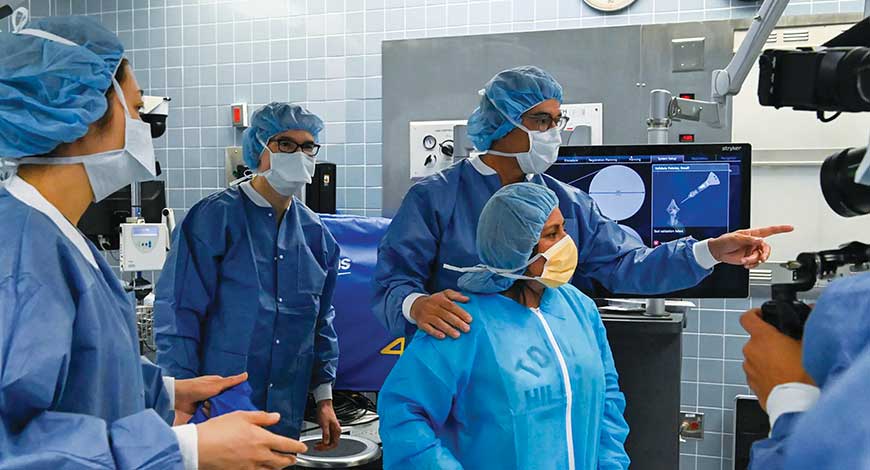
Unusual for a hospital system, Northwell Health, New York State’s largest healthcare provider and private employer, with 21 hospitals, about 900 outpatient facilities and more than 12,000 affiliated physicians has opened its doors to several filmmakers in recent years. Camera crews have filmed brain surgeries and births. They have filmed patients receiving good news and patients learning their cancer is back. And all along, the doctors have spoken candidly about their work and their lives.
It has made for riveting television, including Netflix’s hit Lenox Hill, a docuseries about the doctors and patients in Northwell’s hospital on the Upper East Side. The documentary The First Wave was filmed inside another Northwell hospital during the deadly early days of Covid-19.
Now, Northwell wants to ramp up the number of movies and shows set in its hospitals. Last month, it announced it was starting a production company called Northwell Studios to make more TV shows and films. Five new productions are underway already.
Michael J. Dowling, the CEO of Northwell, said he found actual doctors far more compelling to watch than actors playing them on TV. This is the real stuff, he said in an interview.
The notion of a hospital’s branching out into the entertainment business drew headlines in Hollywood.
It also raises questions about logistics and patient privacy. Beyond the risk of broadcasting botched procedures and aggrieved or dissatisfied patients, or doctors, hospitals must navigate stringent privacy rules and laws, and Northwell’s willingness to allow film crews to set up shop in its hospitals is a rarity these days.
In 2016, another hospital, NewYork-Presbyterian Hospital/Weill Cornell Medical Center, paid a USD 2.2 million penalty to federal regulators after television crews from the documentary series NY Med filmed two patients without their consent. One patient had been hit by a garbage truck and was dying, and though the TV show had blurred his face, it was not enough, federal regulators found.
At the time, hospital administrators and medical ethicists thought the penalty could spell the end of real-life shows set in hospitals. But Northwell executives note they have already had a string of successes and say the studio’s goal is to keep the hits coming.
“We’re very careful to make sure we protect privacy and get everybody’s permission,” Mr. Dowling said. “We’ve never had a problem in any of these shows.”
The most popular of them is “Lenox Hill,” based in the hospital of the same name on East 77th Street. It was filmed starting in 2018 but aired in June 2020, not long after New Yorkers had started banging pots and pans in a nightly tribute of thanks to health care workers.
The show brought viewers into the operating room, where neurosurgeons battled tumors and opened up about their personal lives. It turned some of its central characters into local celebrities.
It also was good for Northwell. Though renowned for its cardiac program, Lenox Hill was something of a sleepy Upper East Side hospital until perhaps a decade ago. It was sandwiched between two giant institutions — Mount Sinai and Weill Cornell. But after it was acquired by the hospital system that became Northwell, Lenox Hill’s fortunes began to improve with ambitious hires and a new neurosurgery program.
Internal polling conducted by Northwell indicates that the various shows filmed at its hospitals – which include a spinoff of Lenox Hill called Emergency NYC and a new two-part Max series on an inpatient psychiatric unit – have all been good advertising, executives said. One marketing slide indicated that viewers who had seen some of the shows were more likely to recommend Northwell Health to others.
Dowling, the CEO, said he was committed to helping make the shows for “humanitarian reasons, educational reasons.” He said he felt “a real responsibility to provide educational material to the public about what goes on inside a health care facility.”
The shows were also morale boosters for staff members and advertised the skills of Northwell surgeons, he said.
Dowling has turned Northwell into the state’s largest hospital system during his tenure. It now has 21 hospitals and earlier this year announced plans to acquire Nuvance, a Connecticut health system, as well.
Dowling said that Northwell had not received any payments for the documentaries and shows that had aired on major streaming services, at least so far. Those shows got their start when filmmakers and producers approached the hospital system seeking access.
Northwell executives said the hospital system’s new studio would provide a more structured process for evaluating any pitches – and could help with generating ideas from within the hospital.
In a news release, the hospital system said its studio venture had a development deal with a production company, CreativeChaos vmg, “to develop and co-produce both scripted and unscripted films.”
The New York Times