Headlines of The Day
The ₹650cr Delhi scam spotlights India’s broken MedTech procurement ecosystem
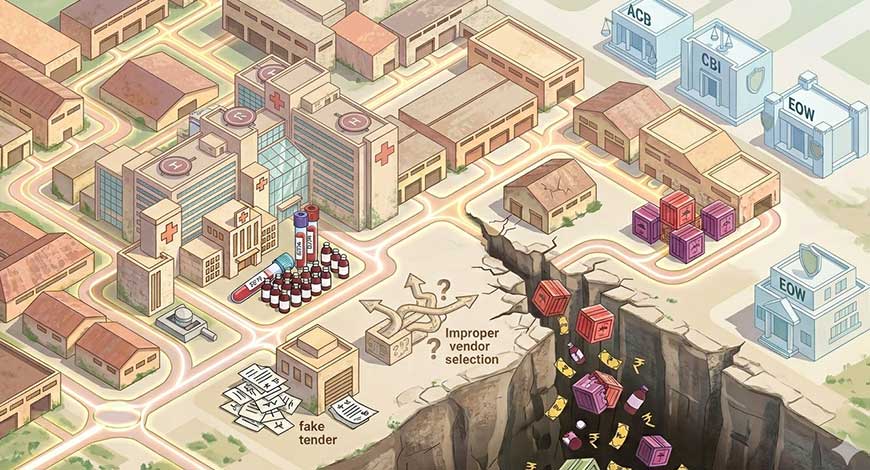
A First Information Report (FIR) registered by Delhi’s Anti-Corruption Branch (ACB) over alleged irregularities in the procurement of medicines and medical equipment worth an estimated Rs 650 crore has thrust the capital’s public health administration into the spotlight. But the scandal is not an isolated incident, it is the latest in a long line of government hospital procurement fraud cases that have drained public health funds across India, from Chhattisgarh to Puducherry and from Uttar Pradesh to Maharashtra.

As investigators in Delhi begin questioning about 10 doctors and nearly 45 officials linked to the Central Procurement Agency (CPA), a picture is emerging of systemic vulnerabilities in how medicines, equipment, and consumables are purchased, stored, and distributed in government health facilities.
“EDTA tubes that should cost Rs 8.50 each were billed at Rs 2,352 per unit. Blood-testing machines available for Rs 5 lakh were invoiced at Rs 17 lakh, “Chhattisgarh ACB chargesheet.
The Delhi case: What we know
The Delhi controversy centres on the Central Procurement Agency, a body established to centralise medicine and equipment purchases for the capital’s government hospitals and mohalla clinics. Centralisation was intended to cut costs through bulk buying and to bring transparency to a fragmented system, but investigators now allege that officials within the CPA exploited that very centralisation to inflate orders, rig supplier selection, and submit bills far above market rates.
A vigilance complaint triggered the scrutiny, after which both the Lieutenant Governor (LG) and the Chief Minister (CM) directed a formal probe. The ACB registered an FIR and has since issued notices to approximately 10 doctors and 45 officials drawn from procurement, stores, and administrative departments across Delhi government hospitals and the CPA itself.
Vendors who blew the whistle have specifically named the CPA’s Chief Medical Officer in connection with purchases reportedly totalling more than Rs 350 crore. The LG separately removed the Director of Health Services (DHS) from his post amid the broader scrutiny. Dozens of doctors have been transferred from their hospital postings pending the inquiry.
The Rs 650 crore FIR is distinct from an earlier “spurious drugs” controversy in which an internal DGHS committee had cleared CPA officials, finding that some sampled medicines were substandard but did not legally qualify as “spurious” under the Drugs and Cosmetics Act. The new case is squarely about financial and procedural irregularities, overbilling, excess ordering, and improper vendor selection, rather than product quality per se.
In a parallel strand of enforcement, Delhi Police and the Crime Branch have busted separate rackets diverting government-supplied free medicines to private markets, highlighting how weaknesses in the procurement chain extend all the way through storage and distribution.
Chhattisgarh: Where a blood-test tube cost Rs 2,352
If the Delhi case is shocking in scale, Chhattisgarh’s Rs 550 crore medical procurement scam may be more alarming in its granular detail. In April 2025, the state’s Anti-Corruption Bureau and Economic Offences Wing (ACB/EOW) filed an 18,000-page chargesheet against six accused, including Shashank Chopda, director of Mokshit Corporation, and several serving and former officials of the Chhattisgarh Medical Services Corporation Ltd (CGMSCL).
Investigators found that multiple private firms colluded to rig competitive bidding for state contracts. Companies submitted fabricated eligibility documents and coordinated their financial bids to ensure Mokshit Corporation would always appear as the lowest bidder, even when its prices were astronomically above market. The ACB’s own comparison figures tell the story starkly:
An EDTA tube for blood collection, available to other institutions at a maximum of Rs 8.50, was invoiced to CGMSCL at Rs 2,352 per piece. A Complete Blood Count (CBC) machine sold in the open market for Rs 5 lakh was supplied to the state corporation for Rs 17 lakh. Investigators say this pattern of systematic overpricing, multiplied across thousands of line items, produced the Rs 550 crore loss to the Chhattisgarh exchequer.
Uttar Pradesh: The NRHM scandal that killed witnesses
The largest medical procurement fraud in recent Indian history unfolded in Uttar Pradesh between 2005 and 2011 under the National Rural Health Mission (NRHM). Investigators and the Central Bureau of Investigation (CBI) established that politicians, bureaucrats, and contractors conspired to siphon an estimated Rs 10,000 crore, approximately US$ 1.1 billion, from funds meant to improve healthcare delivery in rural UP.
Chief Medical Officers across districts colluded with contractors and vendors. Fake tenders were floated. Contracts for upgrading 89 district hospitals were awarded without adhering to any competitive process. Medicine suppliers from Moradabad and elsewhere were charged alongside officials in multiple chargesheets filed by the CBI. Over 70 FIRs were eventually lodged.
The case took a grim turn when at least five persons connected with the scandal, including witnesses and a key accused, died under suspicious circumstances, prompting allegations of murder to cover up the fraud’s paper trail. More than a decade later, prosecutions are ongoing, and the case remains a benchmark for how deeply entrenched procurement corruption can become in a large state’s health system.
Maharashtra: The iron syrup scandal and a reversed blacklist
In 2025-2026, Maharashtra confronted a procurement controversy with a direct public health dimension. Iron syrup supplied for government health programmes targeting anaemia among children and pregnant women was found by the Food and Drug Administration (FDA) to be unsafe for human consumption. Thousands of bottles stored in a Raigad Zilla Parishad warehouse failed quality testing.
The state government acted swiftly in some respects: Chief Minister Devendra Fadnavis ordered the transfer of the Maharashtra Medical Goods Procurement Authority (MMGPA) CEO, Mahesh Awhad. The offending supplier was initially blacklisted for two years under procurement regulations.
But what deepened the controversy was what happened next. The blacklisting decision was reportedly reversed within a month, sparking questions about administrative pressure and transparency. Compounding public concern, the same supplier company was reportedly expected to participate in a Rs 700 crore pharmaceutical procurement tender being planned by the state health department, and could stand to win contracts worth Rs 80 to Rs 100 crore under the new bid.
The Maharashtra episode is notable because it shows how procurement failures translate directly into risks for patients, and how accountability mechanisms can be undermined even after a problem is identified.
Puducherry: Rs 2 crore scam, expired injections, and six arrests
At the other end of the scale in terms of rupee value, but no less troubling in its implications, is the medicine procurement scam uncovered in Puducherry. The state’s Department of Vigilance and Anti-Corruption (DVAC) arrested six individuals, including three former senior Health Department officials, for their role in procuring substandard and expired medicines for government hospitals and educational institutions.
The scam centred on iron sucrose injections sourced from Sri Sai Ram Agency and Padmajothi Agency and supplied to Primary Health Centres across the Union Territory. Lab testing confirmed the medicines were either substandard or past their expiry dates. Cases were registered under Sections 409 and 420 of the IPC and Section 13(1)(a) of the Prevention of Corruption Act. The total estimated loss was pegged at over Rs 2 crore.
The Puducherry case is a reminder that procurement corruption does not only surface in large states or at massive scale, it is distributed across the healthcare system, and its human cost can be significant even when financial figures appear modest.
A national pattern: Why does this keep happening?
Across all these cases, Delhi, Chhattisgarh, UP, Maharashtra, Puducherry, several common threads emerge. Centralised procurement bodies, designed to bring efficiency and transparency, have in multiple instances become vectors for abuse. Insider collusion between officials and favoured vendors is a recurring feature. Competitive bidding is gamed through fabricated documents, coordinated bids, or outright disregard for tender norms. Quality checks are bypassed. Whistleblowers face transfer or intimidation.
The gaps in oversight are structural. State medical services corporations and central procurement agencies often operate with limited independent auditing. Tender evaluation committees may be staffed by the very officials who receive vendor kickbacks. Post-procurement quality checks, where they exist, have frequently been shown to be inadequate.
Anticorruption bodies, the ACB, CBI, EOW, have demonstrated that they can investigate and charge-sheet once political will exists. But investigations are typically reactive, triggered by whistleblowers or political rivalries, rather than by robust preventive systems. Many cases drag for years through courts without conviction, limiting deterrence.
The Delhi Rs 650 crore FIR is the beginning of a formal process, not an end. Whether it leads to accountability, or joins the long list of pending health corruption cases, will depend on the speed and rigour of investigation, the courts’ capacity to adjudicate, and the political will to see the process through.
MB Bureau