Nuclear Medicine Equipment
Expanding horizons in nuclear medicine
Evolution promises substantial advancements in the field of nuclear medicine, paving the way for better diagnostic and therapeutic options.

Nuclear medicine has emerged as a pivotal force in modern healthcare, redefining the way diseases are detected, monitored, and treated. Unlike conventional imaging modalities that primarily reveal anatomical structures, nuclear medicine provides a unique window into the body’s physiological and biochemical processes, enabling earlier and more accurate diagnoses. From its origins in the early 20th century with the discovery of radioactivity to today’s advanced PET, SPECT, and theranostic approaches, the field has evolved into a cornerstone of precision medicine. Its ability to combine diagnosis and therapy within a single framework is reshaping oncology, cardiology, neurology, and beyond, offering clinicians powerful tools to tailor treatment strategies to individual patients. Supported by rapid advances in radiopharmaceuticals, hybrid imaging technologies, and artificial intelligence, nuclear medicine is steadily moving from being a specialized niche to an integral part of global healthcare systems. As the demand for personalized, minimally invasive, and highly effective medical solutions grows, nuclear medicine is positioned not only to transform patient outcomes but also to drive the next wave of innovation across the medical landscape.
Historical foundations and scientific legacy
Over the past few decades, nuclear medicine has undergone a remarkable transformation, with innovations in PET, SPECT, and hybrid imaging technologies reshaping clinical practice. PET has evolved from a specialized research tool into a cornerstone of oncology, cardiology, and neurology, offering unparalleled insights into molecular and metabolic activity. Its integration with Computed Tomography (PET/CT) and Magnetic Resonance Imaging (PET/MRI) has further enhanced diagnostic precision, enabling clinicians to visualize both anatomical detail and functional processes within a single scan. Similarly, advances in Single Photon Emission Computed Tomography (SPECT) have introduced digital detectors, higher sensitivity, and hybrid SPECT/CT systems, greatly improving image clarity and reducing scan times. These developments have accelerated the shift toward precision diagnosis, where complex diseases such as cancer, cardiovascular disorders, and neurodegenerative conditions can be detected earlier and managed more effectively.
Hybrid imaging platforms now stand at the forefront of clinical breakthroughs, combining anatomical, functional, and molecular data to deliver a holistic view of disease progression. Beyond improving diagnostic accuracy, they also play a pivotal role in guiding personalized therapies, monitoring treatment response, and supporting the rise of theranostics–where diagnostic scans directly inform targeted radionuclide therapies. Together, these breakthroughs are redefining standards of care, offering patients faster, safer, and more accurate diagnostics while equipping healthcare systems with the tools needed for more efficient and patient-centered management of complex diseases.
Therapeutic innovations and theranostics
Therapeutic innovations in nuclear medicine are redefining oncology, with targeted radionuclide therapies and theranostics emerging as transformative approaches. Unlike traditional treatments that affect both healthy and diseased tissues, these therapies deliver radiation directly to cancer cells by binding to specific molecular targets, minimizing collateral damage while maximizing therapeutic impact. Theranostics–where the same molecular target is used first for imaging and then for treatment–has become a cornerstone of this revolution, enabling precise patient selection, real-time monitoring, and highly personalized interventions.
Breakthroughs such as prostate-specific membrane antigen (PSMA)-targeted therapies for prostate cancer and lutetium-177 dotatate for neuroendocrine tumours highlight the potential of these approaches to extend survival and improve quality of life for patients with otherwise limited options. Beyond these successes, research is expanding into other challenging malignancies, including pancreatic, colorectal, and brain cancers, with promising results from both beta- and alpha-emitting isotopes. Together, targeted radionuclide therapies and theranostic strategies are not only changing clinical practice but also paving the way toward a new era of precision oncology, where diagnosis and treatment are seamlessly integrated for superior patient outcomes.
Radiopharmaceuticals – Driving the new era of treatment
Radiopharmaceuticals are ushering in a new era of treatment, redefining the way cancer and other complex diseases are managed. Unlike traditional therapies that often affect healthy tissues alongside diseased ones, novel radiopharmaceuticals deliver targeted radiation precisely to tumour sites, minimizing systemic toxicity while maximizing therapeutic impact. This shift is transforming oncology, particularly in prostate and neuroendocrine cancers, where theranostic approaches–pairing diagnostic tracers with therapeutic radionuclides–are enabling both accurate detection and effective treatment in a single continuum of care.
Beyond oncology, radiopharmaceuticals are finding increasing applications in cardiology, neurology, and even rare diseases, offering new pathways for early diagnosis and personalized therapies. The rise of alpha-emitters, innovative PET and SPECT tracers, and next-generation isotopes such as lutetium-177 and actinium-225 underscores the momentum of this field. By combining precision targeting with the growing power of AI-driven imaging and drug development, radiopharmaceuticals are not only improving survival outcomes but also enhancing patients’ quality of life. As research, infrastructure, and manufacturing capabilities expand worldwide, these innovations are positioning radiopharmaceuticals as a cornerstone of precision medicine–bridging diagnostics and therapeutics to shape the future of healthcare.
Safety and patient – Centric approaches
As nuclear medicine rapidly advances with new radiopharmaceuticals and imaging technologies, strengthening patient protection protocols has become more critical than ever. The expanding use of diagnostic and therapeutic procedures offers remarkable opportunities to improve clinical outcomes, but it also raises important considerations for radiation safety. Ensuring that patients receive the benefits of these innovations without unnecessary exposure requires continuous updates in safety guidelines, training, and regulatory frameworks.
A patient-centric approach emphasizes not only the technical safeguards but also process optimization and staff awareness to minimize risks. Advances such as hybrid imaging, personalized dosimetry, and even AI are increasingly being leveraged to improve dose accuracy and streamline protection practices. By balancing the pace of innovation with robust safety management, nuclear medicine can deliver cutting-edge care while safeguarding patients, healthcare professionals, and the broader community.
Discovery and innovation – A legacy and future
The evolution of nuclear medicine is deeply rooted in the groundbreaking discoveries of pioneers who unlocked the mysteries of radiation and radioactivity. From Wilhelm Röntgen’s discovery of x-rays and Henri Becquerel’s identification of radioactivity to the Curie family’s pioneering work with radium and polonium, each milestone laid the foundation for a field that continues to transform healthcare. Visionaries such as Ernest O. Lawrence, who invented the cyclotron, and Glenn Seaborg, who discovered technetium-99m and iodine-131, bridged science and medicine by creating tools and isotopes that revolutionized diagnosis and therapy. Innovations in imaging–ranging from the rectilinear scanner and gamma camera to PET, SPECT, and hybrid modalities like PET/CT and PET/MRI–demonstrate how invention and clinical need converged to deliver precision medicine.
Today, the legacy of these early pioneers continues through relentless research and innovation that shape the future of nuclear medicine. Advancements in radiopharmaceuticals, artificial intelligence–driven imaging, and next-generation detectors are expanding the possibilities of diagnosis and therapy. By bridging discovery, invention, and innovation, nuclear medicine remains a dynamic discipline–one that honors the contributions of the past while charting new frontiers in patient-centric care and precision healthcare.
AI, radiomics, and next-gen imaging intelligence
AI, machine learning, and radiomics are redefining the landscape of nuclear medicine by bridging data complexity with clinical clarity. Traditional imaging generates massive amounts of information that can be difficult to interpret consistently, but AI-powered frameworks now enable deeper insights through automated feature extraction, advanced pattern recognition, and cross-cohort validation. Radiomics, which transforms medical images into quantifiable data, complements AI by providing mathematically traceable biomarkers that enhance transparency and reproducibility. Together, these tools are improving interpretability, allowing clinicians to visualize and understand not only what the model predicts but also why.
In clinical practice, AI-driven systems are proving invaluable in managing high volumes of imaging data while reducing interpretation times and minimizing human error. Models integrating convolutional neural networks, transformer-based architectures, and hybrid radiomics approaches have already demonstrated superior accuracy in distinguishing complex disease subtypes, such as atypical Parkinsonian syndromes, compared with conventional assessments. Beyond accuracy, AI supports clinicians by offering anatomically and physiologically meaningful explanations through visualization tools like attention maps and heatmaps. This dual capability–high diagnostic performance combined with interpretability–positions AI as a trusted partner in precision imaging.
Looking ahead, next-generation imaging intelligence is set to empower clinical decision-making on an unprecedented scale. By integrating AI with radiopharmaceutical advances, hybrid imaging technologies, and patient-specific data, nuclear medicine can move closer to real-time, personalized diagnostics. Such synergy not only enhances diagnostic confidence but also ensures that treatment strategies are tailored with greater precision. Ultimately, the collaboration between human expertise and AI-driven intelligence will transform complex imaging data into actionable insights, marking a new era of patient-centered care.
Integration of nuclear medicine in modern healthcare systems
Nuclear medicine has become an integral component of modern healthcare systems, transcending its traditional role in oncology to serve as a cross-disciplinary pillar of precision medicine. By enabling functional and molecular insights that go beyond conventional anatomical imaging, nuclear medicine supports clinicians in tailoring treatments to individual patients. In cardiology, nuclear imaging techniques such as myocardial perfusion scintigraphy and PET provide critical information for assessing coronary artery disease, guiding interventions, and monitoring therapeutic outcomes. In neurology, innovations in PET tracers have enhanced the diagnosis and management of neurodegenerative disorders such as Alzheimer’s disease, Parkinsonian syndromes, and epilepsy, offering earlier and more accurate detection than ever before. Similarly, in rare and complex diseases where conventional diagnostics often fall short, molecular imaging enables non-invasive visualization of unique biomarkers, thereby supporting more precise and timely interventions.
The integration of nuclear medicine within broader healthcare pathways underscores its value in personalized medicine, where imaging not only aids diagnosis but also directs therapeutic decisions and follow-up care. Collaborative approaches that link nuclear medicine with oncology, cardiology, neurology, and immunology are shaping a new paradigm of patient management, one that is increasingly data-driven, predictive, and patient-centric. As healthcare systems worldwide transition toward integrated and value-based care, nuclear medicine emerges as a unifying discipline–bridging discovery and clinical application while expanding its reach across diverse medical specialties.
Market dynamics – The economic engine behind innovation
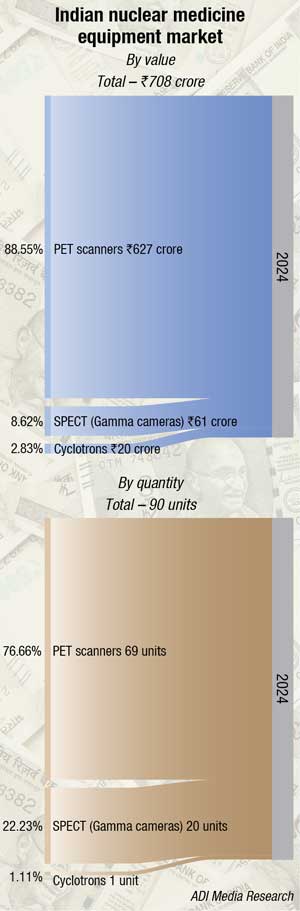
In 2024, the Indian market for nuclear medicine scanners is estimated at ₹627 crore for PET and ₹61 crore for SPECT.
PET scanners accounted for the bulk of sales, with PET-CT alone contributing nearly ₹625 crore, while PET-MRI remained negligible at under ₹2 crore due to limited adoption and high costs. Unit sales in 2024 are estimated at 68 PET-CT systems and just 1 PET-MRI.
GE and Siemens maintained leadership across corporate hospitals and government projects, while Philips and Canon secured niche positions. Demand was driven mainly by oncology and neurology applications, growth of private hospital networks, and government investments in cancer care. Vendors also competed on service contracts, workflow integration, and reliable radioisotope logistics.
|
Leading players* 2024 |
|
| PET scanners | GE & Siemens. Also Philips, and Canon Medical |
| SPECT (Gamma Cameras) | Nihon Kohden |
| Cyclotrons | GE and IBA, Belgium |
|
*Vendors are placed in different tiers on the basis of their sales contribution to the overall revenues of the Indian nuclear medicine equipment market. ADI Media Research |
|
The SPECT (gamma camera) segment remained modest yet strategically relevant, with ₹61 crore in revenues and 20 unit sales in 2024. Demand concentrated in cardiology, oncology, and neurology, with installations largely in tertiary hospitals and accredited diagnostic centers.
Here too, multinationals dominated, with GE and Siemens controlling over 70 percent of the market. Buyers emphasized strong service networks, financing flexibility, regulatory compliance support, and training programs. For the public sector, cost containment was a critical factor, whereas private buyers prioritized clinical integration and advanced software features.
For 2024, at least one new medical cyclotron was commissioned, specifically the facility at Andhra Pradesh MedTech Zone (AMTZ) in Visakhapatnam, which began operations in July 2024 following regulatory approval. This site is the state’s first cyclotron for medical radioisotope production, serving both local and neighboring states. Project details confirm this as the primary addition for 2024, and no other public installations or major tender awards are reported for the year.
The Indian medical cyclotron market is expanding rapidly, driven by increasing cancer prevalence and the demand for diagnostic imaging procedures. Medical cyclotrons are vital for producing radioisotopes used in PET scans, which are important for diagnosing and treating cancer and other diseases. The market benefits from technological advancements in radiopharmaceuticals, government initiatives, and rising adoption of nuclear medicine.
However, challenges persist due to high initial installation costs, regulatory hurdles, and a shortage of skilled professionals. In 2024, some cyclotrons for nuclear medicine were reportedly imported to India but faced delays in commissioning due to regulatory hurdles and prolonged approval timelines. This is primarily attributed to an increasingly stringent clearance process by the Atomic Energy Regulatory Board (AERB).
The outlook is positive, with market growth sustained by expanding access to precision medicine and the setup of new cyclotron facilities across India.
As per the Fortune Business Insights report, the global nuclear medicine market is valued at USD 11.77 billion in 2025, and is expected to reach USD 42.03 billion by 2032, at a CAGR of 19.9 percent.
The nuclear medicine market is gaining unprecedented momentum, supported by robust investments and rapid MedTech innovation. Expanding clinical applications in oncology, cardiology, and neurology are fuelling adoption, while radiopharmaceutical advancements and next-generation imaging technologies are reshaping the way diseases are diagnosed and treated. Strategic acquisitions and collaborations by leading pharmaceutical and healthcare companies are accelerating the introduction of radioligand and targeted alpha therapies, underscoring the sector’s long-term growth potential. These moves are not only boosting product pipelines but also driving greater confidence among investors and policymakers.
At the same time, MedTech innovations are transforming nuclear medicine equipment into more efficient, safer, and patient-centric solutions. Hybrid imaging platforms, AI-enabled diagnostics, and automated dosimetry tools are enhancing precision, optimizing workflows, and supporting the shift toward personalized care. With economic growth in both established and emerging markets fuelling healthcare infrastructure investments, patient access to advanced diagnostics and therapies is expanding rapidly. Altogether, this combination of market momentum, capital infusion, and technological progress is shaping a dynamic ecosystem that positions nuclear medicine as a cornerstone of modern healthcare.
Diverse applications across regions
Nuclear medicine is advancing worldwide, but its applications and growth patterns differ across regions, shaped by healthcare priorities, infrastructure, and research capacity. In India, nuclear medicine is witnessing rapid expansion fuelled by government initiatives, the Make in India campaign, and increasing demand for affordable yet advanced healthcare. The country is investing in domestic production of radiopharmaceuticals, expansion of PET-CT facilities, and training programs to build a skilled workforce, with a strong focus on oncology and cardiology applications. India’s trajectory highlights accessibility, cost-effectiveness, and localization as central to growth.
In Europe, the emphasis lies on innovation, regulatory frameworks, and sustainability. The region has become a hub for clinical trials, theranostics research, and the development of novel isotopes, while also focusing on reducing environmental impact and ensuring ethical AI integration in diagnostics and therapy. Advanced hybrid imaging systems, personalized dosimetry, and AI-driven tools are being integrated into clinical practice, supported by strong collaborative networks among hospitals, universities, and industry.
Meanwhile, the Asia-Pacific region is emerging as a powerhouse, with countries like Japan, South Korea, and Australia leading in cutting-edge research and advanced imaging adoption. Here, the focus is on precision medicine, miniaturized cyclotrons for local isotope production, and AI-powered imaging to enhance diagnostic accuracy. Australia, in particular, has invested heavily in theranostics and sustainable nuclear medicine practices, while Southeast Asia is witnessing gradual adoption as infrastructure improves. Together, these diverse regional approaches highlight how nuclear medicine is being tailored to local needs while contributing to a global movement toward precision healthcare and sustainable innovation.
Policy, regulation, and global collaboration
The safe and effective advancement of nuclear medicine depends heavily on robust policies, regulatory oversight, and international cooperation. Global organizations such as the International Atomic Energy Agency (IAEA) play a pivotal role in setting safety standards, fostering best practices, and supporting training initiatives that ensure nuclear technologies are used responsibly across healthcare systems. At the IAEA headquarters in Vienna, experts from 35 countries convened to assess radiation protection in modern nuclear medicine, emphasizing the urgent need to update guidelines in line with rapid advancements in radiopharmaceuticals and imaging technologies. Researchers such as Chadia Rizk and Vesna Gershan, Radiation Protection Specialists at the IAEA, highlighted the importance of harmonizing protection practices, optimizing dosimetry, and leveraging artificial intelligence to improve dose calculations and safety protocols. Similarly, Professor Michael Lassmann from the University Hospital of Würzburg underscored the dynamic progress in nuclear medicine and the parallel requirement for strengthened education, regulation, and training.
National regulatory authorities complement these international frameworks by enforcing safety protocols, licensing facilities, and monitoring compliance within their jurisdictions. Universities and research institutions also contribute by advancing scientific knowledge and providing specialized training to healthcare professionals. The collaboration between international bodies, national regulators, and academic institutions ensures that innovations in nuclear medicine–such as theranostics, hybrid imaging, and advanced radiopharmaceuticals–are deployed within safe, ethical, and standardized frameworks. By reinforcing regulatory measures and strengthening global partnerships, nuclear medicine can continue to evolve while safeguarding patients, professionals, and the broader community.
Sustainability and green nuclear medicine
Sustainability has become a defining priority in nuclear medicine, as the field balances rapid technological advancement with environmental responsibility. Increasing awareness of the ecological impact of radiopharmaceutical production and clinical procedures has prompted hospitals, research institutions, and policymakers to adopt greener approaches. Efforts are focused on reducing radioactive waste, optimizing discharge methods, and improving radionuclide extraction systems to minimize the environmental footprint of nuclear medicine practices. At the same time, innovations in radiopharmaceutical manufacturing and imaging technologies are enabling more efficient use of resources, lowering emissions, and promoting eco-friendly alternatives without compromising diagnostic or therapeutic accuracy.
Beyond environmental measures, sustainable nuclear medicine also requires strategies that integrate economic efficiency and social responsibility. Reducing costs through streamlined workflows, energy-efficient equipment, and sustainable procurement practices can strengthen both accessibility and long-term viability. Moreover, fostering a culture of sustainability among nuclear medicine professionals is key to embedding eco-friendly practices into daily operations. By aligning innovation with global sustainability goals, the nuclear medicine community can ensure that future advancements not only enhance patient care but also contribute to a greener, more resilient healthcare system.
Emerging trends and future-ready technologies
Nuclear medicine is moving into a transformative era where innovation is redefining how diseases are diagnosed and treated. At the forefront are robotics, which are being integrated into radiopharmaceutical production, quality control, and even patient handling to enhance precision, safety, and efficiency. Automation reduces human error and streamlines workflows, ensuring the timely and reliable delivery of therapies.
Another exciting development is the rise of miniaturized cyclotrons–compact particle accelerators that enable on-site production of short-lived isotopes. These systems bring critical tracers closer to patients, reducing logistical challenges and expanding access, particularly in regions with limited nuclear medicine infrastructure.
Equally important are novel isotopes designed for both diagnostics and therapy. Moving beyond traditional isotopes like technetium-99m and iodine-131, researchers are developing targeted radiopharmaceuticals that improve detection sensitivity and deliver highly personalized treatments in oncology, cardiology, and neurology.
Meanwhile, next-generation imaging systems such as digital PET, total-body PET scanners, and hybrid modalities are pushing the boundaries of resolution, speed, and patient comfort. These innovations not only allow earlier and more accurate disease detection but also provide comprehensive insights into treatment response and disease progression.
Together, these emerging technologies are positioning nuclear medicine as a cornerstone of precision healthcare–making it more patient-centric, accessible, and future-ready.
Shaping the next frontier
Nuclear medicine is entering a transformative era, where scientific discovery and clinical practice are converging to redefine patient care. The advancements in radiopharmaceuticals, targeted therapies, AI-driven imaging, and personalized treatment are steadily expanding the scope of possibilities, from early detection to precision-guided interventions. Yet, alongside these breakthroughs lie persistent challenges- the high costs of innovation, the complexity of regulatory pathways, and the global disparities in access to infrastructure and expertise.
Looking ahead, the next decade will demand a balance between innovation and sustainability, ensuring that these cutting-edge technologies are not only developed but also made accessible and equitable. Achieving this vision will rely on stronger interdisciplinary collaboration–bringing together clinicians, scientists, technologists, and policymakers–and fostering a culture of continuous learning and responsible integration. By future-proofing nuclear medicine with innovation, global partnerships, and sustainable practices, the field is poised to evolve into a cornerstone of modern healthcare, shaping a future where diagnosis and therapy become more precise, efficient, and patient-centered than ever before.
Second opinion
PET-CT in cancer care – Advancing detection, staging, and therapy through nuclear medicine.
Indian nuclear medicine equipment market – Growth and trends.