MB Stories
Big health push, small MedTech leap
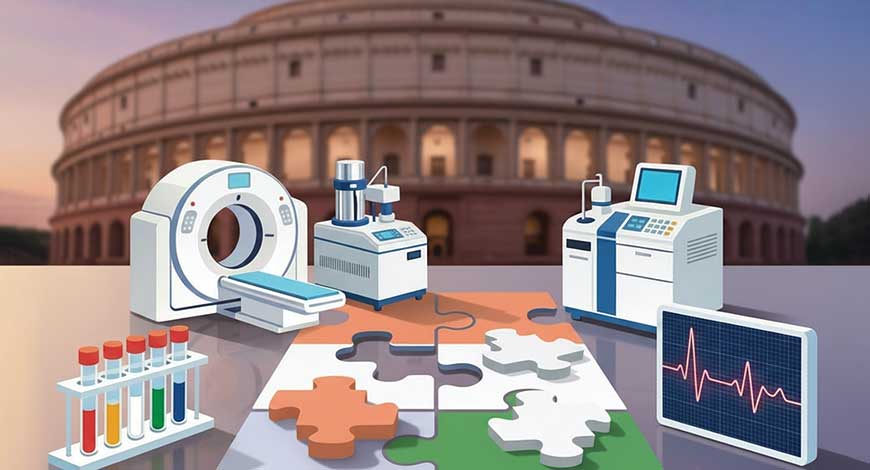
The Union Budget 2026-27 boosts health infrastructure and research but sidesteps bold MedTech-IVD reforms.

Union Budget 2026–27 is clearly a health-first exercise, but for MedTech and IVD it is still an enabling, not transformational, budget: demand visibility improves across hospitals and labs, yet big-ticket device-specific reforms, fiscal tweaks, and procurement overhauls remain unfinished business.
Health outlay–Demand visibility, not yet a step-change
The Ministry of Health & Family Welfare allocation has crossed ₹1.06 lakh crore, up nearly 10 percent over the previous year’s revised estimates, signalling that health is now embedded as a core development priority rather than a one-off pandemic response.
Within this, PMJAY at ₹9,500 crore and NHM at ₹39,390 crore deepen the twin pillars of financial protection and primary-level service delivery, steadily increasing hospital admissions and diagnostic workloads across the country.
For MedTech and IVD, this matters because utilisation is finally catching up with installed capacity in many regions.
More insured procedures and broader screening translate into higher throughput on imaging, OT, ICU and lab equipment, improving asset-turn ratios and strengthening the business case for both replacement and upgradation capex in private as well as trust-run institutions.
Hospitals–CapEx thrust from PM-ABHIM, PMSSY and trauma care
The sharp 67-plus percent jump in Pradhan Mantri Ayushman Bharat Health Infrastructure Mission (PM-ABHIM) to ₹4,770 crore is the single most important line item for equipment suppliers.
This funding is earmarked for critical care blocks, integrated public health laboratories, and upgraded district/sub-district hospitals, effectively creating a multi-year pipeline for ventilators, multiparameter monitors, anaesthesia workstations, digital x-ray, CT, ultrasound, theatre infrastructure, and basic automation in public labs.
Under PMSSY, the continued expansion and operationalisation of AIIMS and government medical colleges–supported by over ₹11,000 crore–pushes demand further up the value chain: oncology centres, transplant units, trauma and emergency care, and AI-enabled surgery all require high-end imaging, LINACs, cath labs, navigation systems, and robotic platforms.
On top of this, the proposal to set up trauma and emergency care centres in every district hospital, with a 50 percent increase in emergency care capacity, is structurally positive for emergency imaging, monitoring, anaesthesia, blood banking and point-of-care testing.
Financially, these are mostly CapEx-heavy public projects with thin operating margins, long receivable cycles and intense price pressure in tenders.
For OEMs and distributors, the opportunity lies in scale and visibility: a clearer project pipeline allows better planning of manufacturing, localisation and service networks, but it also demands rigorous working-capital management and selective participation in tenders where lifecycle support is realistically funded.
Labs and IVD–Volume growth, no structural relief
On the diagnostics side, PM-ABHIM’s push for integrated public health laboratories, expanded disease-control programmes, and district level oncology and NCD care is unambiguously positive for test volumes.
Multi-disease screening, oncology work-ups, and chronic disease management will drive demand for biochemistry, immunoassay, haematology, coagulation, infectious disease panels and molecular platforms, both within public labs and through PPP arrangements with private players.
The Budget also endorses a major expansion in clinical research: a national network of nearly 1,000 accredited clinical trial sites is planned under the broader Biopharma Shakti umbrella.
This ecosystem will require robust central labs, specialised biomarkers, companion diagnostics, and stringent quality systems, opening a premium segment for advanced IVD players who are able to meet global protocol and turnaround expectations.
What remains missing is structural cost and margin relief
There is no targeted GST correction on reagents and essential diagnostic equipment, no interest subvention scheme for lab CapEx, and no explicit support for quality infrastructure such as NABL accreditation, EQA participation and LIS adoption for smaller labs.
For mid-tier regional labs and pathology chains, the paradox persists: more tests, but intense price competition from large chains, tariff ceilings in public programmes, and rising input costs squeeze profitability.
As a result, many will continue to rely on reagent-rental and pay-per-test models, refurb units, and staggered automation rather than investing in the latest platforms, slowing technology diffusion outside the top tier.
Manufacturing, Biopharma Shakti and the MedTech gap
On the manufacturing side, the Budget’s headline is the ₹10,000 crore Biopharma Shakti initiative over five years, aimed at making India a global biopharmaceutical hub through support for biologics, biosimilars, clinical research, and a strengthened NIPER network.
This comes with a plan to develop about 1,000 clinical trial sites and to expand advanced research and regulatory capacity, which will indirectly drive sophisticated diagnostic and imaging demand around oncology, autoimmune disorders, and complex biologic therapies.
For devices and diagnostics, however, the thrust remains indirect.
The existing PLI for medical devices and broader electronics incentives continue, and the enhanced allocation of around ₹40,000 crore for electronics component manufacturing is a positive signal for medical electronics, sensors and test-and-measurement ecosystems.
Yet there is no clearly articulated MedTech 2.0 framework that pushes beyond assembly to deeper localisation of components, sub-assemblies and reagents across mainstream segments like ultrasound, monitors, basic CT, DR and routine analyzers.
But a parallel rationalisation for critical device components, implants and high-end diagnostics has not been attempted, leaving device prices and total episode-of-care costs vulnerable to currency swings and supply-chain shocks.
Workforce, digital and ecosystem enablers
A distinctive strength of this Budget is its deliberate focus on human resources and ecosystem building.
The plan to expand Allied Health Professional education across 10 disciplines, train around 100,000 AHPs and 150,000 caregivers over five years, and upgrade mental health and geriatric care infrastructure has direct implications for equipment utilisation and care models.
More trained technologists, therapists and caregivers mean that hospitals and home-care providers can finally sweat their assets better–running imaging and lab equipment for longer hours, supporting rehabilitation and chronic disease management, and expanding home-based monitoring and assistive device usage beyond urban enclaves.
Simultaneously, the Ayushman Bharat Digital Mission outlay and the broader emphasis on interoperable, tech-enabled care will accelerate deployment of HIS, LIS, RIS–PACS, remote monitoring, AI-enabled triage, and tele-ICU solutions.
For hospitals and labs, this implies:
- A shift from standalone boxes to integrated platforms that talk to ABDM,
- Higher expectations on cybersecurity, data standards and uptime, and
- A clear premium on devices that can plug into digital workflows out of the box.
Policy changes still needed–A MedTech-IVD wishlist
A well-structured, future-ready healthcare budget that stops short of being a MedTech and IVD watershed, a set of policy and execution changes could convert this incremental opportunity into a genuine inflection point:
- A dedicated MedTech–IVD PLI 2.0 that supports component ecosystems, design, testing and exports, rather than only volume-linked finished goods incentives.
- Quality-and outcome linked procurement norms in public programmes–moving tenders away from pure L1 price to lifecycle cost, service quality and clinical performance, with faster payments and clearer maintenance funding.
- Calibrated GST and customs policy for essential diagnostics and devices: lower GST slabs on core reagents and basic equipment, and rationalised duties on critical components to reduce treatment cost volatility.
- Regulatory enablement through a stronger, better-resourced CDSCO device wing, support for SMEs to comply with QMS and evidence requirements, and smoother pathways for adoption of innovative technologies in public systems.
- A structured framework for lab quality–linking reimbursement and empanelment to NABL accreditation, EQA participation, and minimum digital standards, so that growing volumes translate into reliable, comparable results across India.
The Budget gives MedTech and IVD a broader, deeper river of demand–through infrastructure, insurance, biopharma, digital and workforce initiatives–but leaves ample editorial room to argue that without sharper device specific policies and procurement reforms, India will still under leverage this healthcare moment for its domestic medical technology industry.